
Hunter Safety Quiz
How the Scales are Structured
Who Usually Takes This Test?
See How You Compare
Below is a preview of how scores are typically distributed across each scale.
Example Questions From the Test
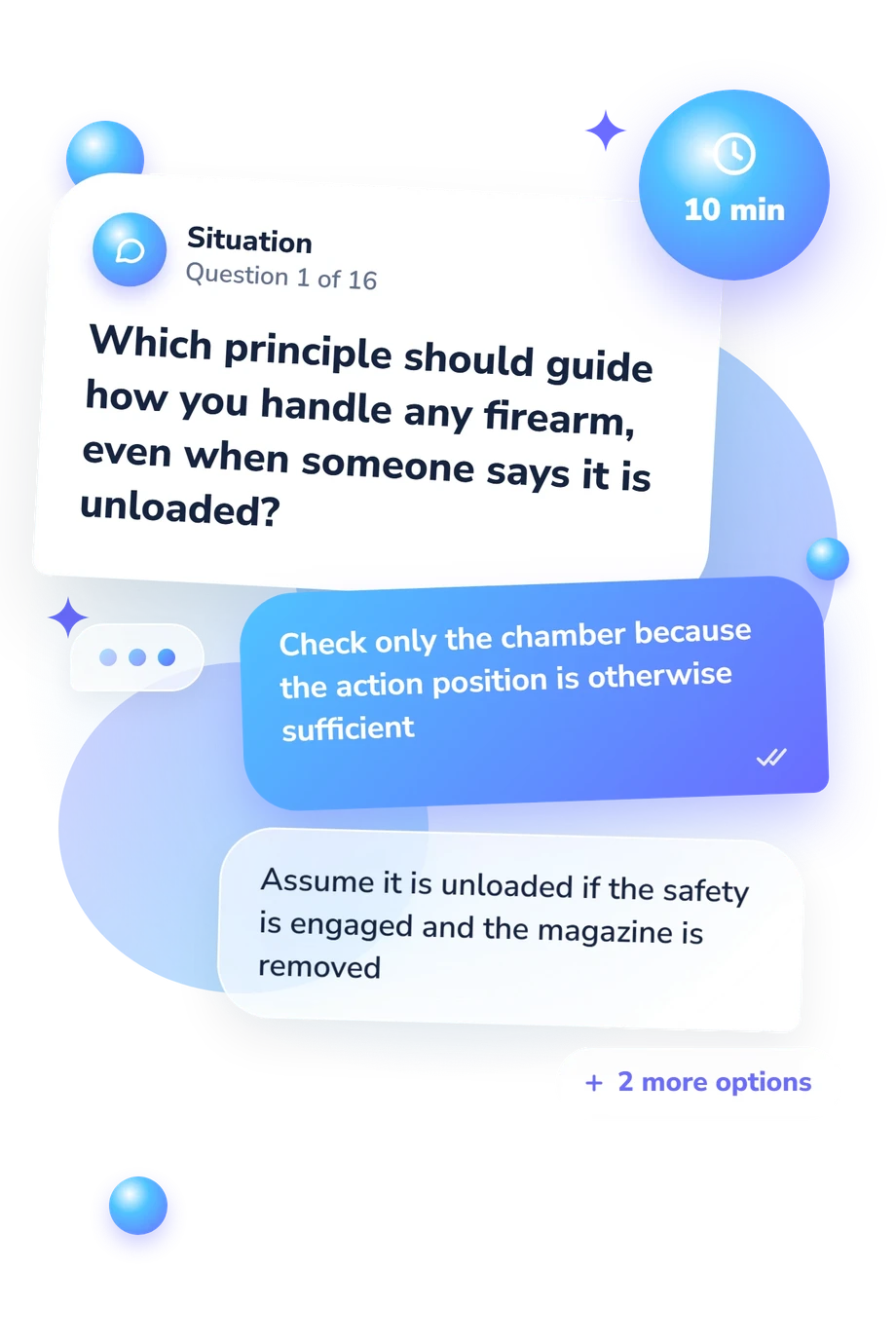
- Check only the chamber because the action position is otherwise sufficient
- Assume it is unloaded if the safety is engaged and the magazine is removed
- Handle it normally unless ammunition is visible nearby
- Treat it as though it is loaded until you personally verify its condition
- Engage the safety before changing your footing
- Keep the muzzle pointed in a safe direction and regain stable control
- Open the action as quickly as possible while still moving
- Grip the trigger guard firmly to keep the firearm from shifting
- Encourage vigorous exercise until normal coordination returns
- Give the person alcohol because it creates a sensation of warmth
- Get the person sheltered, replace wet layers when possible, warm them gradually, and seek help as needed
- Continue toward the destination so the group reaches shelter sooner
Hunter Safety Quiz - Description and methodology of the test
People preparing to hunt, refreshing earlier training, or accompanying someone in the field can use this hunter safety quiz to check recognition of correct firearm, field, wildlife, and emergency-safety principles in scenarios. The assessment concerns answer-based knowledge, not demonstrated judgment or behavior in the field. Its questions can point to topics worth reviewing through a hunter safety course or supervised practice.
What This Assessment Explores
These questions present situations where safe hunting depends on control, identification, preparation, and timely action. They suit people reviewing practical knowledge before or during supervised learning, whether they are new to hunting or returning after time away.
Across the hunter safety questions, the main themes are:
- Firearm handling shows whether choices protect muzzle direction, the action, the trigger, and safe movement.
- Shot selection shows whether you identify the target, background, range, and recovery conditions.
- Field preparation reflects decisions about crossings, tree stands, carrying capacity, and ethical recovery.
- Emergency response captures reactions to bleeding, cold exposure, misfires, and disorientation.
The assessment emphasizes the safest response in each situation. Its single result is best read as an overall knowledge level; the themes identify the content covered by the questions, not individualized scores for each topic.
Methodology and Evidence Base
Each item offers four answer choices describing different actions, making this a structured, scenario-based multiple-choice knowledge assessment. The preferred response follows the safety principle in that situation, and the questionnaire produces one overall result rather than separate subscores. Hunter Safety Knowledge spans 0-16: Foundation needed (0-6), Developing knowledge (7-12), and Strong knowledge (13-16). These bands describe knowledge shown by the answers, not certification or field competence.
Research associated with Niemeyer et al. (1970) supports the educational emphasis on firearm handling, field procedures, knowledge checks, and structured lessons. Bromley et al. (1988) supports separating knowledge gains from observed hunting behavior, while the 2013 Texas course outline and Smith (1984) reinforce organized content and evaluation. The questionnaire is conceptually consistent with this educational work rather than an adaptation of a cited instrument; the sources do not establish its authorship or validation.
The displayed bands are descriptive educational categories rather than norm-based standards. Guessing, wording familiarity, and current attention can affect answers, so use gaps to guide a hunter education course, local regulations, qualified instruction, manuals, and supervised practice.
- Niemeyer, Roy K., Ronald Z. Bacon, and Gideon A. Robarge. A Guide to Instruction in the Shooting Sports-Rifles; Air Rifles; Shotguns; Pistols; Hunter Safety. American Association for Health, Physical Education, and Recreation, 1970. ERIC Document Reproduction Service No. ED 091 139.
- Bromley, Peter T., Herbert Foster, Ed L. Hampton, and J. Douglas Wellman. "Response to Evaluation of the Hunter Education Program in Virginia." Proceedings of the Annual Conference of the Southeastern Association of Fish and Wildlife Agencies 42 (1988): 585-589.
- Texas Parks and Wildlife Department. Basic Course Outline for Use with the New 2013 Today’s Hunter in Texas. Texas Parks and Wildlife Department, 2013.
- Smith, Bradley F. "Improving Program Implementation: Hunter Education." The Journal of Environmental Education 16, no. 1 (1984): 24-28. 10.1080/00958964.1984.9942698
Updated: