
Exponential Functions Quiz
How the Scales are Structured
Who Usually Takes This Test?
See How You Compare
Below is a preview of how scores are typically distributed across each scale.
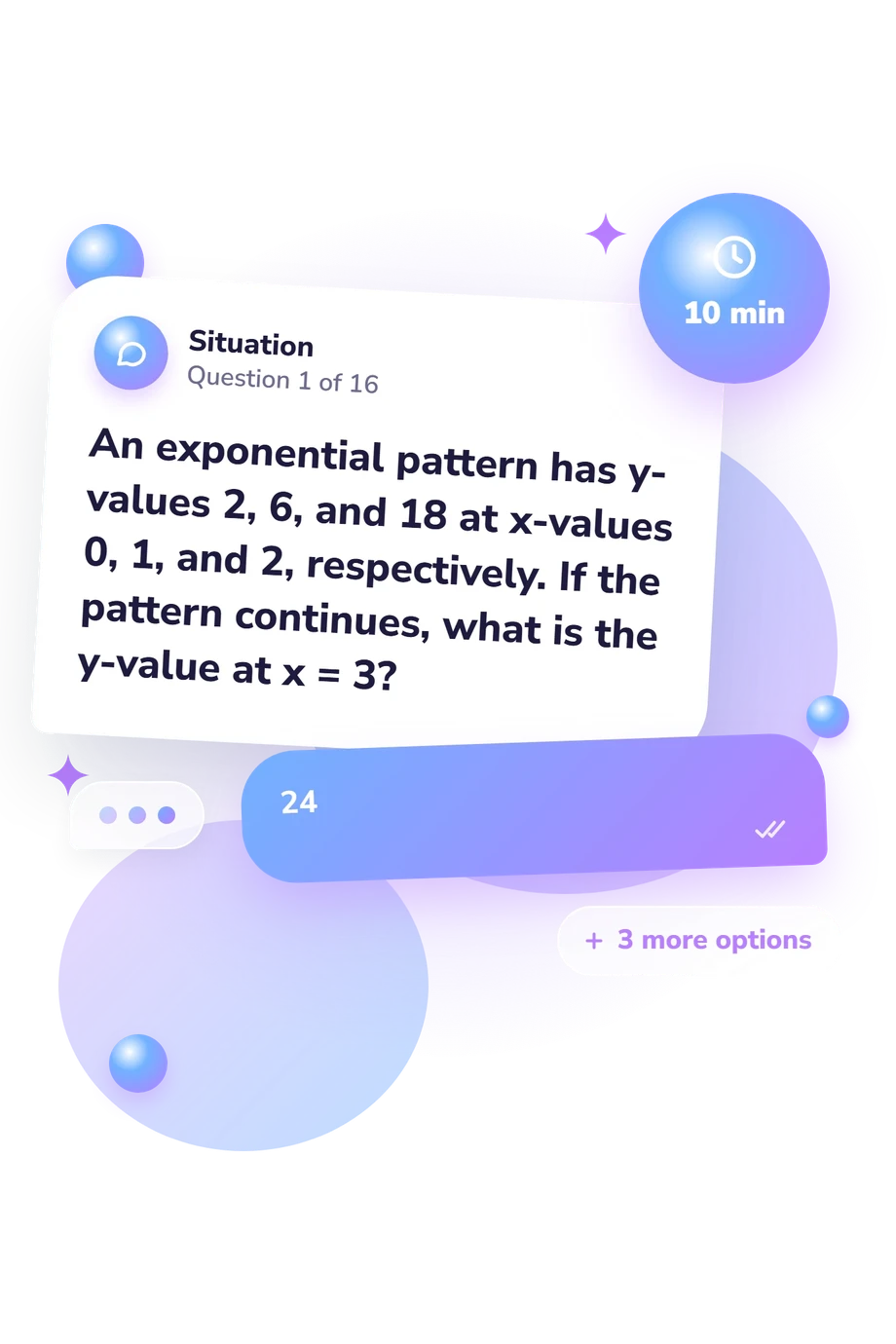
Example Questions From the Test
- 08%
- 8%
- 80%
- 108%
- 2
- 3
- 4
- 16
- 2^x has the greater value
- 3^x has the greater value
- They have the same value
- Their values cannot be compared without a graph
Exponential Functions Quiz - Description and methodology of the test
Students who want to connect algebraic rules with graphs and real-world change can use the exponential functions quiz to check how confidently they reason about growth and decay. A learner may also use it as an exponential functions test when reviewing a unit before logarithms or more complex models. The result describes current topic knowledge and points toward areas that deserve further study.
What This Assessment Explores
The questionnaire examines whether a learner can recognize and use exponential relationships in symbolic, graphical, and applied settings. It suits students or independent learners reviewing algebra who want to connect equations with meaning and distinguish multiplicative from additive change. The result describes current topic knowledge rather than general mathematical ability.
Items address notation, evaluation, comparisons, transformations, domain and range, inverse functions, asymptotes, and growth, decay, depreciation, medicine, and population models. They show which concepts are secure and where exponential functions practice may be most useful.
The displayed profile uses one knowledge scale with three interpretive bands:
- Foundational (0-6) indicates partial recognition and points to review of exponential form, factors, and basic evaluation.
- Developing (7-12) indicates many core concepts, with further practice potentially needed for transformations or applied models.
- Strong (13-16) indicates consistent command of notation, equations, graphs, comparisons, and applications.
Methodology and Evidence Base
Each item presents a short equation, numerical pattern, graph property, or applied situation with four answer choices. The groups sample evaluation, model selection, transformations, function behavior, and inverse relationships, so the format checks recognition and routine application without showing every step of the learner’s reasoning.
The questionnaire reports a total on the knowledge scale. Because no item-weighting rule is stated, that total is a broad performance indicator rather than a calibrated estimate. Reviewing answers from this quiz on exponential functions can help when the learner explains why an option works instead of memorizing a choice.
The approach is conceptually consistent with Confrey and Smith (1994), who connect exponential reasoning with multiplicative change and rates. Confrey and Smith (1995) add the ideas of splitting and covariation. Díaz-Berrios and Martínez-Planell (2022) provide a close research context for learners’ understanding of exponential and logarithmic relationships; this questionnaire is not an adaptation or validation of those studies.
It is an online knowledge check without reported norms or standardization. Results may reflect recent instruction, wording interpretation, and familiarity with the contexts, so they are best used to guide targeted study.
- Confrey, Jere, and Erick Smith. “Exponential Functions, Rates of Change, and the Multiplicative Unit.” Educational Studies in Mathematics, vol. 26, nos. 2-3, 1994, pp. 135-164. 10.1007/BF01273661
- Díaz-Berrios, Tomás, and Rafael Martínez-Planell. “High School Student Understanding of Exponential and Logarithmic Functions.” The Journal of Mathematical Behavior, vol. 66, 2022, article 100953. 10.1016/j.jmathb.2022.100953
- Confrey, Jere, and Erick Smith. “Splitting, Covariation, and Their Role in the Development of Exponential Functions.” Journal for Research in Mathematics Education, vol. 26, no. 1, 1995, pp. 66-86. 10.5951/jresematheduc.26.1.0066
Updated: