
Developmental Psychology Quiz
How the Scales are Structured
Who Usually Takes This Test?
See How You Compare
Below is a preview of how scores are typically distributed across each scale.
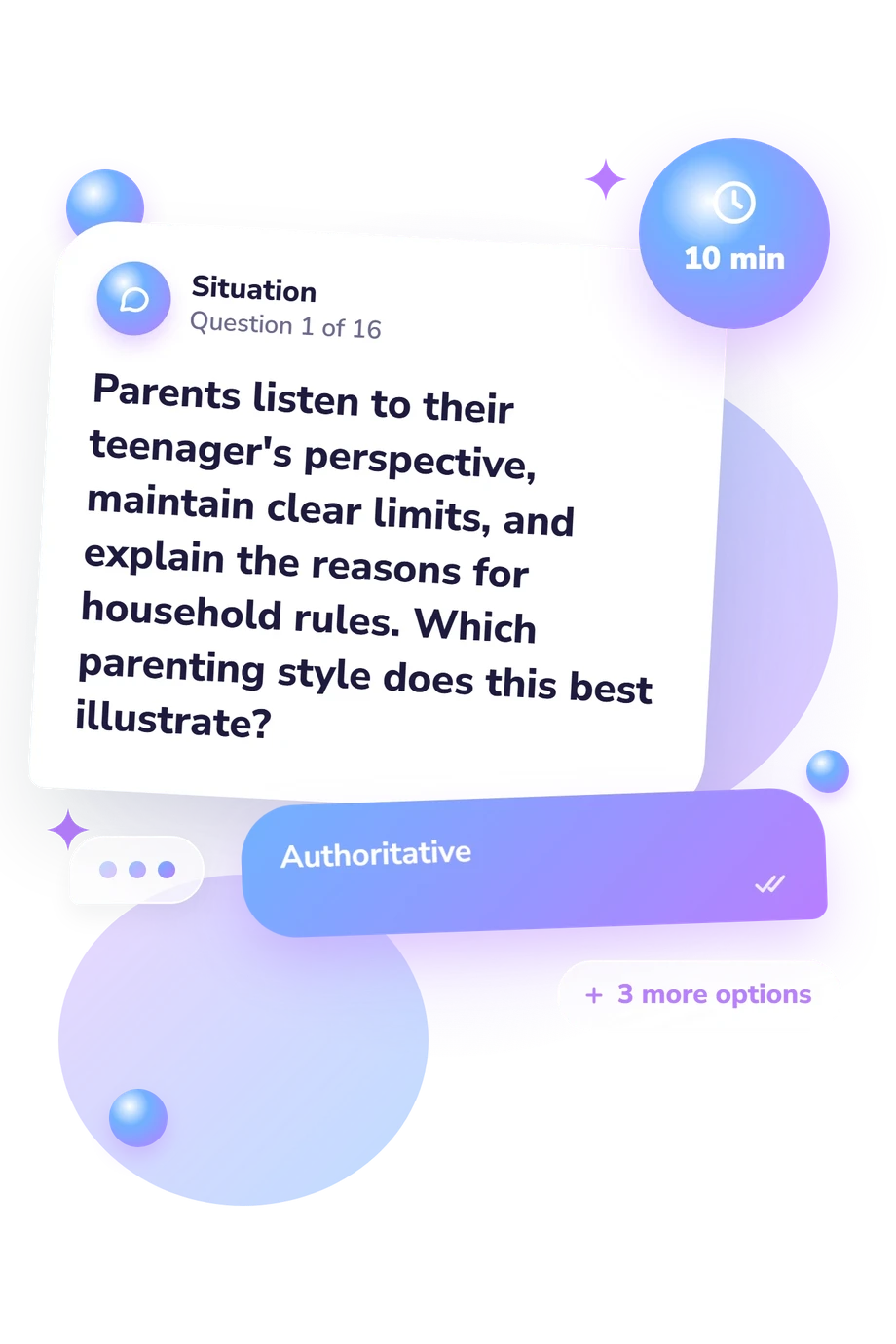
Example Questions From the Test
- Authoritative
- Permissive
- Authoritarian
- Uninvolved
- Industry versus inferiority
- Identity versus role confusion
- Intimacy versus isolation
- Generativity versus stagnation
- Case-control design
- Cross-sectional design
- Longitudinal design
- Naturalistic observation
Developmental Psychology Quiz - Description and methodology of the test
Students, educators, and curious readers can use this developmental psychology quiz to check their grasp of core ideas across the human lifespan. It is a focused educational knowledge check that evaluates accurate recognition of theories, processes, stages, and research principles. This developmental psychology assessment also indicates which concepts can be applied to examples and which topics merit another look, giving the respondent a practical direction for study.
What This Assessment Explores
The assessment samples developmental knowledge through situations involving children, adolescents, adults, and older people. Instead of asking for personal history, it asks the respondent to identify the theory, process, stage, research design, or principle that best explains each example. This developmental psychology test suits learners reviewing introductory material and readers who want a structured refresher.
The main themes are:
- Cognitive development shows recognition of object permanence, conservation, false-belief understanding, and changing abilities across adulthood.
- Social-emotional development reflects knowledge of attachment, parenting, identity, morality, and relationships.
- Language and learning development captures concepts such as phonemes, habituation, scaffolding, and supported performance.
- Lifespan and research concepts connect prenatal timing, puberty, aging, and longitudinal study design to broader developmental patterns.
Methodology and Evidence Base
Each item presents a short scenario followed by four answer choices. The respondent selects the option that best fits the named concept, so performance depends on distinguishing related terms rather than recalling isolated definitions. The displayed scale is Developmental Psychology Knowledge, scored as 0-16 correct: Foundation Building (0-6), Developing Knowledge (7-12), and Strong Knowledge (13-16). These bands describe the level of foundational developmental psychology knowledge demonstrated by correct answers and application of concepts on this educational questionnaire.
The human development quiz measures which foundational distinctions the respondent can apply, including links among cognition, social-emotional change, language, learning, and research methods, and it shows how those ideas operate in examples rather than assigning a fixed level of ability. The content is conceptually consistent with Kail and Cavanaugh (2016), while selected ideas correspond to Ainsworth and colleagues’ attachment framework, Piaget’s account of cognitive development, and Erikson’s psychosocial theory.
Results can be affected by guessing, attention, prior coursework, and current context, so the score is best read as a snapshot of performance on these items rather than a standardized clinical conclusion.
- Kail, Robert V., and John C. Cavanaugh. Human Development: A Life-Span View. 7th ed. Cengage Learning, 2016.
- Ainsworth, Mary D. Salter, Mary C. Blehar, Everett Waters, and Sally Wall. Patterns of Attachment: A Psychological Study of the Strange Situation. Lawrence Erlbaum Associates, 1978.
- Piaget, Jean. The Origins of Intelligence in Children. International Universities Press, 1952. 10.1037/11494-000
- Erikson, Erik H. Identity: Youth and Crisis. W. W. Norton & Company, 1968.
Updated: