
Literal Equations Quiz
How the Scales are Structured
Who Usually Takes This Test?
See How You Compare
Below is a preview of how scores are typically distributed across each scale.
Example Questions From the Test
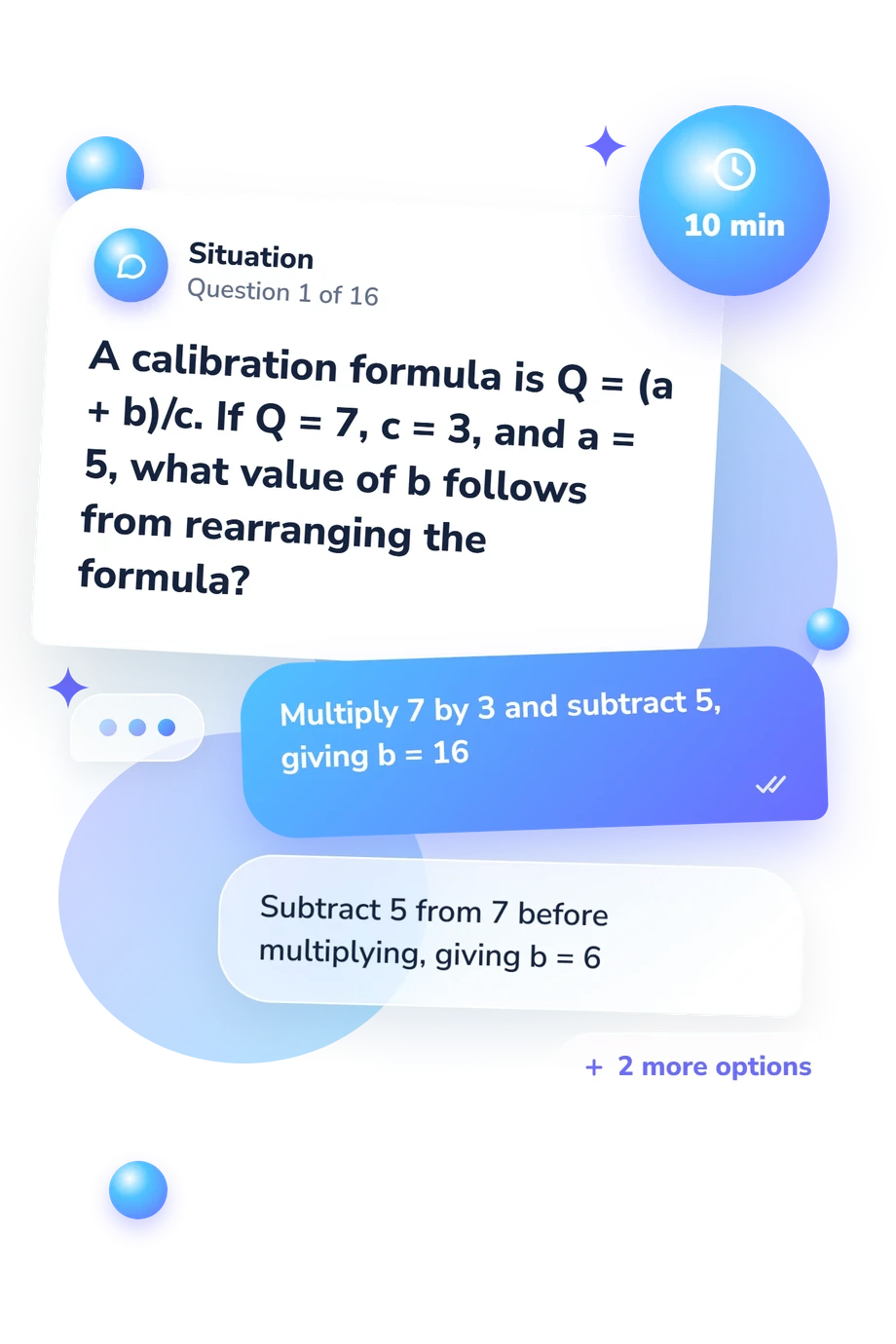
- Multiply 7 by 3 and subtract 5, giving b = 16
- Subtract 5 from 7 before multiplying, giving b = 6
- Divide 7 by 3 and subtract 5, giving b = −8/3
- Subtract the product from 5, giving b = −16
- Divide by twice the length: w = A/(2l)
- Reverse the ratio: w = l/A
- Subtract the length: w = A − l
- Divide both sides by the length: w = A/l
- Invert the interest ratio: r = Pt/I
- Treat the product as a term to subtract: r = I − Pt
- Multiply by P but divide by t: r = IP/t
- Divide interest by both factors: r = I/(Pt)
Literal Equations Quiz - Description and methodology of the test
For students, teachers, and independent learners, the literal equations quiz offers a focused way to check whether formula manipulation remains accurate when symbols, signs, fractions, and applied contexts change. It can support literal equations practice when you want to examine symbolic reasoning, trace errors, and prepare for more advanced work.
What This Assessment Explores
This assessment measures how accurately a learner rearranges an equation for a selected variable while preserving equality. Examples from geometry, motion, finance, measurement, temperature, resistance, and general algebra test whether the same operations transfer across notation and contexts. As a formula rearrangement quiz, it helps students and independent learners identify gaps in symbolic manipulation.
The questions sample four skill areas:
- Inverse operations show whether each algebraic step is reversed in sequence.
- Grouped expressions show whether parentheses, fractions, and powers remain intact.
- Applied formulas show whether symbolic procedures transfer to practical contexts.
- Variables on both sides show whether terms are collected consistently.
Results are reported as Literal Equations Knowledge (0-16): Foundations to Review (0-6), Developing Command (7-12), or Strong Command (13-16). This describes performance on the tested transformations, not complete algebra proficiency.
Methodology and Scientific Basis
Most items present formulas or relationships; you select from four answer choices that offer either a rearrangement or a conceptual definition. Selecting the response that preserves equality or identifies the concept correctly makes it a structured performance task rather than a self-report inventory. The result summarises performance on these items within the reported band.
The approach is conceptually consistent with work by Eltoum on algebraic structure and transformations. It also connects with research by Xu and colleagues on flexible equation solving and by Martinez and colleagues on algebra performance when preparation differs. These sources support the relevance of the tested skills, but not standardized norms for this questionnaire.
Answers from this quiz on literal equations can clarify whether an error involved an inverse operation, a grouped term, or a variable moved across equality.
Interpret the band as targeted feedback about formula manipulation. It can point to revisiting inverse operations, fractions, powers, denominators, or variables on both sides, while stronger performance suggests more consistent handling of the sampled transformations. Because the items move between symbolic and applied formulas, attention, notation slips, reading speed, and prior familiarity can affect accuracy on these transformations.
- Eltoum, Russina A. (2023). The conceptual difficulties Saudi female ELL students encountered in learning algebra: A case of a college preparatory program. Asian Journal for Mathematics Education, 2(3), 365-389. 10.1177/27527263231203092
- Xu, Le, Ru-De Liu, Jon R. Star, Jia Wang, Ying Liu, and Rui Zhen. (2017). Measures of Potential Flexibility and Practical Flexibility in Equation Solving. Frontiers in Psychology, 8, Article 1368. 10.3389/fpsyg.2017.01368
- Martinez, Mara V., John Bragelman, and Timothy Stoelinga. (2016). Underprepared Students’ Performance on Algebra in a Double-Period High School Mathematics Program. The Mathematics Educator, 25(1), 3-31.
Updated: