
Do I Need a Boyfriend Quiz
How the Scales are Structured
Who Usually Takes This Test?
See How You Compare
Below is a preview of how scores are typically distributed across each scale.
Example Questions From the Test
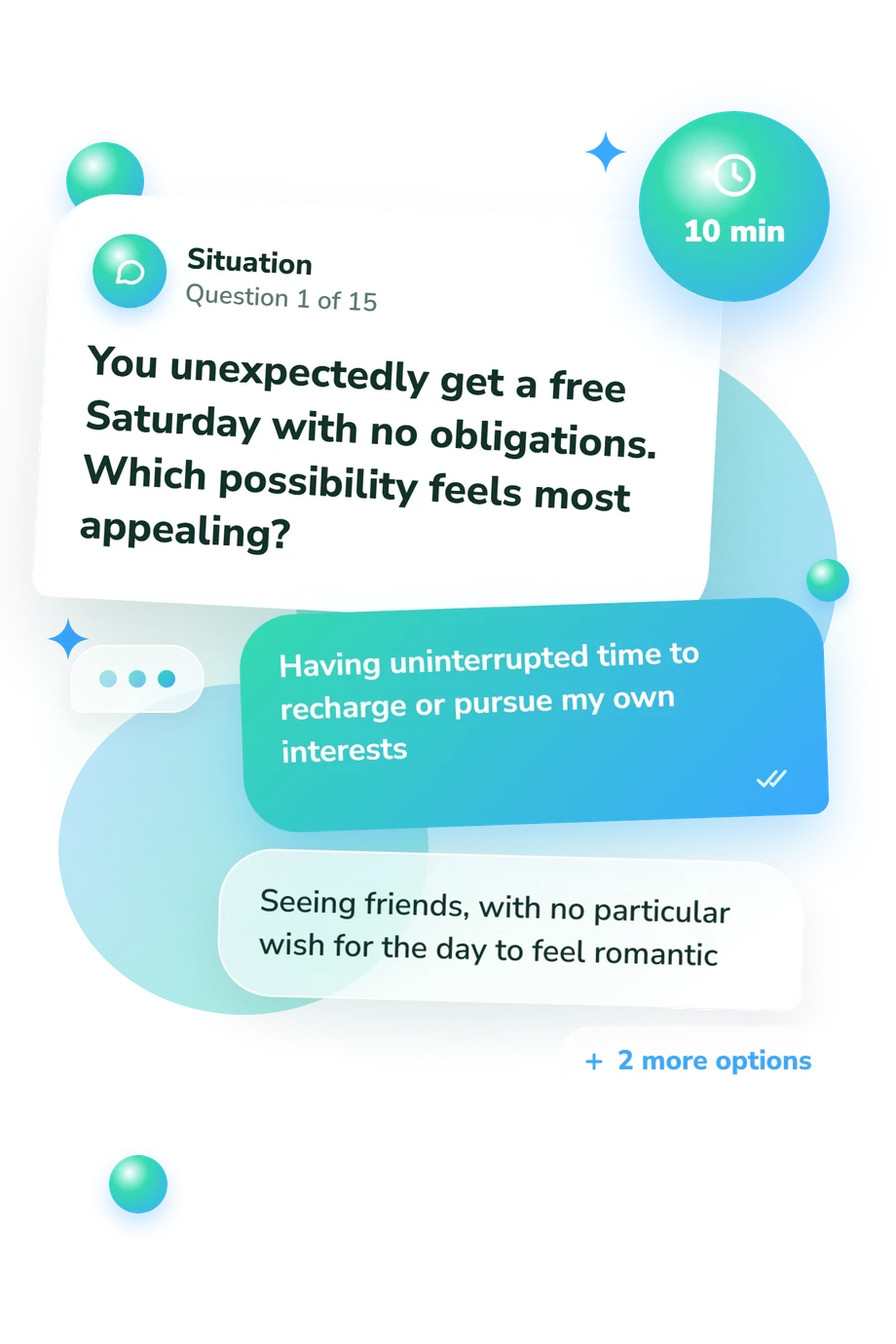
- Having uninterrupted time to recharge or pursue my own interests
- Seeing friends, with no particular wish for the day to feel romantic
- Going on a date if an interesting opportunity came up
- Sharing the day with someone in a close, affectionate relationship
- My interest rises sharply because I feel left behind
- I notice the contrast, but it only slightly changes my interest
- It prompts some comparison and makes dating feel more important
- Their relationships do not determine what I want for myself
- It sounds pleasant in theory, though I rarely seek it out
- I feel a strong pull toward that kind of connection
- I can appreciate it, but my life feels satisfying without it
- I feel interested and would make some effort to pursue it
Do I Need a Boyfriend Quiz - Description and methodology of the test
People deciding whether dating fits their life right now may find the Do I Need a Boyfriend Quiz useful for examining how current routines, emotional availability, and social expectations affect that choice. This questionnaire is intended for people reflecting on singleness, emotional energy, romantic priorities, and dating choices. It offers a profile to consider, not a verdict about what you should do next.
What the Questionnaire Measures
The items address partnership room, romantic desire, and outside comparison. Free time, conflict, routines, events, and couples make themes concrete.
The result dimensions are:
- Current Relationship Capacity (0-15) shows available room for time, energy, openness, and adjustment: Limited Room Right Now (0-5), Conditional Capacity (6-10), or Substantial Capacity (11-15).
- Desire for Romantic Connection (0-15) reflects the present pull toward affection, closeness, and shared experiences: Other Needs Lead (0-5), Open but Unhurried (6-10), or Strong Romantic Pull (11-15).
- External Relationship Pressure (0-15) captures the influence of expectations, comparison, and social messages: Internally Directed (0-5), Mixed Influence (6-10), or Pressure Is Prominent (11-15).
Read the pattern as context for a broader relationship decision, not identity: capacity is not an obligation to date, desire does not prove a partner is needed or suitable, and high pressure does not invalidate genuine romantic desire.
Methodology and Evidence Base
Each item presents an everyday situation with four response options. The choices contrast availability, interest, flexibility, and sensitivity to comparison, so the respondent selects the closest description. As self-report, the result reflects the respondent’s current perspective.
Separate totals let capacity, desire, and pressure be considered together rather than collapsed into one yes-or-no answer. Because the item format does not specify a universal point value for options, interpretation should follow the displayed bands and overall pattern, not an invented formula.
Its closest conceptual anchor is MacDonald et al.'s (2026) study of motives in romantic relationship pursuit. Capacity is conceptually consistent with commitment-readiness research by Hadden et al. (2018), while pressure connects with Spielmann et al. (2013) on fear of being single and settling. Desire measures the pull toward affection, closeness, and shared experiences; comparison may influence that pull and is examined separately through the pressure dimension.
These studies offer conceptual comparisons only; they do not establish norms, scoring, or validation for this online questionnaire. Mood and self-perception can shift answers, so the profile describes present tendencies rather than predicting relationship success.
- MacDonald, Geoff, Serena Thapar, William S. Ryan, Joanne M. Chung, Elaine Hoan, and Yoobin Park. (2026). Why Do You Want a Romantic Relationship? Individual Differences in Motives for Romantic Relationship Pursuit. Personality and Social Psychology Bulletin, 52(8), 2230-2246. 10.1177/01461672251331699
- Hadden, Benjamin W., Christopher R. Agnew, and Kenneth Tan. (2018). Commitment Readiness and Relationship Formation. Personality and Social Psychology Bulletin, 44(8), 1242-1257. 10.1177/0146167218764668
- Spielmann, Stephanie S., Geoff MacDonald, Jessica A. Maxwell, Samantha Joel, Diana Peragine, Amy Muise, and Emily A. Impett. (2013). Settling for less out of fear of being single. Journal of Personality and Social Psychology, 105(6), 1049-1073. 10.1037/a0034628
Updated: