
Psychology Memory Quiz
How the Scales are Structured
Who Usually Takes This Test?
See How You Compare
Below is a preview of how scores are typically distributed across each scale.
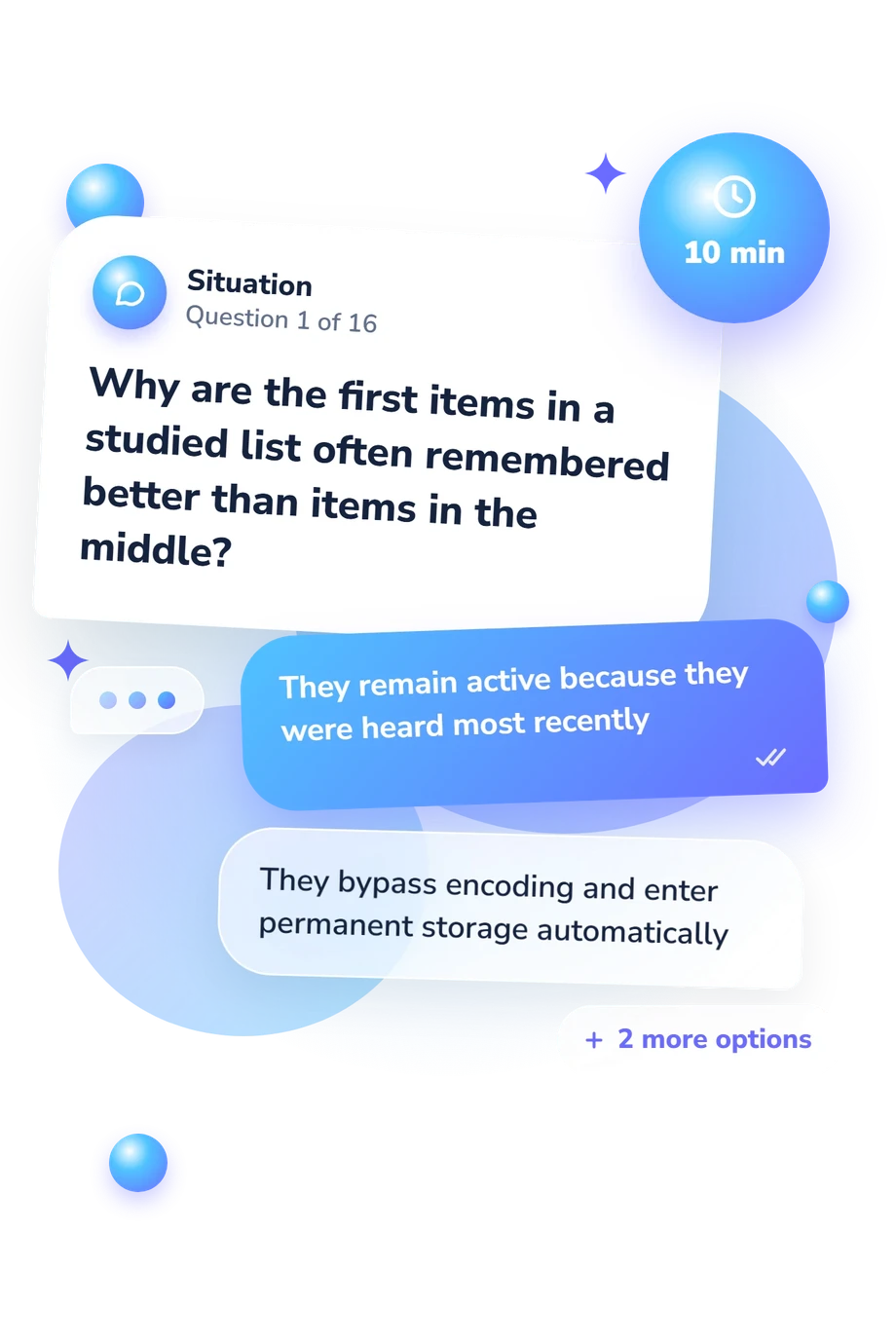
Example Questions From the Test
- Proactive interference
- Retroactive interference
- Source monitoring
- State-dependent retrieval
- Response inhibition
- Retrieval from long-term memory
- Memory reconsolidation
- Selective attention
- The misinformation effect
- Encoding specificity
- The recency effect
- Retroactive interference
Psychology Memory Quiz - Description and methodology of the test
Students, curious learners, and anyone revisiting basic cognitive psychology can use this quiz about memory in psychology to check how clearly they recognize major principles. The result offers a snapshot of knowledge for study planning and self-reflection. The Psychology Memory Quiz focuses on concepts rather than personal memory ability, making it useful for identifying mechanisms that deserve another review.
What This Assessment Explores
Questions and brief examples ask respondents to recognize how information is encoded, stored, retrieved, and altered. The topics span memory systems, attention, learning conditions, interference, and recollection accuracy. As a psychology learning and memory quiz, it suits concept review and study planning.
These practical groups, not formal scales, are:
- Memory types and systems show whether you distinguish episodic, semantic, procedural, prospective, sensory, and working memory.
- Learning principles show whether you recognize rehearsal, retrieval practice, spacing, encoding specificity, and attention.
- Interference shows whether you identify proactive, retroactive, and misinformation effects.
- Organization and vivid recollection show how you interpret serial position, chunking, and changing memories.
Psychology Memory Knowledge ranges from 0-16: Foundations to build (0-6) means review; Developing knowledge (7-12) shows some confusion; Strong knowledge (13-16) reflects recognition of most covered principles. It measures knowledge, not memory ability or health.
Methodology and Evidence Base
Each item presents a question, sometimes using a brief memory example, with four answer choices. The respondent selects the option that best matches the principle, and the displayed result is an educational total of correct answers. A higher total means more questions were answered correctly, not that someone has better everyday memory. The options test recognition of definitions, examples, and applications of memory concepts.
Its online format makes it a psychology memory test built around an educational multiple-choice approach rather than a task measuring recall speed, capacity, or accuracy for newly learned material. Its concepts are conceptually consistent with Atkinson and Shiffrin (1968) on memory systems, Baddeley and Hitch (1974) on working memory, Tulving and Thomson (1973) on encoding specificity, and Roediger and Karpicke (2006) on retrieval practice.
Interpret the result as a snapshot of current knowledge. Prior study, wording, guessing, attention, and test conditions can affect performance, while a short knowledge check cannot represent every memory process. The bands help choose review topics but do not establish a clinical condition, individual memory capacity, or complete psychological profile.
- Atkinson, R. C., and Shiffrin, R. M. (1968). Human Memory: A Proposed System and Its Control Processes. In The Psychology of Learning and Motivation: Advances in Research and Theory, Vol. 2, pp. 89-195. Academic Press. 10.1016/S0079-7421(08)60422-3
- Baddeley, A. D., and Hitch, G. (1974). Working Memory. In The Psychology of Learning and Motivation, Vol. 8, pp. 47-89. Academic Press. 10.1016/S0079-7421(08)60452-1
- Tulving, E., and Thomson, D. M. (1973). Encoding Specificity and Retrieval Processes in Episodic Memory. Psychological Review, 80(5), 352-373. 10.1037/h0020071
- Roediger, H. L., and Karpicke, J. D. (2006). Test-Enhanced Learning: Taking Memory Tests Improves Long-Term Retention. Psychological Science, 17(3), 249-255. 10.1111/j.1467-9280.2006.01693.x
Updated: