
Pot Odds Quiz
How the Scales are Structured
Who Usually Takes This Test?
See How You Compare
Below is a preview of how scores are typically distributed across each scale.
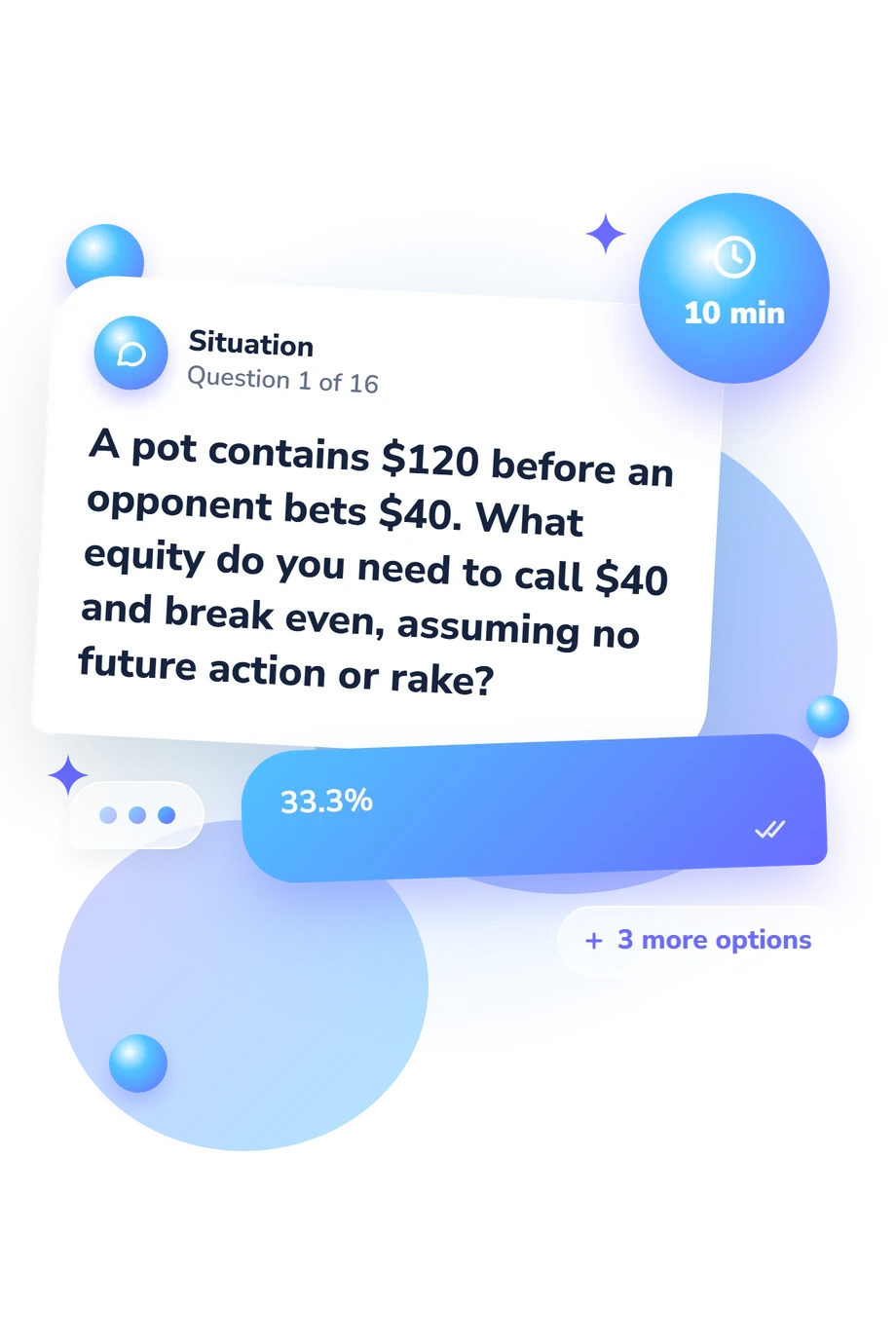
Example Questions From the Test
- The cost of calling with the amount currently available to win
- The size of your stack with the size of the big blind
- Your number of outs with your opponent's likely number of outs
- The current pot with the amount you have already invested
- 6%
- 0%
- 1%
- 3%
- 7%
- 25%
- 20%
- 3%
Pot Odds Quiz - Description and methodology of the test
Players who want to check whether their poker calculations are reliable can use this pot odds quiz as a focused learning assessment. It suits anyone reviewing calls, draws, and expected value, from a newer player building fundamentals to a more experienced player testing consistency. Used as a pot odds practice quiz, it highlights which areas of decision-making deserve another pass rather than predicting results at the table.
What This Assessment Explores
This questionnaire examines common poker decisions: comparing call costs with potential winnings, translating outs into equity, allowing for ties and rake, and recognizing implied or reverse implied odds. It suits players checking conceptual understanding, not a complete playing style.
The drawing questions make it useful as a poker outs quiz, linking card probabilities with the price of a call. Other items test implied odds and expected value, including whether a decision can remain profitable across uncertain outcomes.
The displayed result is Pot Odds Knowledge (0-16), with these bands:
- Foundation to build (0-6) means reviewing call cost, the pot after calling, and break-even equity.
- Developing knowledge (7-12) reflects many core ideas, with practice still useful for multiway pots, drawing odds, and EV.
- Strong knowledge (13-16) reflects consistent use of pot-odds concepts in common scenarios, but remains educational rather than predictive.
Methodology and Scientific Basis
Each item presents a poker scenario with answer choices. The questions cover break-even calculations, pot-size comparisons, one-card and two-card drawing probabilities, implied and reverse implied odds, rake, ties, and expected value. This makes it a pot odds decision quiz: it tests applying concepts to changing numbers, not recalling one formula.
The method is scenario-based, multiple-choice assessment of applied probability and decision reasoning. Responses become one educational knowledge score; no finer-grained ability should be inferred from an individual item or range alone.
Its content is conceptually consistent with Liley and Rakow (2010) on probability estimation in poker, and with the mathematical treatments in Chen and Ankenman and Sklansky. Billings and Kan support assessing poker decisions as a distinct skill. These sources support the subject matter; they do not make this online questionnaire a validated adaptation of any published instrument.
These works provide context rather than norms for this online version. Interpretation can be affected by attention, guessing, calculation skill, and prior experience, while a single result leaves out opponent modeling and emotional control. Reviewing actual hands alongside it gives a fuller picture.
- Liley, James, and Tim Rakow. (2010). Probability estimation in poker: A qualified success for unaided judgment. Journal of Behavioral Decision Making, 23(5), 496-526. 10.1002/bdm.670
- Chen, Bill, and Jerrod Ankenman. (2006). The Mathematics of Poker. Pittsburgh, PA: ConJelCo LLC.
- Sklansky, David. (1999). The Theory of Poker. Las Vegas, NV: Two Plus Two Publishing LLC.
- Billings, Darse, and Morgan Kan. (2006). A Tool for the Direct Assessment of Poker Decisions. ICGA Journal, 29(3), 119-142. 10.3233/ICG-2006-29302
Updated: