
Energy Transformation Quiz
How the Scales are Structured
Who Usually Takes This Test?
See How You Compare
Below is a preview of how scores are typically distributed across each scale.
Example Questions From the Test
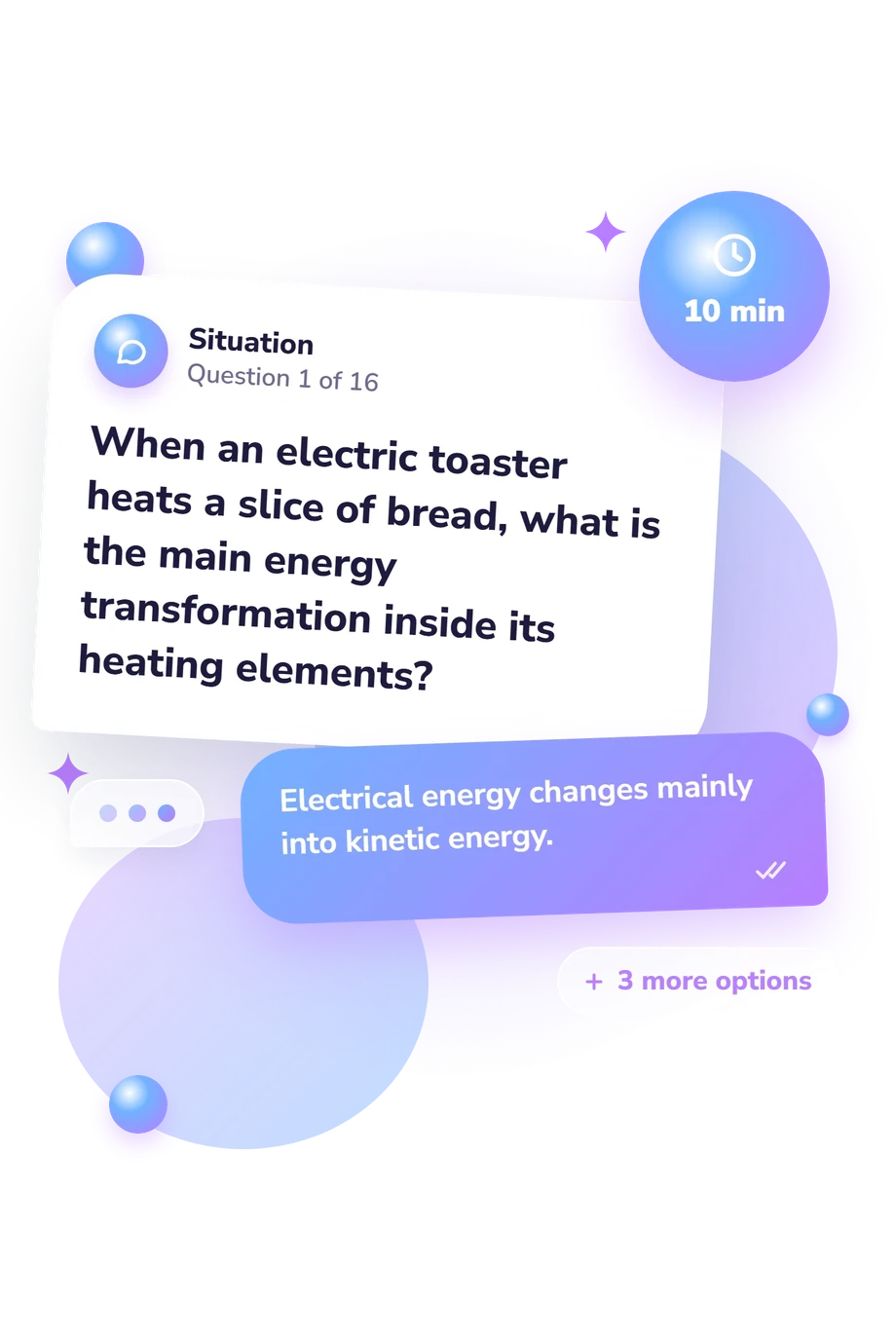
- Electrical energy changes mainly into kinetic energy.
- Thermal energy changes into electrical energy.
- Chemical energy changes directly into thermal energy.
- Electrical energy changes into thermal energy.
- Thermal energy into gravitational potential energy
- Chemical energy into radiant energy
- Radiant energy into chemical energy
- Kinetic energy into electrical energy
- Thermal energy changes into chemical energy.
- Radiant energy changes into mechanical energy.
- Chemical energy changes directly into electrical energy.
- Mechanical energy changes into thermal energy through friction.
Energy Transformation Quiz - Description and methodology of the test
Students, teachers, and curious learners can use this energy transformation quiz to check whether they can follow energy as it moves between forms and systems. This practical transformation of energy quiz connects classroom principles with appliances, vehicles, plants, and power stations. The result gives a focused picture of conceptual strengths and topics that merit further study.
What This Assessment Measures
The assessment focuses on conceptual understanding rather than calculation speed. Its energy transformation questions ask you to recognize changes between electrical, thermal, chemical, radiant, kinetic, mechanical, gravitational-potential, sound, and internal energy, then follow those changes through familiar systems. Several items also test conservation, useful output, losses to surroundings, and efficiency.
The single displayed scale is Energy Transformation Knowledge (0-16). It summarizes how accurately your answers apply transformation principles across everyday, natural, and technological examples. The result is shown in one of these bands:
- Foundations to build (0-6) indicates that you recognize some energy forms but need more practice with transfer and transformation.
- Developing understanding (7-12) indicates that you can trace many familiar changes while strengthening multi-step systems, conservation, or efficiency.
- Strong understanding (13-16) indicates that you apply the principles accurately across varied examples.
Methodology and Evidence Base
Each item presents one best answer from four choices. The options distinguish correct transformations from reversed energy flow, lost energy, or confused forms. The questionnaire presents one overall result, but its item-to-score conversion is not stated; no separate subscale is shown.
Methodologically, this energy conversion quiz uses a concept-assessment approach: selecting the best explanation rather than recalling vocabulary. The content is conceptually consistent with Energy Concept Assessment (Neumann et al., 2013), which treats energy learning as understanding forms, transfers, conservation, and system reasoning. Its question format fits distractors that reveal misconceptions discussed by Singh and Rosengrant (2003). Nordine, Krajcik, and Fortus (2011) support connecting transformations across contexts and representations.
The questionnaire is conceptually consistent with Energy Concept Assessment and the cited misconception research, but it is not presented as an adaptation of those published instruments, and no standardisation or norms are stated for its score. Results can be affected by guessing, wording, prior instruction, or recall. Use the band to target review-especially conservation, efficiency, or multi-step chains-and combine it with explanations or teacher-led assessment when detailed judgment is needed.
- Neumann, Knut, Tobias Viering, William J. Boone, and Hans E. Fischer. "Towards a learning progression of energy." Journal of Research in Science Teaching 50, no. 2 (2013): 162-188. 10.1002/tea.21061
- Singh, Chandralekha, and David Rosengrant. "Multiple-choice test of energy and momentum concepts." American Journal of Physics 71, no. 6 (2003): 607-617. 10.1119/1.1571832
- Nordine, Jeffrey, Joseph Krajcik, and David Fortus. "Transforming energy instruction in middle school to support integrated understanding and future learning." Science Education 95, no. 4 (2011): 670-699. 10.1002/sce.20423
Updated: