
Fashion Quiz Questions
How the Scales are Structured
Who Usually Takes This Test?
See How You Compare
Below is a preview of how scores are typically distributed across each scale.
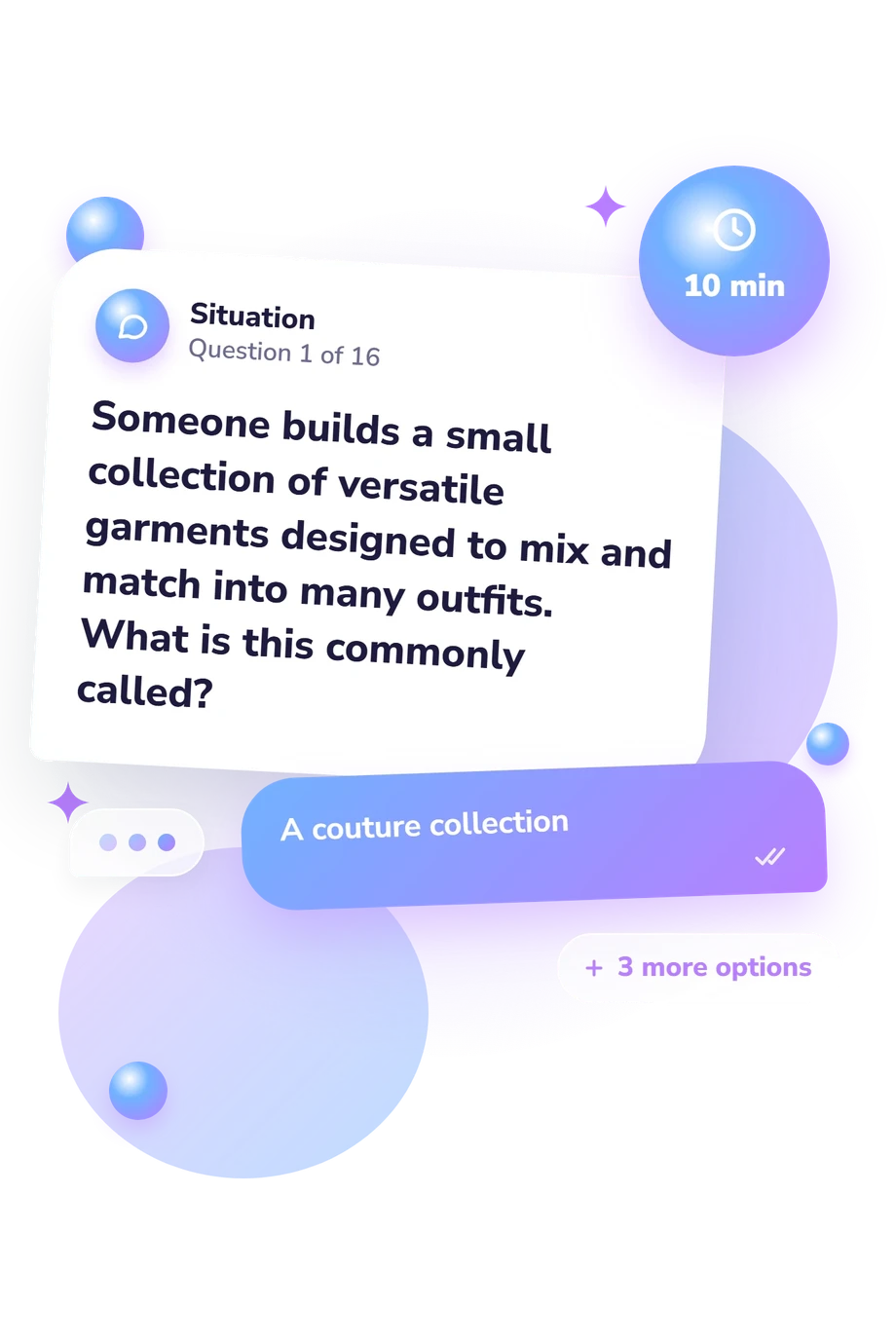
Example Questions From the Test
- A couture collection
- A capsule wardrobe
- A seasonal color story
- A diffusion line
- Made to measure
- Hand embroidered
- Limited edition
- Ready to wear
- Seam allowance
- Hem facing
- Wearing ease
- Dart intake
Fashion Quiz Questions - Description and methodology of the test
Readers who want to check how confidently they understand clothing, style, and fashion terminology can take the Fashion Quiz Questions assessment as a focused knowledge exercise rather than a personality profile. This assessment suits curious shoppers, students, makers, stylists, and anyone building a stronger vocabulary for discussing garments. The result from this fashion knowledge quiz gives a clear indication of current strengths and topics that deserve further study.
What This Assessment Explores
The questions examine practical and historical knowledge rather than taste or personal style. They cover fabric structures and grain direction, pattern and garment construction, textile terminology, dress codes, color relationships, recurring motifs, and influential designers. As a fashion knowledge test, the assessment can reveal whether a respondent recognizes everyday clothing concepts alongside the technical language used in apparel.
The result is organized around one displayed dimension:
- Fashion Knowledge (0-16) shows how well your answers cover fashion terminology, practical concepts, textiles, construction, and established history. Foundation (0-6) indicates core ideas may need review; Developing (7-12) reflects broad knowledge with some gaps; Strong (13-16) indicates a well-rounded command of the tested material.
This profile supports self-reflection and targeted learning. It does not assess creativity, personal taste, sewing ability, or wardrobe quality, because those qualities are outside the prompts.
Methodology and Scientific Basis
Each item gives a factual or applied prompt with four choices. Respondents identify construction terms, interpret care symbols, recognize designers or fabrics, and apply grain or dress-code conventions. This format tests established answers, not taste, creativity, or confidence.
Within this assessment, fashion pub quiz questions address technical terms and historical references alongside garment knowledge. Han (2019) distinguishes objective from subjective knowledge and prior experience in apparel. This questionnaire is conceptually consistent with that distinction because it asks for demonstrable answers, not confidence ratings; it is neither a reproduction nor validated adaptation of Han’s study. Flynn, Goldsmith and Kim (2000) treat fashion knowledge as measurable, while Shim and Dubey (1995) connect apparel knowledge with consumer skills. The studies provide conceptual context rather than validation of this online assessment.
The questionnaire reports the displayed score bands as performance descriptors, but has no stated item-weighting or scoring procedure and lacks documented norming or standardization. Its bands describe performance on this questionnaire, not a percentile, qualification, or diagnosis. Guessing, memory, prior study, cultural familiarity, and attention can shape answers, so use it to choose review topics.
- Han, Tae-Im. "Objective knowledge, subjective knowledge, and prior experience of organic cotton apparel." Fashion and Textiles 6, article 4 (2019). 10.1186/s40691-018-0168-7
- Flynn, Leisa Reinecke, Ronald E. Goldsmith, and Wan-Min Kim. "A cross-cultural validation of three new marketing scales for fashion research: Involvement, opinion seeking and knowledge." Journal of Fashion Marketing and Management: An International Journal 4(2), 110-120 (2000). 10.1108/eb022583
- Shim, Soyeon, and Smita Dubey. "Conceptualization and Measurement of Perceived Consumer Knowledge and Skills in Apparel Products: An Exploratory Study among College Students." Family and Consumer Sciences Research Journal 23(3), 227-248 (1995). 10.1177/1077727X95233001
Updated: