
Egg Quiz
How the Scales are Structured
Who Usually Takes This Test?
See How You Compare
Below is a preview of how scores are typically distributed across each scale.
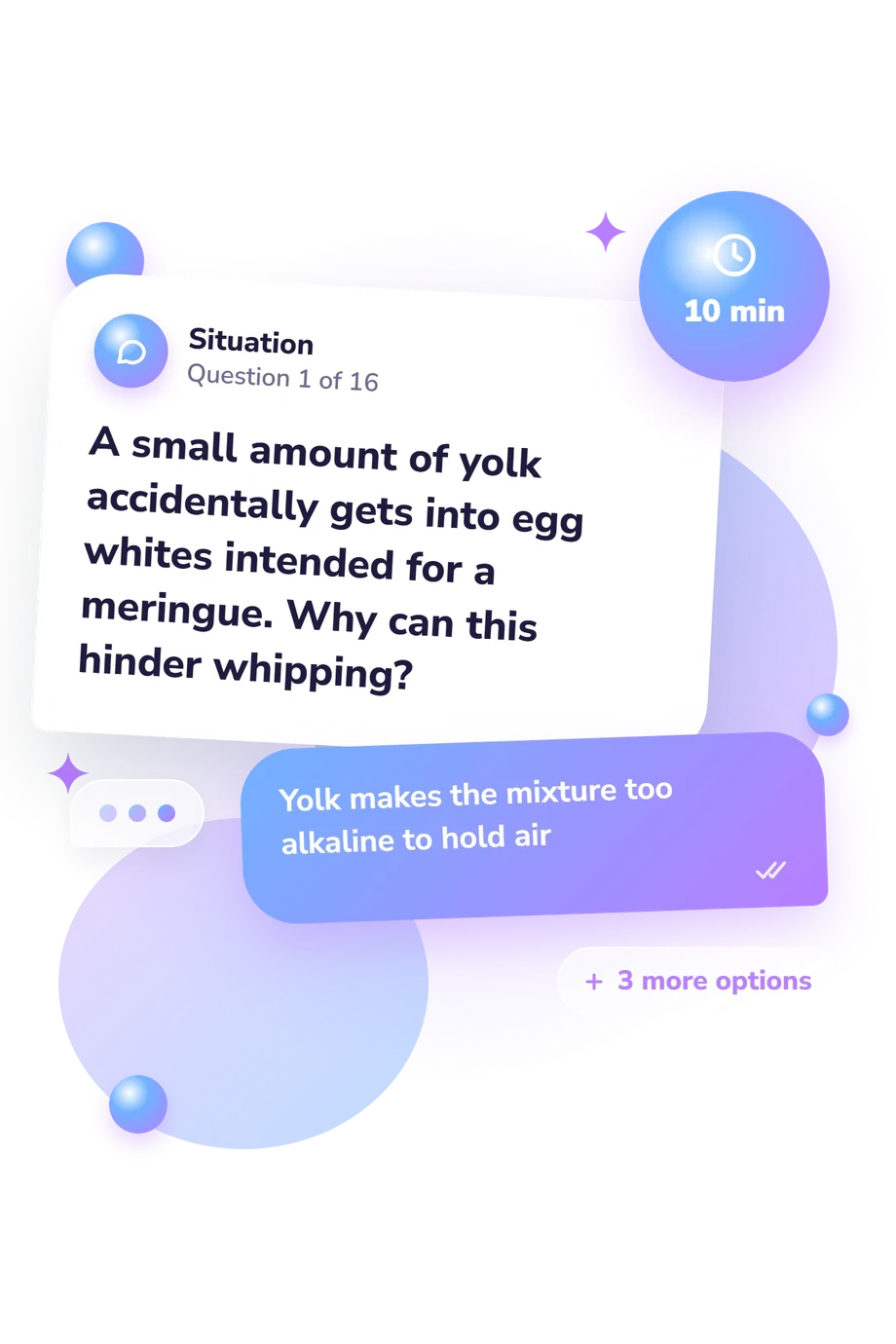
Example Questions From the Test
- Choosing eggs with the darkest shells available
- Bringing ordinary eggs to room temperature first
- Using pasteurized eggs or pasteurized egg products
- Separating the whites and yolks before combining them
- Its sugar permanently thickens oil when chilled
- Its calcium neutralizes all acids in the mixture
- Its shell-forming proteins convert the oil into water
- Its emulsifiers help oil and water-based ingredients remain mixed
- Magnesium sulfate
- Calcium phosphate
- Sodium bicarbonate
- Calcium carbonate
Egg Quiz - Description and methodology of the test
People who want to check whether their kitchen knowledge matches everyday habits can use this egg quiz as a focused learning check. It suits home cooks, bakers, students, and anyone curious about what eggs do in recipes and how safe handling decisions work. The quiz questions about eggs connect familiar ingredients with practical explanations, helping readers identify solid understanding and topics worth revisiting.
What This Assessment Explores
This assessment checks practical knowledge of egg structure, food science, cooking behavior, freshness, and safe handling. It suits readers who want to understand what they know before changing a recipe or reviewing kitchen routines. As an egg knowledge test, it emphasizes explanations behind familiar observations rather than labels alone.
The content falls into four groups:
- Anatomy covers albumen, chalazae, membranes, air cell, and shell, showing how an egg is organized.
- Cooking science explains coagulation, foams, emulsions, and heat-driven texture changes.
- Safety and handling covers pasteurized eggs, cross-contamination, cleaning, and raw-egg exposure.
- Freshness clues connect shell color, candling, buoyancy, and air-cell growth with their practical meaning.
These areas contribute to the Egg Knowledge scale: 0-16. Emerging Knowledge (0-6) shows basic understanding with room to grow; Developing Knowledge (7-12) reflects a useful foundation; Eggcellent Knowledge (13-16) indicates strong, well-rounded knowledge.
Methodology and Scientific Basis
This is a criterion-scored, multiple-choice knowledge assessment: each item presents a kitchen or biology scenario with four choices. Selecting the best explanation tests factual recognition and application rather than preference. Each correct answer adds one point to the total.
Viewed as an egg science quiz, this assessment is conceptually consistent with specific sources. Sabbah et al. (2024) is the closest match for knowledge and practices involving raw-egg purchase, preparation, storage, and consumption. Wilson (2017) supports the anatomy and functional explanations, while Wang and Wang (2009) is especially relevant to yolk contamination and egg-white foaming. The questionnaire is not presented as an adaptation of any one published instrument.
Because this online version has no stated standardized norm sample, its bands are descriptive learning categories rather than population norms or clinical thresholds. Performance may also reflect prior cooking experience, attention, and familiarity with technical terms. Read the result as a guide to topics worth revisiting, especially when a missed answer concerns food safety or a process that affects recipe outcomes.
- Sabbah, Mohammed, Kamal J. I. Badrasawi, Lubna Kharraz, and Manal Badrasawi. "Knowledge and handling practices for raw hen's eggs during purchase, preparation, storage, and consumption: a cross sectional study." Scientific Reports, vol. 14, 2024, article 7122. 10.1038/s41598-024-56288-8
- Wilson, Philippe B. "Recent advances in avian egg science: a review." Poultry Science, vol. 96, no. 10, 2017, pp. 3747-3754. 10.3382/ps/pex187
- Wang, Guang, and Tong Wang. "Effects of Yolk Contamination, Shearing, and Heating on Foaming Properties of Fresh Egg White." Journal of Food Science, vol. 74, no. 2, 2009, pp. C147-C156. 10.1111/j.1750-3841.2009.01054.x
Updated: