
Kpop Ideal Type Quiz
How the Scales are Structured
Who Usually Takes This Test?
See How You Compare
Below is a preview of how scores are typically distributed across each scale.
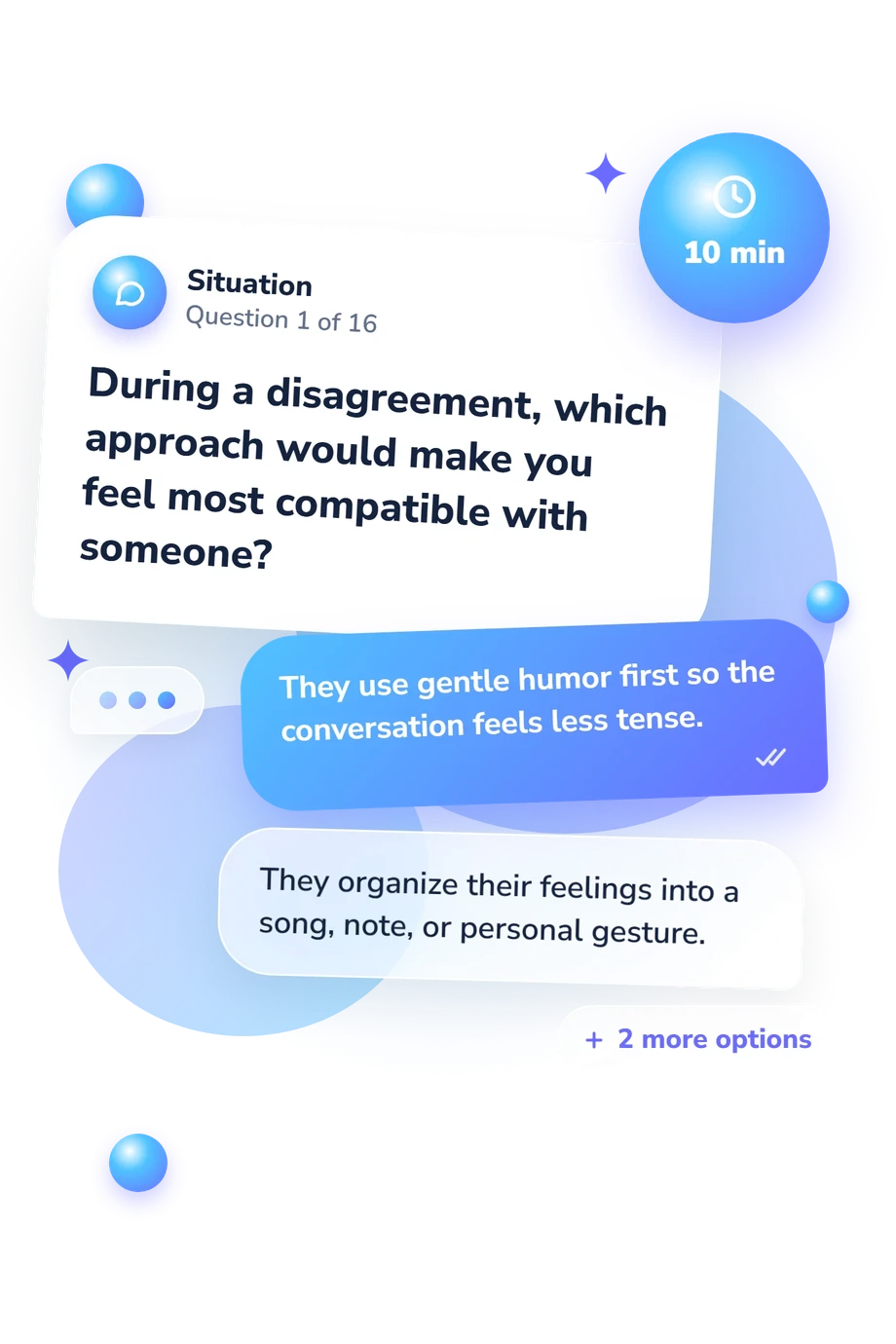
Example Questions From the Test
- They use gentle humor first so the conversation feels less tense.
- They organize their feelings into a song, note, or personal gesture.
- They take some quiet time and return when both of us are calmer.
- They initiate a warm, direct conversation and make room for both perspectives.
- They turn it into a ridiculous challenge with running jokes.
- They make a lively playlist and keep the conversation moving.
- They find the most efficient route so we can finish sooner.
- They use the quiet time for a thoughtful conversation.
- Find an interesting display or activity we can explore together.
- Stay beside me and let me settle in at my own pace.
- Introduce me thoughtfully to one or two friendly people.
- Pull me into an easy game or joke that breaks the tension.
Kpop Ideal Type Quiz - Description and methodology of the test
People who want to reflect on the kind of romantic presence they find appealing can use the Kpop Ideal Type Quiz as a structured comparison of partner qualities. It produces a Kpop ideal type profile showing which partner qualities appeal to the respondent, not the respondent's own personality. The questionnaire is a preference-based profile that highlights a leading result and shows when preferences are blended.
What This Assessment Explores
Scenarios about disagreement, affection, planning, creativity, and social energy reveal whether expressive originality, considerate initiative, lively humor, or quiet dependability feels most appealing. Together, these profiles help readers reflect on valued partner qualities; this Korean ideal type quiz measures preference, not personality.
The four result profiles are distinguished as follows:
- Artistic Free Spirit (0-12) measures attraction to imagination and self-expression: 0-4 - Grounded Preference, 5-8 - Creative Curiosity, 9-12 - Artistic Free Spirit Affinity.
- Caring Leader (0-12) measures attraction to warm communication and thoughtful initiative: 0-4 - Independent Preference, 5-8 - Warmth Appreciated, 9-12 - Caring Leader Affinity.
- Playful Mood-Maker (0-12) measures attraction to humor and shared fun: 0-4 - Different Energy, 5-8 - Selective Spark, 9-12 - Playful Mood-Maker Affinity.
- Quiet Protector (0-12) measures attraction to calm reliability and practical loyalty: 0-4 - Expressive Preference, 5-8 - Steady Comfort, 9-12 - Quiet Protector Affinity.
Methodology and Evidence Base
Each item presents a relationship situation with four possible responses. Scenarios cover emotional conversation, practical support, creativity, humor, planning, and social energy, so you choose the response that feels most compatible.
The result reports four profile scores. The highest marks your strongest affinity; scores within one point indicate a blended ideal type. The displayed bands show lower, moderate, or strong affinity, while the questionnaire does not state how many points each response contributes.
Research on mate preferences by Csajbók and Berkics, together with work on relationship ideals by Simpson and colleagues and Driebe and colleagues, offers conceptual context for these four preference profiles. Their constructs overlap with the qualities this questionnaire asks readers to prefer, but the questionnaire is not an adaptation of, or a validation study for, those published works.
Self-report makes this Kpop ideal type test sensitive to current context, cultural expectations, and self-awareness. Its scores are descriptive rather than norm-referenced, and no independent validation is provided, so the profile describes a preference pattern rather than a definitive account of compatibility.
- Goodwin, Robin, Tara Marshall, Marta Fülöp, Joseph Adonu, Slawomir Spiewak, Felix Neto, and Sonia Hernandez Plaza. “Mate Value and Self-Esteem: Evidence from Eight Cultural Groups.” PLOS ONE 7, no. 4 (2012): e36106. 10.1371/journal.pone.0036106
- Csajbók, Zsófia, and Mihály Berkics. “Factor, factor, on the whole, who’s the best fitting of all?: Factors of mate preferences in a large sample.” Personality and Individual Differences 114 (2017): 92-102. 10.1016/j.paid.2017.03.044
- Driebe, Julie C., Julia Stern, Lars Penke, and Tanja M. Gerlach. “Stability and Change of Individual Differences in Ideal Partner Preferences Over 13 Years.” Personality and Social Psychology Bulletin 50, no. 8 (2024): 1263-1279. 10.1177/01461672231164757
- Simpson, Jeffry A., Garth J. O. Fletcher, Geoff Thomas, and Louise Giles. “Ideals in Intimate Relationships.” Journal of Personality and Social Psychology 76, no. 1 (1999): 72-89. 10.1037/0022-3514.76.1.72
Updated: