
Fathers in the Bible Quiz
How the Scales are Structured
Who Usually Takes This Test?
See How You Compare
Below is a preview of how scores are typically distributed across each scale.
Example Questions From the Test
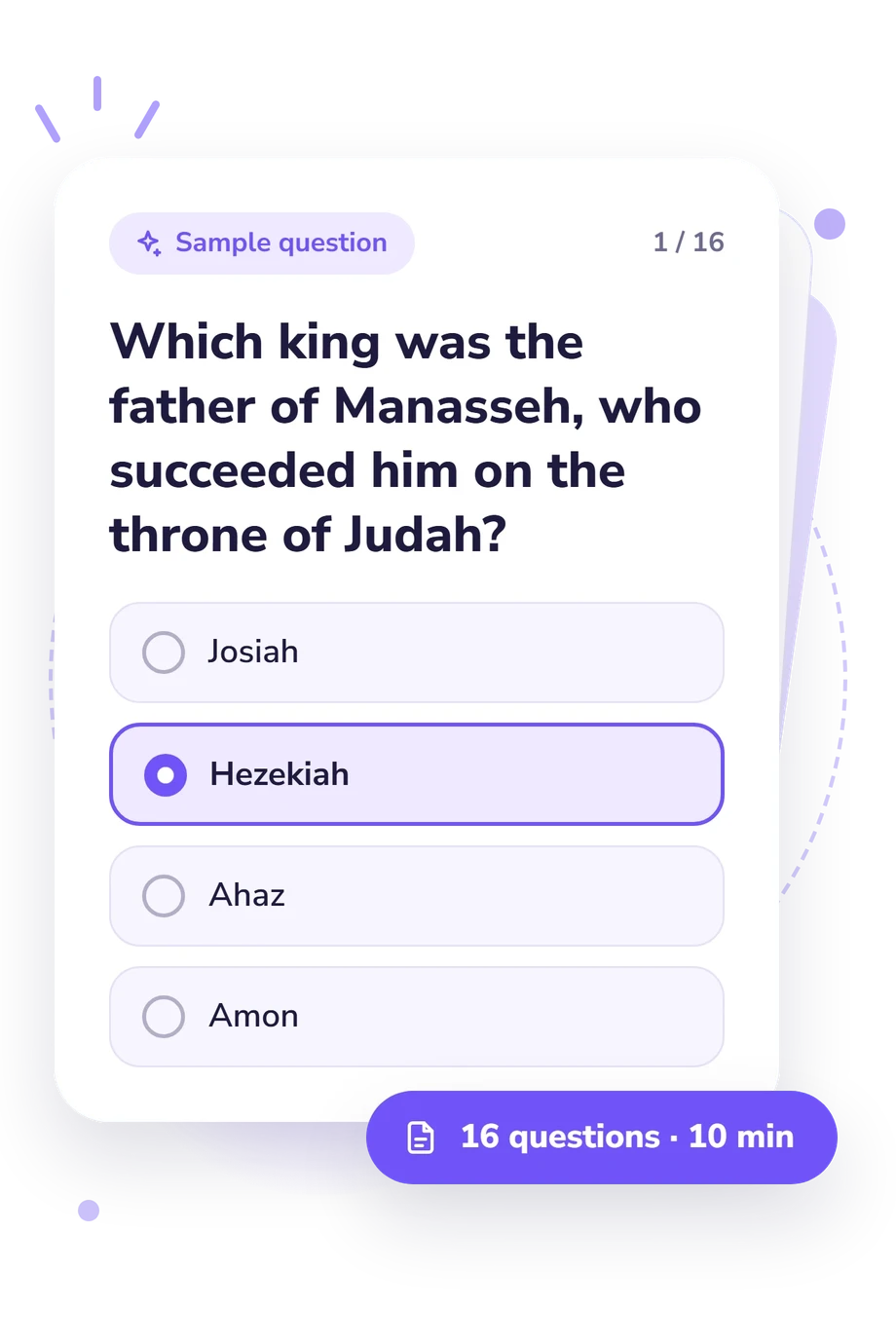
- Josiah
- Hezekiah
- Ahaz
- Amon
- Eli
- Elkanah
- Kish
- Abner
- He asks the disciples to heal her without Jesus
- He falls at Jesus' feet and pleads for help
- He waits at home for Jesus to notice the problem
- He asks Jesus only to send medicine
Fathers in the Bible Quiz - Description and methodology of the test
Readers who want to test their familiarity with biblical family narratives can use the Fathers in the Bible Quiz as a focused knowledge check rather than a measure of faith or personal character. It suits individual reflection, family discussion, church education, or classroom review. At a Father’s Day gathering, the quiz can serve as a fathers day bible quiz, opening a conversation about names, relationships, choices, and memorable scenes.
What This Test Measures
The questions cover father-child relationships, family lines, and memorable decisions or responses in biblical narratives. Some ask the respondent to identify a father from a known genealogy or episode; others test recognition of a father’s compassion, grief, blessing, or loyalty. This makes the assessment relevant to readers revisiting Scripture, teaching a group, or checking their own recall. As a quiz about biblical fathers, it measures themed knowledge and simple narrative interpretation, not parenting ability, faith intensity, or moral character.
The displayed result uses one scale:
- Fathers in the Bible Knowledge: 0-16. Foundation (0-6) indicates recognition of some major figures with several relationships or episodes still unfamiliar; Developing (7-12) reflects solid knowledge of many important fathers and related stories; Strong (13-16) indicates broad, accurate knowledge across family lines and key events in both Testaments.
Methodology and Evidence
Each item presents a short biblical situation or relationship followed by four answer choices. Selecting the best-supported answer requires recognition of names, relationships, and biblical context, plus discrimination among plausible alternatives. The questionnaire reports performance on the displayed scale without documenting additional weighting or an item-level scoring rule.
Conceptually, the questionnaire is consistent with the Bible Knowledge Scale (Krull & McCloy, 2022), a published instrument for assessing biblical knowledge. It is not an adaptation of that instrument. The NRSVue supplies an English reference for the biblical names and episodes, while Jeynes (2009) places Bible literacy within broader educational research without validating this online questionnaire. As a quiz about fathers in Scripture, it should be read as a focused knowledge activity rather than a standardized measure.
Interpret the outcome as performance on selected content rather than a complete measure of biblical literacy. Translation familiarity, prior teaching, memory for names, and guessing can influence it. No standardized norms or reliability estimates are documented for this online questionnaire, so the result is best used to choose topics for further reading or discussion.
- Krull, Douglas S., and Rodney A. McCloy. 2022. "Add to Your Faith Virtue and to Virtue Knowledge: A Bible Knowledge Scale." Journal of Psychology and Christianity 41(2): 106-117.
- National Council of the Churches of Christ in the United States of America. 2021. The Holy Bible: New Revised Standard Version Updated Edition. Friendship Press.
- Jeynes, William H. 2009. "The Relationship Between Bible Literacy and Academic Achievement and School Behavior." Education and Urban Society 41(4): 419-436. 10.1177/0013124508327653
Updated: