
Facts on Aging Quiz
How the Scales are Structured
Who Usually Takes This Test?
See How You Compare
Below is a preview of how scores are typically distributed across each scale.
Example Questions From the Test
- A reasonable prediction based on normal cognitive decline.
- A neutral attempt to match technology with younger workers.
- An appropriate accommodation for all applicants above a certain age.
- Ageism, because an age-based stereotype is replacing assessment of the individual.
- Both should stop because chronological age determines driving safety.
- Both should continue because driving experience offsets age-related changes.
- Each person’s functional abilities, health, and driving performance should be considered.
- Retirement status is the most useful indicator of driving ability.
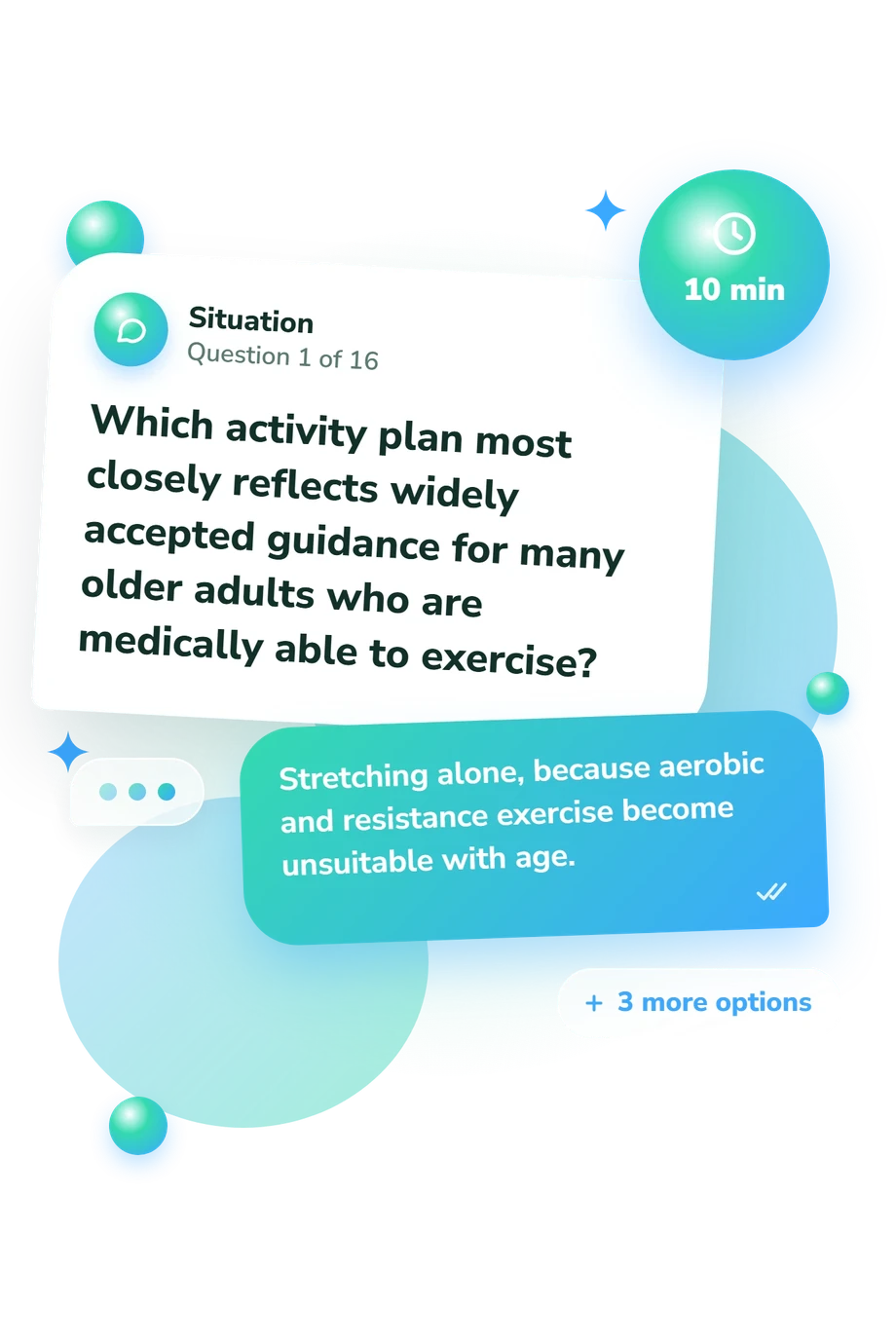
- Stretching alone, because aerobic and resistance exercise become unsuitable with age.
- A tailored mix of aerobic activity, muscle strengthening, and balance work.
- High-intensity exercise every day, regardless of current ability or health conditions.
- Avoiding structured activity and conserving energy for essential daily tasks.
Facts on Aging Quiz - Description and methodology of the test
Readers who want to examine common beliefs about later life can use the Facts on Aging Quiz, an online questionnaire, to distinguish evidence from stereotypes. It suits learners, caregivers, educators, and anyone considering how answers about aging challenge assumptions about health, independence, or relationships. The result supports reflection on those judgments without treating older adults as one profile.
What This Assessment Explores
Rather than measuring age itself, this assessment examines how accurately a respondent interprets situations involving later life. The items ask readers to separate typical variation from stereotypes, notice concerning changes, and weigh function with health and context.
As an educational quiz about aging, it suits people reviewing facts about aging without reducing older adults to one profile. Its themes include:
- Health and safety show whether the respondent recognizes exercise, falls, medicines, sleep, osteoporosis, and sudden confusion.
- Cognition and wellbeing show whether normal variation is separated from assumptions about inevitable dementia or depression.
- Function and independence show whether driving, hearing, learning, and daily ability are judged beyond age.
- Social and intimate life show whether relationships, loneliness, retirement, and adjustment are understood as variable.
Together, these dimensions show whether aging statements are considered in context rather than applied automatically to every person.
Methodology and Scientific Basis
The educational format presents each item as a scenario or statement with four multiple-choice options. The respondent chooses the option that best fits it. The questionnaire displays an educational total on Facts on Aging Knowledge, 0-16, but does not state how individual responses contribute to that total.
The result bands are Emerging knowledge (0-6), Developing knowledge (7-12), and Strong knowledge (13-16). They indicate increasing performance on these items: common myths may persist at the first level, core facts may have gaps at the second, and typical variation may be distinguished from stereotypes and concerning changes at the third. This is an educational score, not a medical assessment. Sudden cognitive or functional changes remain health concerns, regardless of band.
The questionnaire’s content is conceptually consistent with Palmore’s 1977 quiz, but that relationship does not establish that Palmore authored, adapted, or validated the online version. Harris, Changas, and Palmore’s 1996 work offers related multiple-choice context, while Seufert and Carrozza’s 2002 study discusses alternate measures. These studies do not validate this questionnaire or establish population norms.
Because guessing, education, wording, and current context can affect answers, this aging knowledge quiz is most useful for identifying learning priorities.
- Palmore, Erdman. "Facts on Aging: A Short Quiz." The Gerontologist, 17(4), 315-320, 1977. 10.1093/geront/17.4.315
- Harris, Diana K., Paul S. Changas, and Erdman B. Palmore. "Palmore's First Facts on Aging Quiz in a Multiple-Choice Format." Educational Gerontology, 22(6), 575-589, 1996. 10.1080/0360127960220605
- Seufert, Robert L., and Mark A. Carrozza. "A Test of Palmore's Facts on Aging Quizzes as Alternate Measures." Journal of Aging Studies, 16(3), 279-294, 2002. 10.1016/S0890-4065(02)00050-6
Updated: