
Dream Man Quiz
How the Scales are Structured
Who Usually Takes This Test?
See How You Compare
Below is a preview of how scores are typically distributed across each scale.
Example Questions From the Test
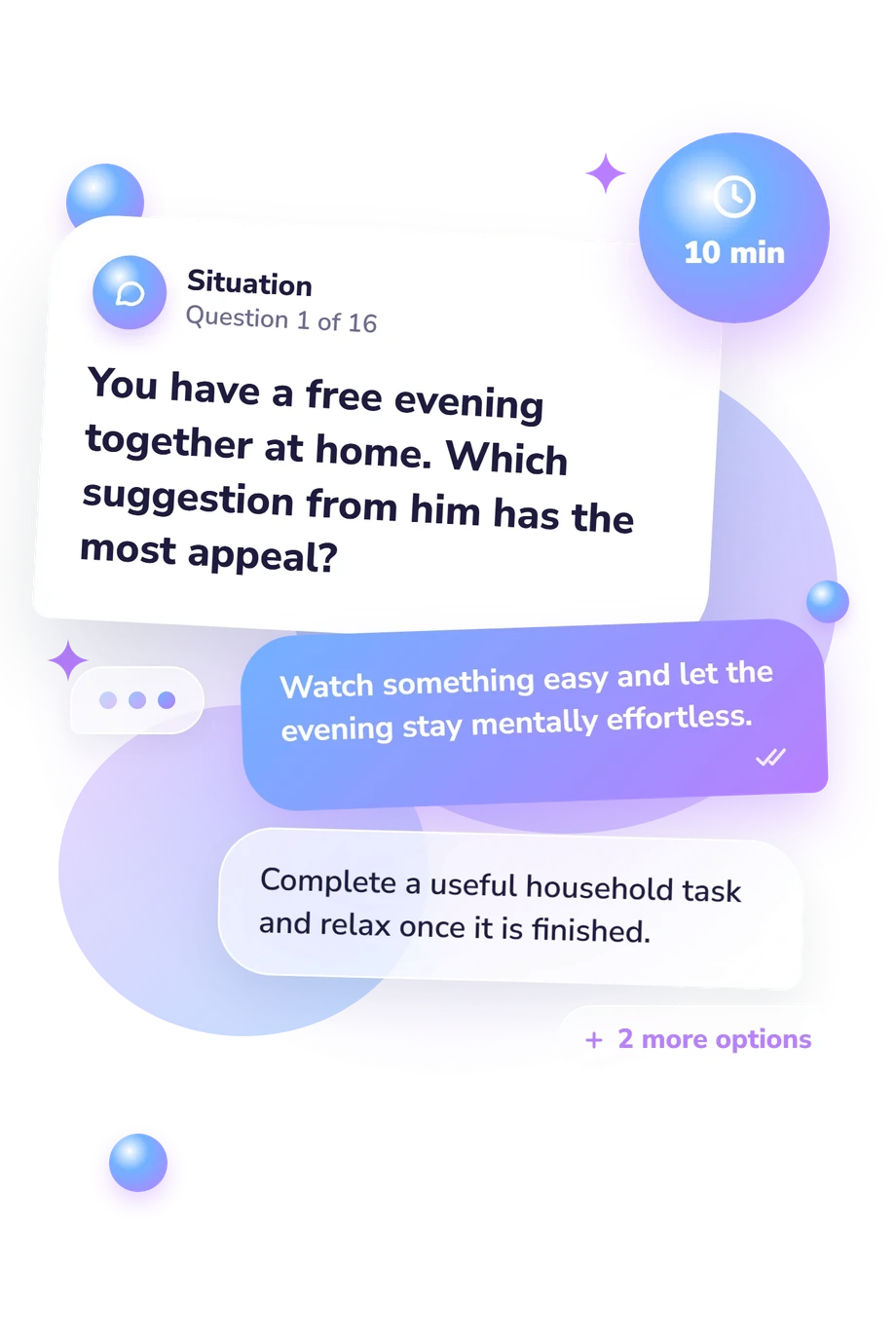
- Watch something easy and let the evening stay mentally effortless.
- Complete a useful household task and relax once it is finished.
- Choose a thoughtful film and talk afterward about what stood out to us.
- Explore a question neither of us fully understands and follow the discussion wherever it leads.
- Bold gestures and spontaneous moments that make ordinary days feel cinematic.
- Quiet, dependable affection expressed in familiar and consistent ways.
- Frequent playful surprises that still reflect my tastes and boundaries.
- Thoughtful gestures attached to birthdays, anniversaries, or planned dates.
- He tells me the full plan early so I know exactly what to expect.
- He arranges an unfamiliar experience and reveals it only when we arrive.
- We choose the main activity together, but he adds one unexpected twist.
- He keeps the details secret but bases the date on something he knows I enjoy.
Dream Man Quiz - Description and methodology of the test
People who want to clarify what they value can use this dream man quiz to translate everyday preferences into a balanced profile. Its result presents your romantic partner preferences as a profile of attraction priorities, showing which relationship qualities matter most to you. The profile is most useful as a prompt for noticing the relationship rhythm and qualities you would genuinely enjoy.
What This Assessment Explores
Everyday relationship situations map the dream partner traits that feel most attractive to you, turning preferences about affection, leisure, surprises, support, disagreement, travel, future planning, and shared routines into a structured profile. The four dimensions are:
- Ambitious Builder (0-12) measures attraction to purpose, long-term goals, and building together; bands: Different Emphasis (0-4), Shared Momentum (5-8), Core Partnership (9-12).
- Romantic Adventurer (0-12) measures attraction to spontaneity, playful romance, and discovery; bands: Occasional Spark (0-4), Active Ingredient (5-8), Defining Spark (9-12).
- Steady Partner (0-12) measures attraction to consistency, calm support, and dependable partnership; bands: Optional Quality (0-4), Meaningful Anchor (5-8), Core Ideal (9-12).
- Thoughtful Intellectual (0-12) measures attraction to curiosity, reflective conversation, and ideas; bands: Complementary Trait (0-4), Valued Connection (5-8), Essential Chemistry (9-12).
These outcomes describe relationship appeal, not a fixed personality type.
Methodology and Scientific Basis
The four-option format makes this a self-report preference profile. Each relationship preference question offers four concrete responses to a situation, and your selected options are aggregated into four displayed scores. The highest score represents your strongest affinity; any outcome within one point of it joins a blended result. No individual answer should be read alone.
Its conceptual basis is consistent with Driebe's 2024 study, which examines how ideals can remain meaningful while changing over time. Fletcher et al.'s 1999 study presents relationship ideals as multidimensional, while Figueredo et al.'s 2006 study links desired partner qualities with personality preferences. The questionnaire is conceptually consistent with these studies but is not identified as an adaptation of their published measures or as validated by them.
The displayed bands describe the catalogue's interpretation of each score range, so the result shows your relative pattern within this questionnaire. Self-report may reflect current mood, recent relationship experiences, and self-image; use the profile to examine preferences alongside real interactions, not as a clinical conclusion.
- Julie C. Driebe, Julia Stern, Lars Penke, and Tanja M. Gerlach (2024). Stability and Change of Individual Differences in Ideal Partner Preferences Over 13 Years. Personality and Social Psychology Bulletin, 50(8), 1263-1279. 10.1177/01461672231164757
- Garth J. O. Fletcher, Jeffry A. Simpson, Geoff Thomas, and Louise Giles (1999). Ideals in intimate relationships. Journal of Personality and Social Psychology, 76(1), 72-89. 10.1037/0022-3514.76.1.72
- Aurelio José Figueredo, Jon Adam Sefcek, and Daniel Nelson Jones (2006). The ideal romantic partner personality. Personality and Individual Differences, 41(3), 431-441. 10.1016/j.paid.2006.02.004
Updated: