
Classical Composer Quiz
How the Scales are Structured
Who Usually Takes This Test?
See How You Compare
Below is a preview of how scores are typically distributed across each scale.
Example Questions From the Test
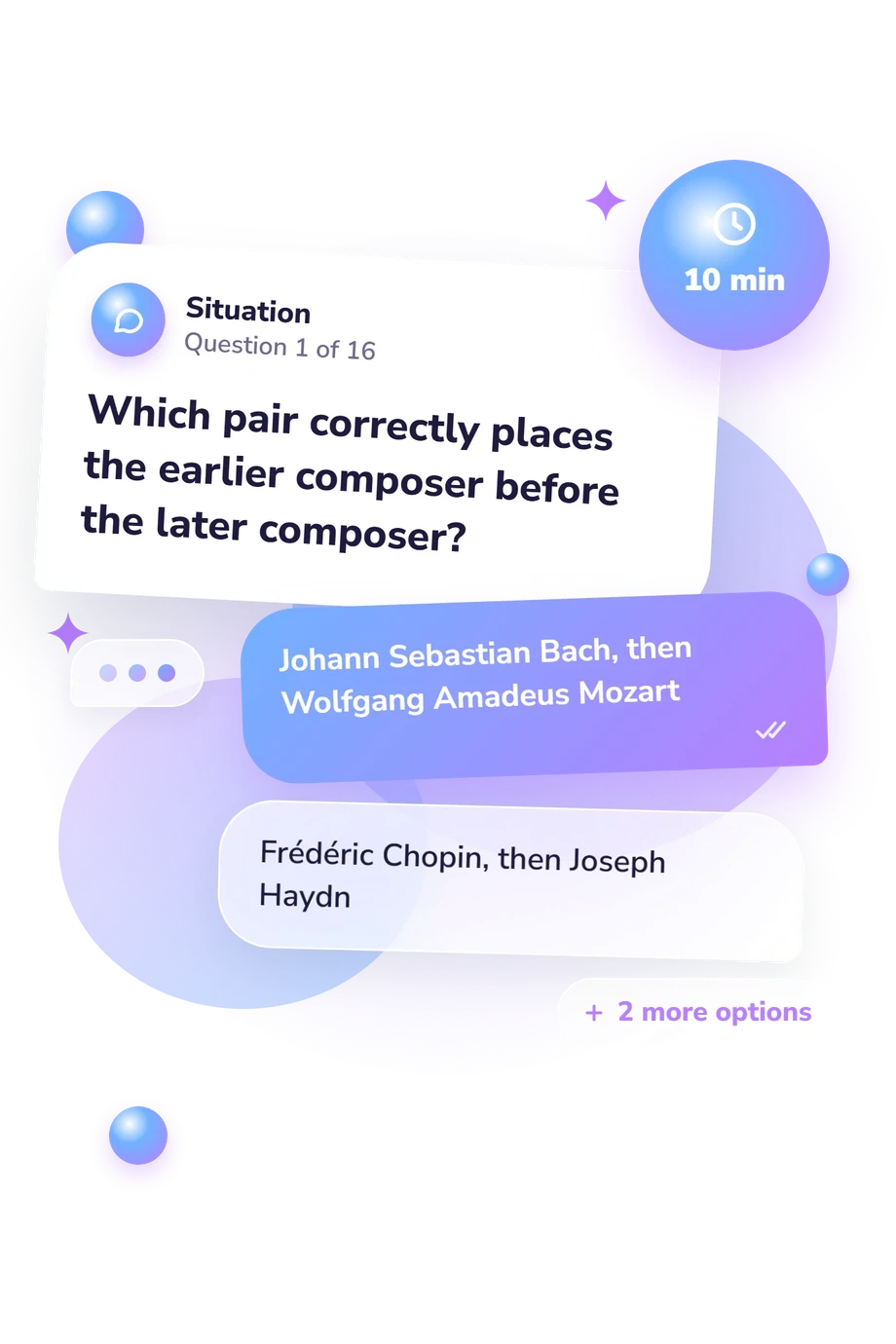
- Johann Sebastian Bach, then Wolfgang Amadeus Mozart
- Frédéric Chopin, then Joseph Haydn
- Claude Debussy, then Ludwig van Beethoven
- Igor Stravinsky, then Johannes Brahms
- Gustav Mahler
- Robert Schumann
- Hugo Wolf
- Franz Schubert
- Pyotr Ilyich Tchaikovsky
- Sergei Prokofiev
- Léo Delibes
- Aram Khachaturian
Classical Composer Quiz - Description and methodology of the test
Listeners who want a focused way to check their grasp of Western art music can use the classical composer quiz as a knowledge exercise rather than a personality test. For curious students, concertgoers, and other listeners, this composer quiz offers a structured way to review familiar names and repertoire. It can guide reflection on how your music-history knowledge has developed and where further study might be rewarding.
What This Assessment Explores
The items measure factual recognition across chronology, repertoire, genre, and musical periods. They use famous motifs, titles, characters, ensembles, and descriptive clues, so this classical music quiz is useful for listeners who want to organize what they already know.
The main knowledge areas represented are:
- Chronology shows whether you can place composers and traditions in historical order.
- Work recognition tests whether a melody, title, or program clue leads to the correct composer.
- Genre and period links show how accurately you connect opera, ballet, symphony, concerto, song, and chamber music with their creators.
The result is reported as Classical Composer Knowledge, with a 0-16 range: Foundations (0-6), Developing Knowledge (7-12), and Strong Knowledge (13-16). These bands describe the breadth and accuracy of your identifications, not musical taste or performance ability.
Methodology and Scientific Basis
Each item presents a music-history prompt with four answer choices. The prompts span chronology, signature works, opera, ballet, symphony, concerto, song, and chamber repertoire; you select the composer that best fits each clue. The displayed result places knowledge in one of the three descriptive bands.
Gammon's 2003 study is the closest subject-specific comparison: it examines music knowledge among secondary music PGCE applicants, or trainee teachers. This questionnaire is conceptually consistent with that emphasis, but is not an adaptation or standardized version. Omar and colleagues' 2010 work offers a cognitive perspective in which music knowledge is organized through links among composers, works, and musical concepts; the quiz uses similar associations without reproducing that instrument.
Because this quiz about classical composers samples familiar repertoire, the result is most useful when you note which clues felt familiar and which required elimination. Prior lessons, concert exposure, cultural familiarity, guessing, and attention can shift results. The displayed result reflects recall of sampled repertoire, not the full depth of musical understanding. This online questionnaire has no population norming; its displayed bands are descriptive categories rather than population norms.
- Gammon, Vic. "The subject general knowledge of secondary music PGCE applicants." British Journal of Music Education, 20(1), 83-99, 2003. 10.1017/S0265051702005235
- Omar, Rohani, Julia C. Hailstone, Jane E. Warren, Sebastian J. Crutch, and Jason D. Warren. "The cognitive organization of music knowledge: a clinical analysis." Brain, 133(4), 1200-1213, 2010. 10.1093/brain/awp345
Updated: