
Hamlet Act 5 Quiz
How the Scales are Structured
Who Usually Takes This Test?
See How You Compare
Below is a preview of how scores are typically distributed across each scale.
Example Questions From the Test
- He is wounded with his own poisoned blade
- He mistakenly drinks from the cup intended for Hamlet
- He is disarmed and arrested by the Danish court
- He escapes the hall but dies before reaching the harbor
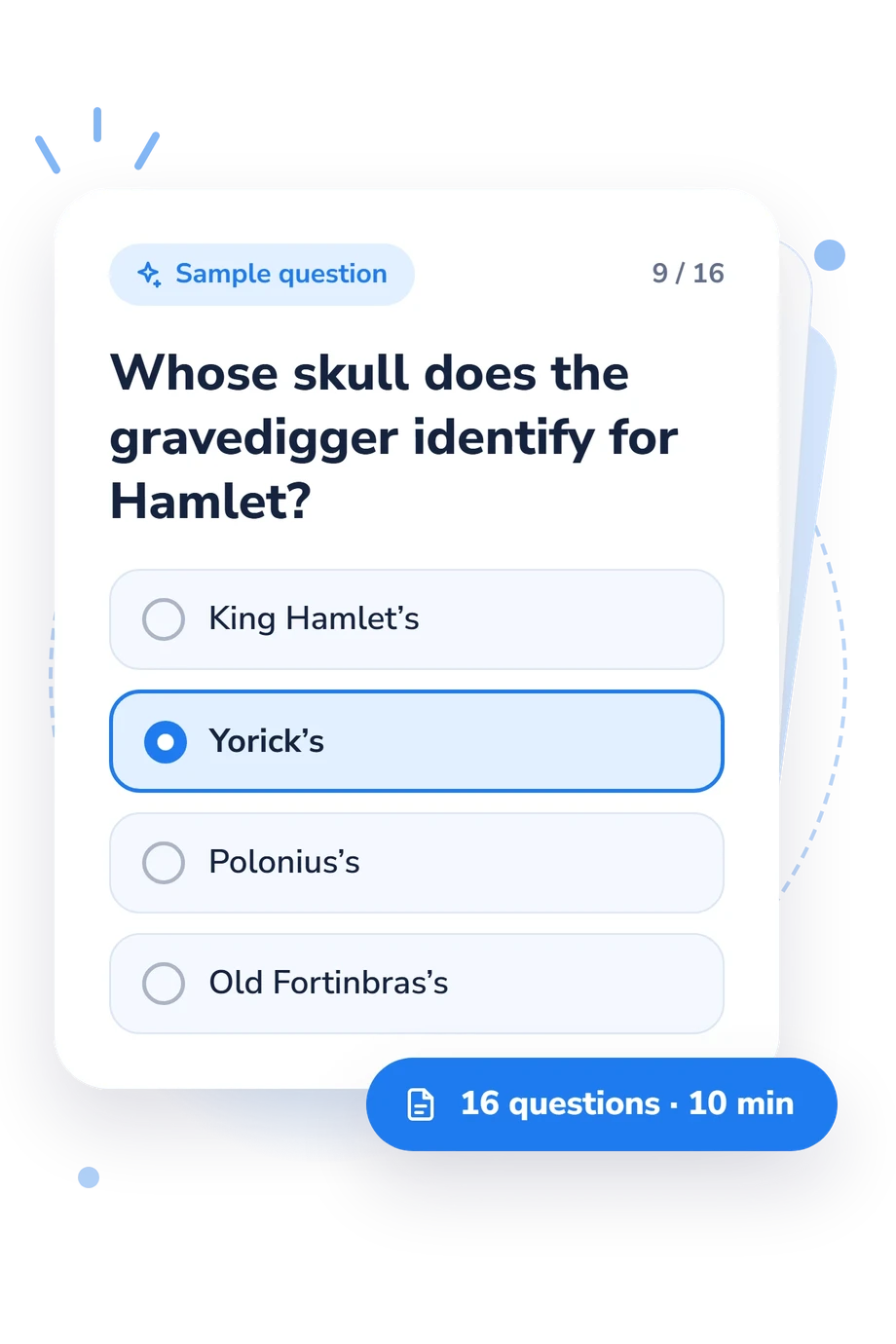
- King Hamlet’s
- Yorick’s
- Polonius’s
- Old Fortinbras’s
- Laertes’s supporters from France
- The Norwegian king and his royal council
- Fortinbras and his forces, returning from Poland
- English soldiers escorting Rosencrantz and Guildenstern
Hamlet Act 5 Quiz - Description and methodology of the test
Readers checking how securely they understand Shakespeare’s final act can use the Hamlet Act 5 Quiz as a focused literature assessment. It is suited to students, teachers, and independent readers revisiting plot, character motives, imagery, and the political consequences of Hamlet’s death. As a hamlet act v quiz, it emphasizes connected comprehension, helping identify which scenes or relationships merit closer reading.
What This Assessment Explores
Act 5 brings together the play’s treatment of death, Ophelia’s burial, Hamlet’s changed resolve, the fencing plot, and Fortinbras’s arrival. Questions in this Hamlet Act 5 knowledge test ask readers to connect events with motives and themes rather than recall isolated details.
The questions therefore organize understanding around four connected areas:
- The gravedigger scene tests whether you recognize its legal, religious, and philosophical questions about death.
- Ophelia’s burial checks how well you connect grief, ritual, and Hamlet’s confrontation with Laertes.
- The duel examines whether you can follow Claudius and Laertes’s lethal design and its chain of consequences.
- Fortinbras’s arrival measures your understanding of succession, public honor, and Hamlet’s political meaning.
The displayed scale is Hamlet Act 5 Knowledge (0-16), with Foundation to revisit (0-6), Developing command (7-12), and Strong command (13-16).
Methodology and Evidence Base
Each item presents a scene, action, motive, or interpretive issue followed by four answer choices. The respondent selects the option that best fits the play. The displayed result is reported through the scale’s three bands, which distinguish levels of command across the complete Act 5 question set; the weighting of individual answers is not specified. A Hamlet Act 5 study quiz therefore combines close reading with recall without requiring the reader to reproduce quotations.
Content is anchored in Shakespeare’s Hamlet, Act 5, and is consistent with the Thompson-Taylor edition and G. R. Hibbard’s edition. Lawrence’s study offers a closely related discussion of Fortinbras’s role and the ending’s political implications. The questionnaire is conceptually consistent with this literary material and is not an adaptation of either edition or Lawrence’s study.
Interpretation uses the displayed bands: the result describes performance on this Act 5 question set rather than overall literary ability. Memory, attention, prior study, and an individual reading of ambiguous dramatic moments can also affect performance on questions about the gravediggers, the duel, succession, and the play’s final resolution.
- Shakespeare, William. Hamlet: Revised Edition. Edited by Ann Thompson and Neil Taylor. The Arden Shakespeare Third Series. Bloomsbury Publishing, 2016.
- Shakespeare, William. Hamlet. Edited by George Richard Hibbard. The Oxford Shakespeare. Clarendon Press, 1987.
- Lawrence, William Witherle. “Hamlet and Fortinbras.” PMLA, vol. 61, no. 3, 1946, pp. 673-698. 10.1632/459241
Updated: