
Ohm's Law Quiz
How the Scales are Structured
Who Usually Takes This Test?
See How You Compare
Below is a preview of how scores are typically distributed across each scale.
Example Questions From the Test
- Voltage equals current divided by resistance.
- Voltage equals current multiplied by resistance.
- Current equals voltage multiplied by resistance.
- Resistance equals current multiplied by voltage.
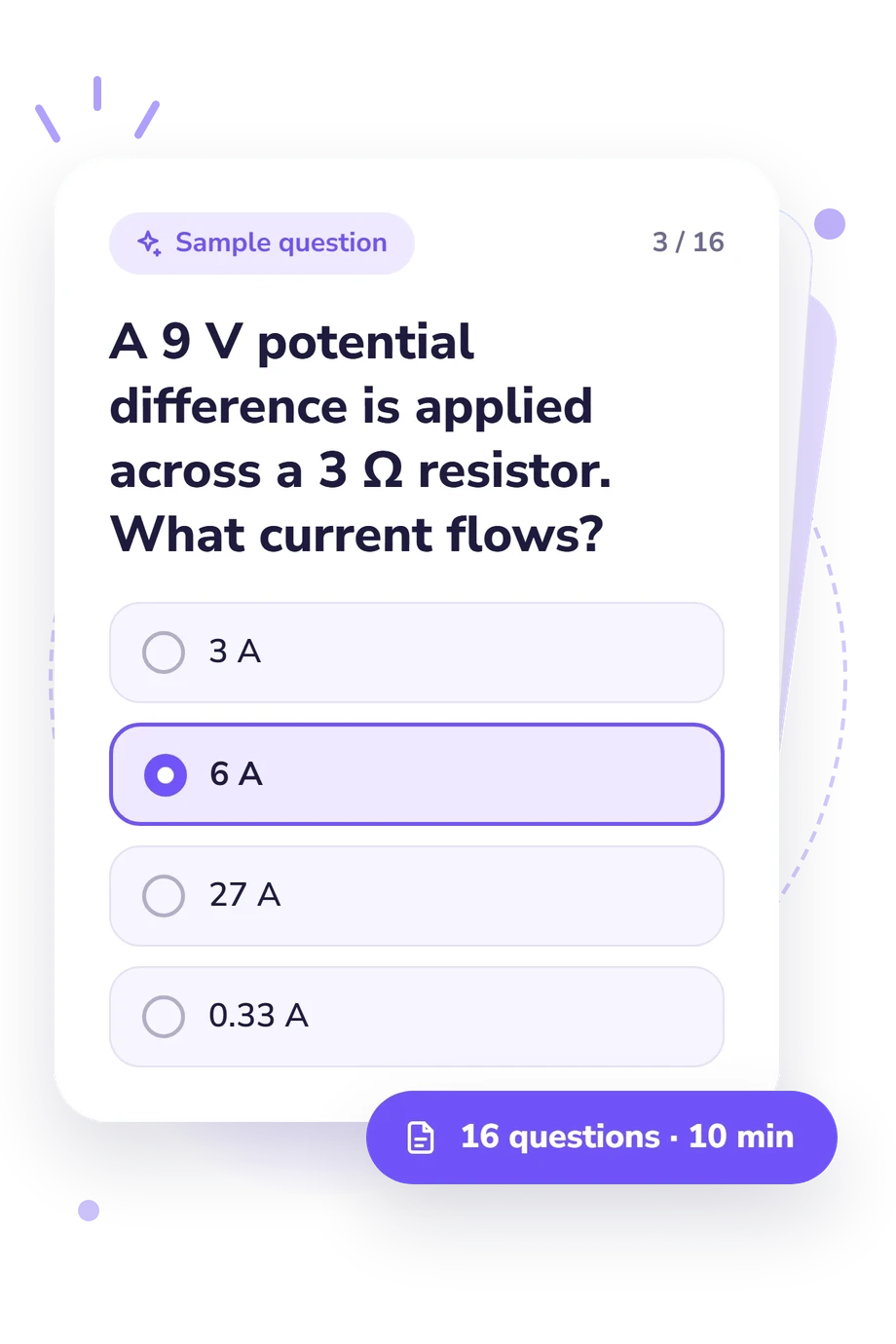
- 3 A
- 6 A
- 27 A
- 33 A
- 30 Ω
- 2 Ω
- 8 Ω
- 033 Ω
Ohm's Law Quiz - Description and methodology of the test
Students, hobbyists, and anyone revising introductory circuit theory can use the Ohm's Law Quiz to check whether voltage, current, and resistance work as a connected system rather than isolated definitions. The result from this ohm's law knowledge test gives an overall band and points to broad topics such as calculation and circuit reasoning, without identifying exactly which skills were missed before further study or practical work.
What This Assessment Measures
This assessment checks practical use of Ohm's law in ordinary circuit situations. Items cover V = IR, units, rearrangement, current, voltage, resistance, power, graphs, filament behavior, and series-versus-parallel connections.
Across the ohm's law questions, three connected areas recur:
- Equations and quantities show whether you connect voltage, current, resistance, and power.
- Graphs and components show whether you recognize voltage-current slope and heating-related non-ohmic behavior.
- Circuit applications show whether you can reason about series current, parallel voltage, meter placement, and low-resistance paths.
The reported scale is Ohm's Law Knowledge (0-16). Emerging foundations (0-6) calls for review of meanings, units, and substitution; Developing knowledge (7-12) shows many essentials with gaps in rearranging, graphs, or applications; Strong knowledge (13-16) indicates reliable use in common circuit situations.
Methodology and Evidence Base
Each item presents a physics question with four answer choices. You select the option fitting the relationship or calculation, combining conceptual recognition with numerical application. One point is awarded per correct answer, producing a total of 0-16. The score bands summarize performance on this questionnaire and should not be presented as population comparisons.
The content is conceptually consistent with Ohm's law, which links potential difference, current, and resistance under defined conditions. It also aligns with the introductory treatment of current, resistance, power, graphs, and simple series and parallel circuits in Urone and Hinrichs. The questionnaire is not presented as an adaptation of either published work.
The assessment offers a revision knowledge check through an ohm's law practice quiz format, but its score is best read as a snapshot of accuracy. Performance may reflect prior teaching, recent practice, guessing, or difficulty with particular wording. The format tests selected multiple-choice conceptual and numerical reasoning rather than every aspect of laboratory measurement or real circuit construction, so missed items are most useful when reviewed through the relevant equation, unit, or circuit principle.
- Ohm, Georg Simon. The Galvanic Circuit Investigated Mathematically. T. H. Riemann, 1827. 10.5479/sil.354716.39088005838644
- Urone, Paul Peter, and Roger Hinrichs. College Physics 2e. OpenStax, 2022, Chapter 20: Introduction to Electric Current, Resistance, and Ohm's Law.
Updated: