
Emoji Bible Quiz
How the Scales are Structured
Who Usually Takes This Test?
See How You Compare
Below is a preview of how scores are typically distributed across each scale.
Example Questions From the Test
- The Lost Sheep
- The Unforgiving Servant
- The Prodigal Son
- The Talents
- Pentecost
- Elijah's sacrifice on Mount Carmel
- The Tower of Babel
- The Transfiguration
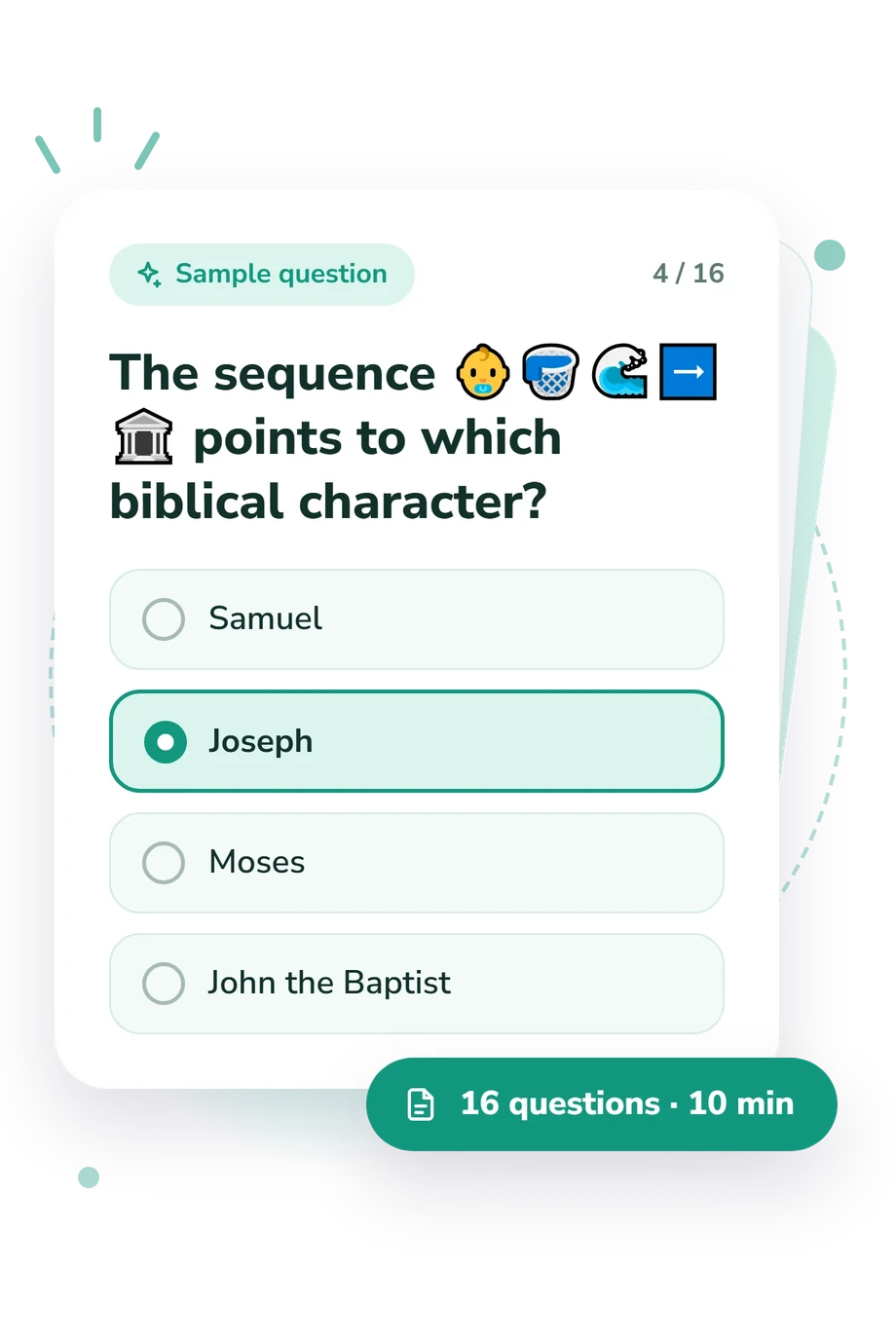
- Samuel
- Joseph
- Moses
- John the Baptist
Emoji Bible Quiz - Description and methodology of the test
People who enjoy visual learning can use this assessment to revisit Scripture in a playful, low-pressure format. The emoji bible quiz is intended for readers who want a practical way to check their recall and decide whether to spend more time studying biblical material. Reviewing emoji-based Bible quiz answers afterward can support personal study or discussion. The result is educational rather than a measure of faith.
What This Test Measures
These clues sample recognition of biblical people, events, parables, teachings, and narrative details from both the Old and New Testaments. A reader taking this Bible emoji test is asked to connect a compact visual sequence with the scriptural context that best explains it, rather than recall a quotation word for word. The result reflects how readily familiar material can be identified from abbreviated cues.
The Bible Knowledge scale is scored from 0-16 and is reported through three educational bands:
- Foundations to Build (0-6) indicates recognition of some biblical themes while major characters and narratives remain useful targets for review.
- Developing Knowledge (7-12) indicates that many familiar passages and several symbol-to-context links are recognized.
- Strong Knowledge (13-16) indicates consistent interpretation of clues about characters, events, parables, and teachings.
Methodology and Evidence Base
Each item presents an emoji sequence and four answer choices. The respondent selects the person, story, event, parable, or teaching that best matches the clue. The total is reported through the displayed result bands; the questionnaire defines no additional weighting or point-allocation rule beyond the recorded score.
Conceptually, the questionnaire is consistent with the Bible Knowledge Scale, especially its emphasis on recognizing biblical content and connecting knowledge with scriptural references. It is not presented as an adaptation, revalidation, or standardized administration of that published instrument. A related adult Bible-knowledge study provides context for assessing Bible knowledge among adults, but its sample and procedures do not establish norms for this online questionnaire.
As a Bible knowledge quiz, it is best read as a focused educational snapshot. Performance can be affected by emoji ambiguity, translation choices, prior religious education, memory, attention, or guessing. The score can guide further reading or discussion, but it cannot represent comprehensive biblical knowledge or faith commitment, and it should not be treated as a diagnosis.
- Krull, Douglas S., and Rodney A. McCloy. “Add to Your Faith Virtue and to Virtue Knowledge: A Bible Knowledge Scale.” Journal of Psychology & Christianity, vol. 41, no. 2, 2022, pp. 106-117.
- Gourlay, Kenneth H. “An Assessment of Bible Knowledge among Adult Southern Baptist Sunday School Participants.” Christian Education Journal: Research on Educational Ministry, vol. 10, no. 1, 2013, pp. 7-29. 10.1177/073989131301000102
Updated: