
Einstein Quiz
How the Scales are Structured
Who Usually Takes This Test?
See How You Compare
Below is a preview of how scores are typically distributed across each scale.
Example Questions From the Test
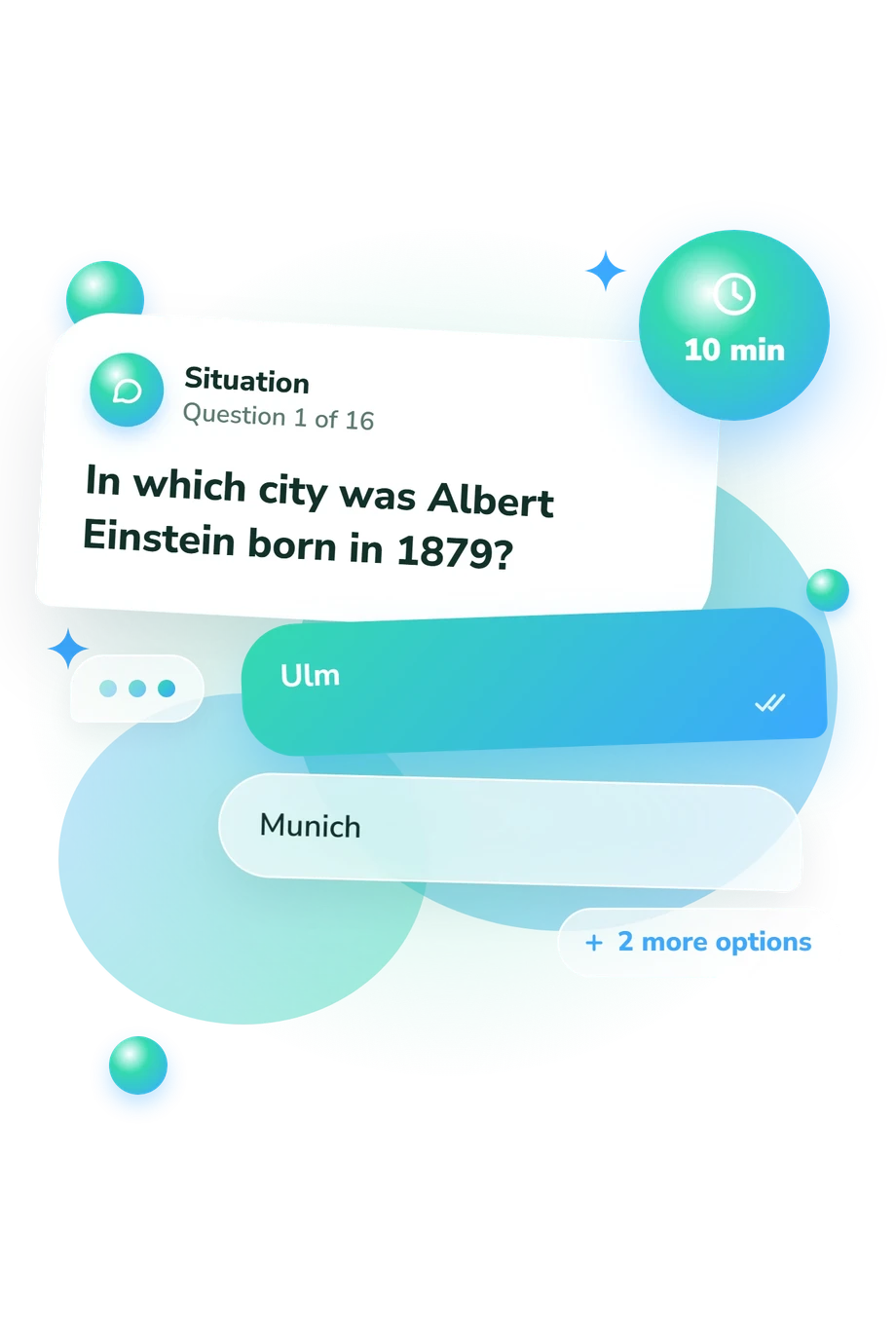
- Ulm
- Munich
- Bern
- Princeton
- France
- The United Kingdom
- The United States
- Belgium
- His prediction of gravitational waves
- His formulation of general relativity
- His explanation of the law of the photoelectric effect
- His mass-energy equation alone
Einstein Quiz - Description and methodology of the test
Readers seeking a structured way to revisit Einstein’s life and physics can use the Einstein Quiz to test whether familiar facts connect with the ideas behind them. Its quiz questions about Einstein cover biography, relativity, quantum theory, and scientific legacy, helping a learner see which areas feel secure and which deserve review. It suits curious learners, students, and anyone studying the subject independently.
What This Assessment Explores
The assessment combines factual recall with conceptual recognition. Items cover Einstein’s life, work, music, public decisions, and scientific debates, then connect observations with relativity, gravitation, atoms, light, time, and cosmology. The assessment’s biographical and scientific content makes its Einstein trivia quiz format useful for learning.
The result shows current knowledge, not intelligence.
The main thematic groups are:
- Biography and context show how well you recall key events, institutions, and choices.
- Relativity and gravitation indicate whether spacetime, light, acceleration, and time fit together.
- Quantum and atomic ideas measure recognition of the photoelectric effect, Brownian motion, probability, and EPR.
- Legacy and cultural detail reflect knowledge of influence, correspondence, instruments, and formulations.
Einstein Knowledge runs from 0-16: Foundations Forming (0-6) signals emerging familiarity; Developing Knowledge (7-12) reflects a solid, connected base; Strong Command (13-16) reflects broad, accurate knowledge of Einstein’s biography, theories, and legacy.
Methodology and Scientific Basis
Each item presents a factual or conceptual prompt with four answer choices. Selecting the correct option adds one point, so the final result is a raw count of correct responses. Questions ask about biography, landmark papers, and interpretations of ideas such as relativity, quantum probability, and the photoelectric effect.
The questionnaire tests knowledge of Einstein through educational content, using an Einstein knowledge quiz format. Pais (1982) provides the historical and scientific frame for the biographical coverage and for topics such as relativity, Brownian motion, and quantum debates. Einstein’s 1905 papers, his account of relativity, and the EPR paper supply primary context for the ideas tested. The questionnaire is conceptually consistent with these works, but it is not an adaptation of them.
These works establish subject matter for the questions. The questionnaire’s displayed bands are performance levels for these questions; higher results reflect correct recognition across biography, theories, and scientific legacy. Results can vary with prior study, language, memory, and current context, so the score is most useful for choosing topics to review.
- Abraham Pais, Subtle Is the Lord: The Science and the Life of Albert Einstein. Oxford University Press, 1982.
- Albert Einstein, Einstein's Miraculous Year: Five Papers That Changed the Face of Physics, edited and introduced by John Stachel. Princeton University Press, 1998.
- Albert Einstein, Relativity: The Special and the General Theory. Methuen and Co., 1920.
- Albert Einstein, Boris Podolsky, and Nathan Rosen, Can Quantum-Mechanical Description of Physical Reality Be Considered Complete? Physical Review 47(10), 777-780, 1935. 10.1103/PhysRev.47.777
Updated: