
How Midwestern Are You Quiz
How the Scales are Structured
Who Usually Takes This Test?
See How You Compare
Below is a preview of how scores are typically distributed across each scale.
Example Questions From the Test
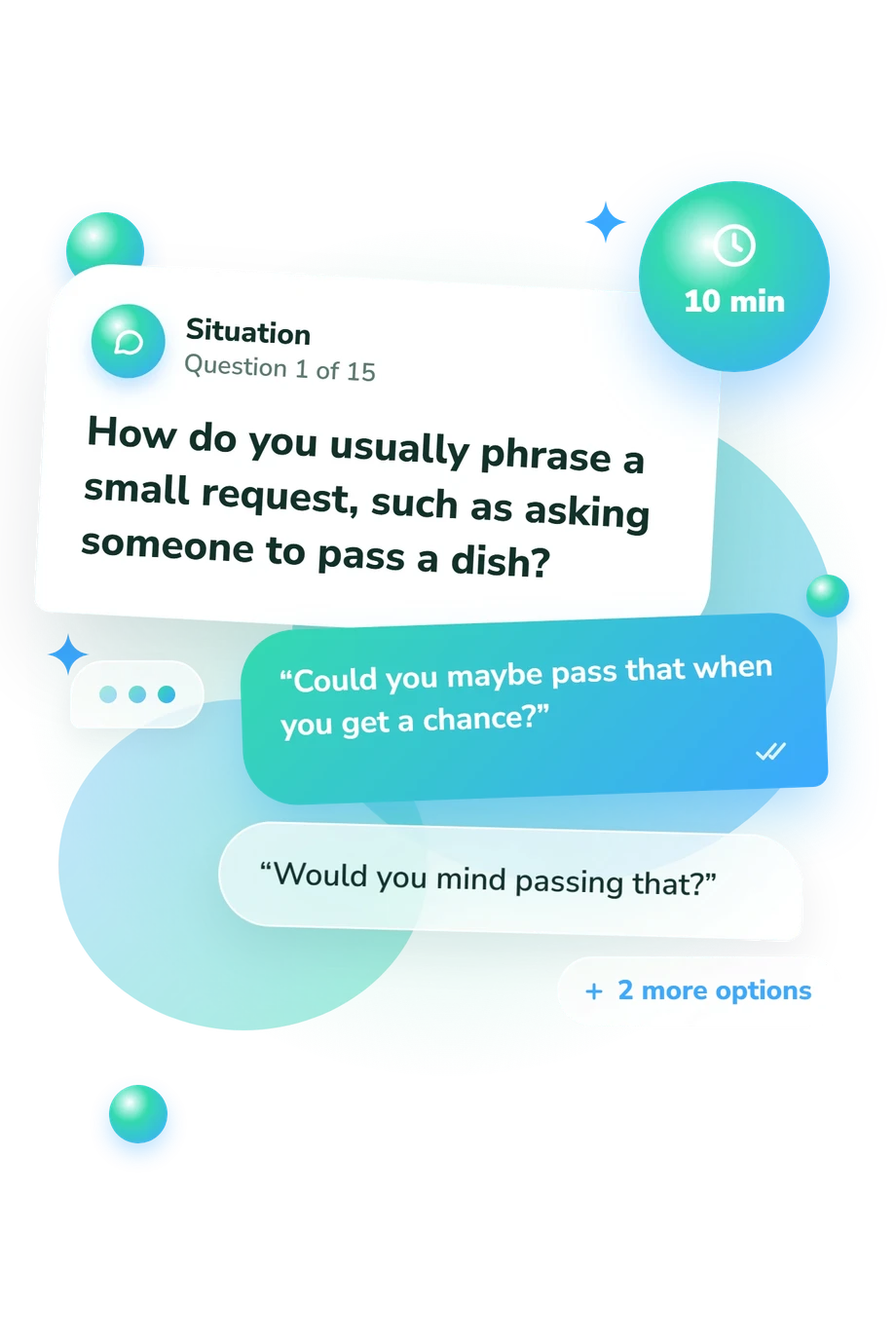
- “Could you maybe pass that when you get a chance?”
- “Would you mind passing that?”
- “Please pass that.”
- “Pass that over, thanks.”
- I wish them well but usually do not participate
- I make a small contribution if the cause connects with me
- I attend or buy something to support the event
- I volunteer, contribute supplies, or encourage others to join me
- “Ope—sorry! Let me scoot past you here.”
- A quick “Sorry” while moving the cart
- A smile or nod as I make room
- I quietly move the cart out of the way
How Midwestern Are You Quiz - Description and methodology of the test
People considering this regional self-reflection quiz may find the questionnaire useful when they want to examine everyday exchanges, local participation, and responses to food, weather, or familiar places. The How Midwestern Are You Quiz organizes those situations into three dimensions, helping respondents notice how they phrase requests, handle small social rituals, engage in local participation, and respond to seasonal change. Its result gives those observations a structure for personal reflection.
What This Assessment Explores
This questionnaire examines conversational habits, community habits, and seasonal associations resembling patterns linked with parts of the Midwest. It focuses on lived situations, not geography or trivia. Its topics connect interaction style with reciprocity, food, weather, and local reference points, placing everyday choices in the context of Midwest regional traditions.
Three result dimensions are:
- Conversational Style (0-15) reflects conversational habits, not politeness: Different cadence (0-5) is concise, Familiar notes (6-10) adds softening or small talk, and Strong resonance (11-15) makes rituals prominent.
- Neighborly Reciprocity (0-15) reflects local exchange: Independent approach (0-5) favors self-sufficiency, Selective connection (6-10) shows situational participation, and Strong reciprocity (11-15) shows recurring favors.
- Regional Routines and Place (0-15) reflects food, weather, and place, not factual knowledge: Personal traditions (0-5) are less tied, Partial resonance (6-10) feels partly familiar, and Strong resonance (11-15) shapes experience.
Methodology and Evidence Base
Each item offers four ordered response choices, moving from less to more resonance with the situation described. Prompts cover requests, apologies, directions, potlucks, weather talk, departures, borrowed dishes, snow, neighborly help, newcomers, seasonal change, and regional food. Results appear on three displayed scales; their bands describe the response pattern, without implying an unstated point value.
Cayton and Gray (2001) provide regional-history context; Homan (2025) frames “Midwest Nice” as socially situated; Shortridge (2003) supports attention to regional food traditions; and Rentfrow et al. (2013) describe broader psychological regions. The questionnaire is conceptually consistent with these works, not a direct adaptation or administration of any one source.
In this online self-report format, the result functions as an online regional self-reflection profile. The displayed bands are descriptive categories for the pattern represented by your answers, not a ranking against a representative Midwestern sample. Self-presentation, current context, memory, and familiarity with local customs can shape responses, so treat the result as a reflection prompt rather than a diagnosis.
- Cayton, Andrew R. L., and Susan E. Gray, eds. (2001). The American Midwest: Essays on Regional History. Bloomington: Indiana University Press.
- Homan, Emilie. (2025). “Kill ’em with Kindness”: Midwest Nice as a Mechanism of Whiteness. Education Sciences, 15(2), 145. DOI 10.3390/educsci15020145
- Shortridge, Barbara G. (2003). Not Just Jello and Hot Dishes: Representative Foods of Minnesota. Journal of Cultural Geography, 21(1), 71-94. DOI 10.1080/08873630309478267
- Rentfrow, Peter J., Samuel D. Gosling, Markus Jokela, David J. Stillwell, Michal Kosinski, and Jeff Potter. (2013). Divided We Stand: Three Psychological Regions of the United States and Their Political, Economic, Social, and Health Correlates. Journal of Personality and Social Psychology, 105(6), 996-1012. DOI 10.1037/a0034434
Updated: