
Rational Expressions Quiz
How the Scales are Structured
Who Usually Takes This Test?
See How You Compare
Below is a preview of how scores are typically distributed across each scale.
Example Questions From the Test
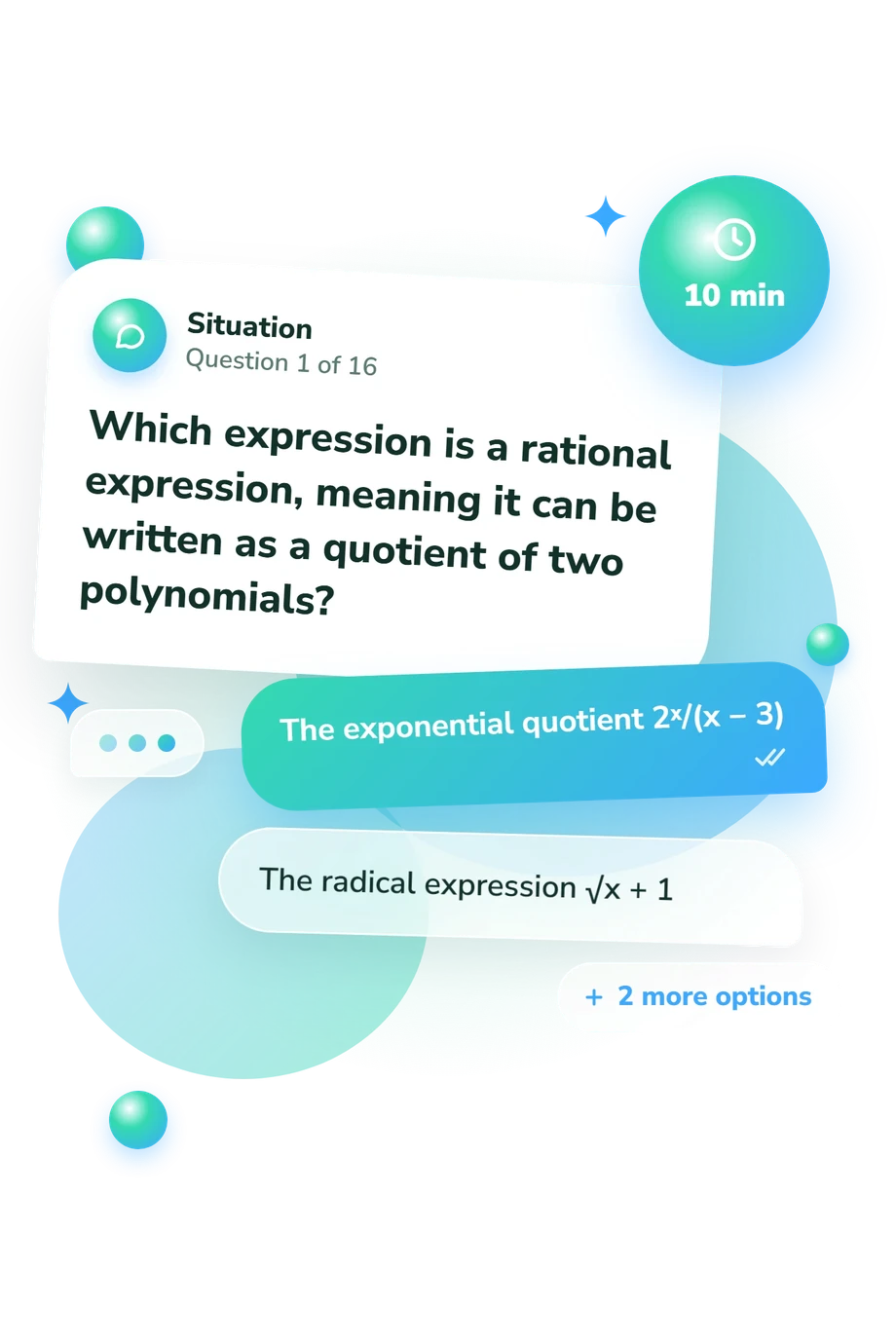
- The exponential quotient 2ˣ/(x − 3)
- The radical expression √x + 1
- The polynomial quotient (x² − 4)/(x + 1)
- The radical-denominator expression 1/(√x − 1)
- (5x + 2)/[x(x + 1)]
- 5/[x(x + 1)]
- 5/(2x + 1)
- (5x + 3)/[x(x + 1)]
- x²(x − 2)(x + 2), which repeats the factor x
- x(x − 2), which omits the factor x + 2
- x(x² − 4)(x − 2), which repeats the factor x − 2
- x(x − 2)(x + 2), containing each distinct factor once
Rational Expressions Quiz - Description and methodology of the test
Designed for learners who want to check their algebra foundations, the rational expressions quiz examines whether you can work with fractions whose numerators and denominators are polynomials. It suits students reviewing classwork and independent learners checking a specific skill set. The result can guide algebraic fractions practice by showing which kinds of reasoning are secure and where further work may help.
What This Assessment Explores
Rational expressions involve more than cancelling factors: restrictions, common denominators, equation solving, and graphical meaning must stay connected. This assessment suits learners revising algebra or checking those skills. Its mix of foundational and multi-step items makes it useful as a rational expressions practice test when a wrong choice points to a reasoning gap.
The question themes cover four areas:
- Identifying structure shows whether you recognize rational expressions and factors that create restrictions.
- Performing operations measures how you combine, simplify, multiply, divide, and evaluate them.
- Solving equations shows whether you preserve excluded values while finding permissible solutions.
- Interpreting graphs and applications checks your understanding of holes, asymptotes, and formulas in context.
The reported scale is Rational Expressions Knowledge (0-16): Foundation Building (0-6), Developing Command (7-12), or Strong Command (13-16). It summarizes performance across connected skills rather than naming a permanent ability.
Methodology and Scientific Basis
Each item presents a problem with four answer options. The questions move among definitions, symbolic operations, restrictions, equations, graph features, and an average-cost application, so performance depends on both procedure and validity conditions. The questionnaire reports a single total, but the point contribution of each selected answer is not documented; no finer point rule should be assumed.
As a rational expressions assessment, it is conceptually consistent with Ruhl, Belward and Balatti (2011) on common simplification errors and Yantz (2013) on links between algebraic rational expressions and rational numbers. Eccius-Wellmann, Brofman-Epelbaum and Corona (2025) contributes a visual-attention perspective on algebraic-fraction simplification, while OpenStax College Algebra 2e states the standard rules used for factoring, restrictions, operations, equations, and graphs. These sources support the content domains; they do not make this quiz an adaptation of any one published instrument.
Read the result as an educational snapshot rather than a standardized, norm-referenced measure for this exact version. Recent instruction and familiarity with multiple-choice formats may affect performance, while selected answers do not reveal how you arrived at them, so the result may miss differences in underlying reasoning; use the score to select practice topics and verify them by solving and explaining problems independently.
- Ruhl, K.A., Belward, S.R., and Balatti, J. (2011). A Systematic Analysis of Errors in the Simplification of a Rational Expression. In Proceedings of the Eighth Southern Hemisphere Conference on Teaching and Learning Undergraduate Mathematics and Statistics, Rotorua, New Zealand, pp. 314-321.
- Yantz, Jennifer. (2013). Connected Representations of Knowledge: Do Undergraduate Students Relate Algebraic Rational Expressions to Rational Numbers? Mid-Western Educational Researcher, 25(4), 47-61.
- Eccius-Wellmann, Cristina, Jacobo José Brofman-Epelbaum, and Violeta Corona. (2025). Eye Tracking Characterization of Algebraic Fraction Simplifications. Education Sciences, 15(12), 1710. 10.3390/educsci15121710.
- Abramson, Jay. (2021). College Algebra 2e. Houston, TX: OpenStax.
Updated: