
Hindi Quiz
How the Scales are Structured
Who Usually Takes This Test?
See How You Compare
Below is a preview of how scores are typically distributed across each scale.
Example Questions From the Test
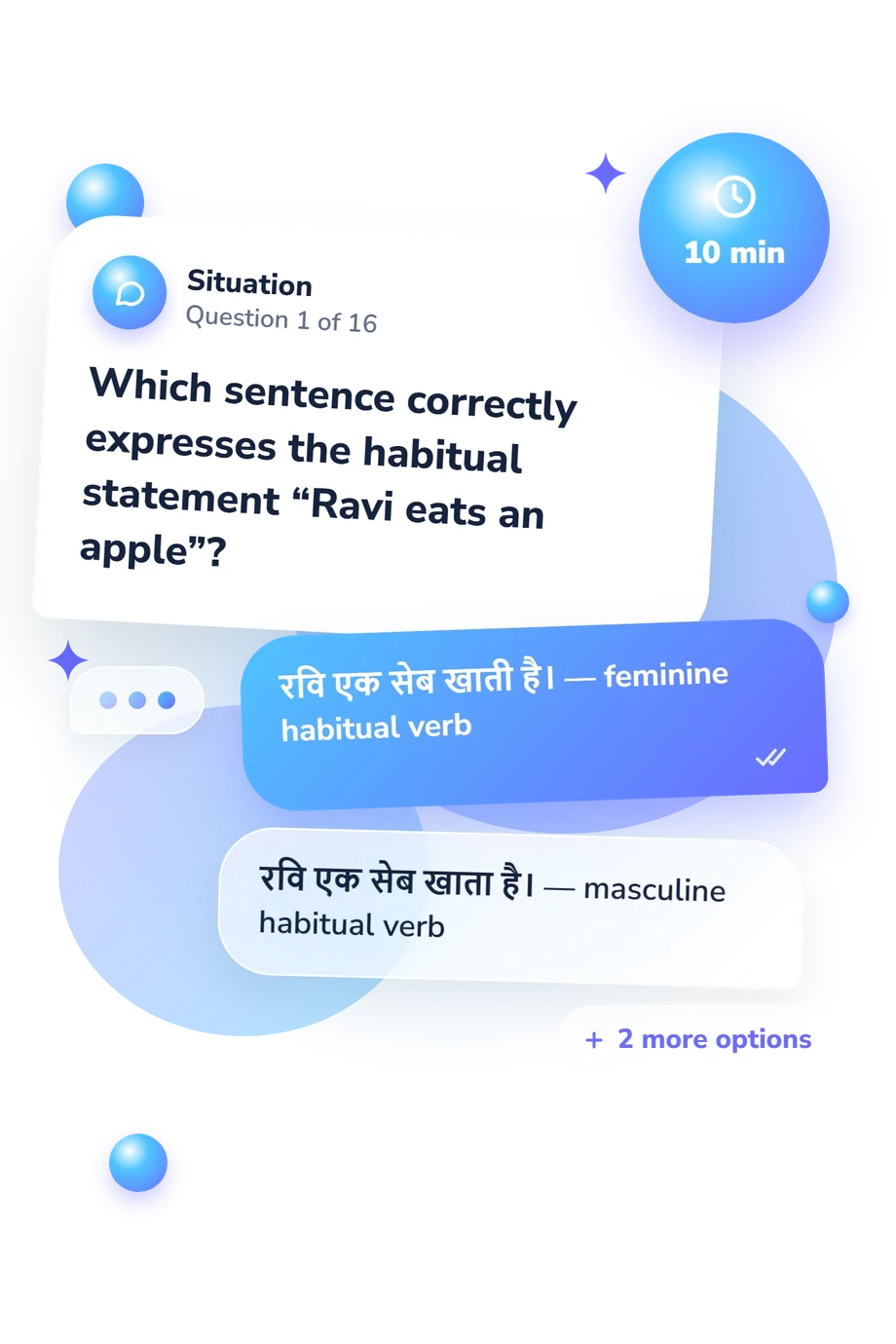
- रवि एक सेब खाती है। — feminine habitual verb
- रवि एक सेब खाता है। — masculine habitual verb
- रवि एक सेब खा रहा था। — past continuous action
- रवि ने एक सेब खाया। — completed past action
- The book is moving away from the table.
- The book is beneath the table.
- The book is on the table.
- The book belongs to the table.
- नेहा हर दिन गाता है। — masculine habitual form
- नेहा हर दिन गाती है। — feminine habitual form
- नेहा ने हर दिन गाया। — completed past form
- नेहा हर दिन गा रही थी। — past continuous form
Hindi Quiz - Description and methodology of the test
People beginning or continuing Hindi study can use this Hindi quiz to check recognition of written forms and meanings used in everyday situations. Its focus is on recognizing useful patterns rather than producing a formal proficiency profile. This quiz on the Hindi language helps learners notice whether grammar, vocabulary, Devanagari recognition, or comprehension deserves more attention. The result can guide independent practice.
What This Assessment Explores
The questionnaire samples foundational Hindi through meaning, grammar, script, and practical usage. This Hindi language quiz asks learners to distinguish forms such as gender agreement, postpositions, tense, comparisons, directions, and routine requests.
The single reported scale is Hindi Knowledge: 0-16. Its bands are Foundations to Build (0-6), Developing Knowledge (7-12), and Strong Foundational Knowledge (13-16). The bands describe increasing command of the basics sampled here, while the highest band explicitly remains a snapshot rather than a complete fluency measure.
The following four areas describe the content sampled by the questions, not separate scores:
- Vocabulary and meaning items show recognition of common words and expressions.
- Grammar and agreement items show whether forms fit gender, number, tense, and context.
- Devanagari items link written characters with sounds or meanings.
- Everyday comprehension items cover requests, directions, possession, time, and cause.
Methodology and Evidence Base
Each item presents a Hindi sentence, word, Devanagari character, or everyday situation with four answer choices. The options test recognition of meaning, gender and number agreement, tense, comparison, postpositions, polite requests, directions, and other practical forms.
As a short fixed-choice Hindi knowledge test, it reports the displayed score and corresponding descriptive band. That result reflects the knowledge sampled here; it is not a conversion into an official ACTFL level or a general fluency claim.
Tests of Language Proficiency: Hindi (Subbiah, 2005), Hindi CAP, and the ACTFL Hindi Proficiency Guidelines provide context for Hindi assessment and proficiency descriptions. Dandonoli and Henning’s study of construct validity illustrates why proficiency should be interpreted through the abilities an assessment actually samples. These sources provide context rather than validation, norms, or standardization for this online questionnaire; the questionnaire is not an adaptation or standardized administration of those assessments.
Its displayed result is descriptive rather than norm-referenced. Guessing, prior instruction or exposure, attention, and current testing conditions can affect performance, so the result works best for focused self-reflection alongside broader language practice.
- Pon Subbiah (2005). Tests of Language Proficiency for Secondary (Standard X) Level: Hindi. Central Institute of Indian Languages. ISBN 8173421331.
- Sachiko Kamioka and Martyn Clark (2010). Hindi Computerized Assessment of Proficiency (Hindi CAP). CASLS Technical Report 2010-8. Center for Applied Second Language Studies, University of Oregon.
- ACTFL (1990). ACTFL Hindi Proficiency Guidelines. Foreign Language Annals, 23(3), 235-252.
- Patricia Dandonoli and Grant Henning (1990). An Investigation of the Construct Validity of the ACTFL Proficiency Guidelines and Oral Interview Procedure. Foreign Language Annals, 23(1), 11-22. DOI 10.1111/j.1944-9720.1990.tb00330.x
Updated: