
Spanish Interrogatives Quiz
How the Scales are Structured
Who Usually Takes This Test?
See How You Compare
Below is a preview of how scores are typically distributed across each scale.
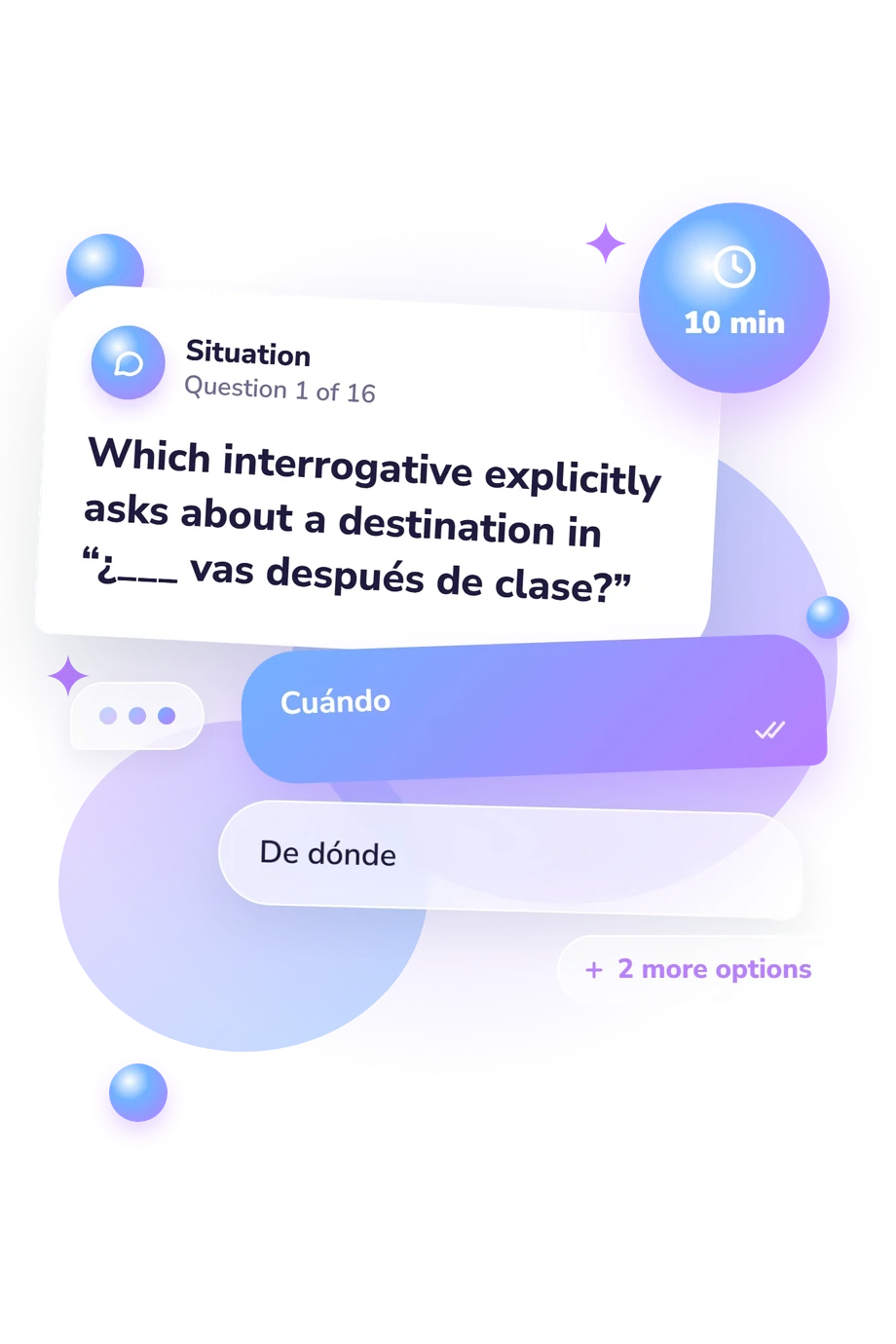
Example Questions From the Test
- Cuándo
- De dónde
- Adónde
- Por qué
- Cuánto
- Cuánta
- Cuántas
- Cuántos
- ¿Por qué llegaste tarde? — Porque perdí el autobús.
- ¿Porque llegaste tarde? — Por qué perdí el autobús.
- ¿Porqué llegaste tarde? — Porque perdí el autobús.
- ¿Por que llegaste tarde? — Porqué perdí el autobús.
Spanish Interrogatives Quiz - Description and methodology of the test
Spanish learners deciding what to review next can use the Spanish Interrogatives Quiz to check whether their current study is translating into reliable choices. The result helps them decide whether to revisit core forms, practise contextual distinctions, or move on to more complex Spanish questions. As a quiz on interrogative words in Spanish, it offers a focused performance snapshot for planning further study.
What This Assessment Explores
This assessment helps learners distinguish Spanish interrogative forms in context. Its items cover locations, people, quantities, choices, reasons, definitions, time, accents, agreement, and standard question writing. The result highlights forms that merit targeted revision after missed choices are reviewed.
As a quiz on Spanish question words, it checks whether each form fits the sentence, meaning, or supplied answer. Its main dimensions are:
- Location, direction, and time questions show whether you separate dónde, adónde, de dónde, and cuándo.
- People, choices, definitions, and quantities indicate accurate use of quién, qué, cuál, and cuánto forms with agreement.
- Reasons and indirect questions reveal control of por qué, porque, written accents, and context.
- Spanish Interrogatives Knowledge (0-16) reports the result: Foundation (0-6) signals emerging recognition, Developing (7-12) shows partial control, and Strong (13-16) indicates consistent command across direct questions, indirect questions, and contextual choices.
Methodology and Evidence Base
Each item presents a Spanish prompt with four answer choices. The respondent selects the form that best matches meaning, agreement, accentuation, or standard usage; some choices depend on context or a supplied answer. Scoring produces one overall result, interpreted through the single scale described above; no separate subscale totals are shown.
Batchelor and San José (2010) clarify the interrogative pronouns and adverbs tested here. Butt, Benjamin, and Moreira Rodríguez (2019) cover modern forms, agreement, accents, and usage, while Goodall (2011) relates to Spanish question structure and inversion.
The result is a performance summary for the forms and contexts represented here, not a measure of overall Spanish proficiency. Reviewing missed distinctions can show whether to revisit a form, check agreement or accents, or practise it in a direct or indirect question. That review makes Spanish interrogative practice more targeted for continued study.
- Batchelor, R. E., and Miguel Ángel San José. (2010). Interrogative pronouns and adverbs. In A Reference Grammar of Spanish (pp. 327-330). Cambridge University Press. 10.1017/CBO9780511845604.061
- Goodall, Grant. (2011). Syntactic satiation and the inversion effect in English and Spanish wh-questions. Syntax, 14(1), 29-47. 10.1111/j.1467-9612.2010.00148.x
- Butt, John, Carmen Benjamin, and Antonia Moreira Rodríguez. (2019). A New Reference Grammar of Modern Spanish (6th ed.). Routledge. ISBN: 9781138124011
Updated: