
Sun Moon or Star Quiz
How the Scales are Structured
Who Usually Takes This Test?
See How You Compare
Below is a preview of how scores are typically distributed across each scale.
Example Questions From the Test
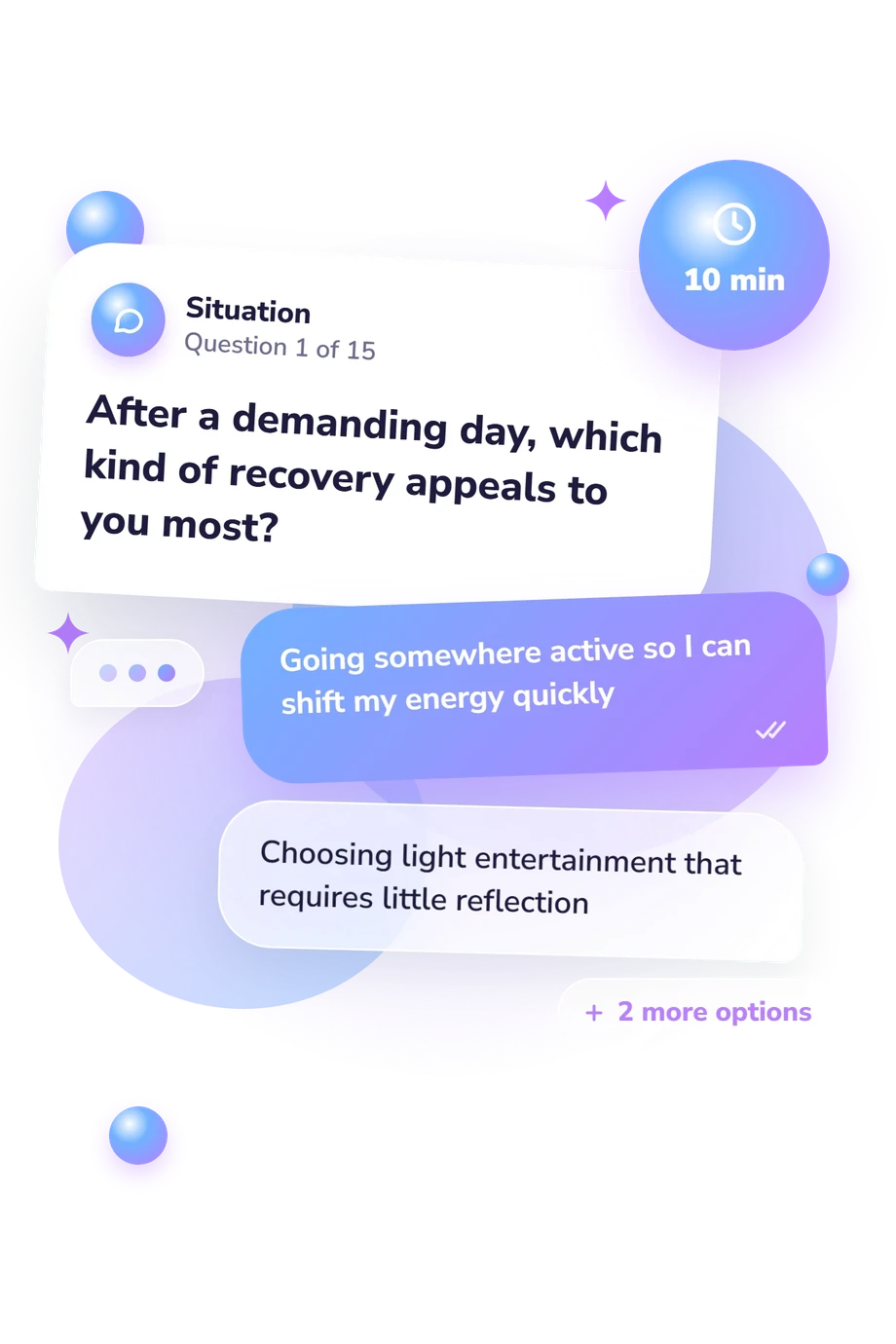
- Going somewhere active so I can shift my energy quickly
- Choosing light entertainment that requires little reflection
- Talking through the day with someone I trust
- Spending quiet time alone to absorb what I felt
- Contribute when someone identifies a clear need
- Suggest a direction and encourage everyone to get moving
- Take ownership of a visible piece that could restore momentum
- Pause and observe before deciding whether to intervene
- Settle into a quiet conversation with one familiar person
- Wait until someone draws me into the wider group
- Introduce myself to several people as opportunities arise
- Start an upbeat exchange that brings people together
Sun Moon or Star Quiz - Description and methodology of the test
Readers who want to reflect on social energy, inner experience, emotional atmosphere, and openness to possibility can use the sun moon star quiz as a structured prompt. The sun moon or star quiz presents three score-specific symbolic affinities drawn from everyday preferences. The quiz’s sun, moon, and star themes offer language for noticing tendencies without turning them into a fixed identity.
What This Assessment Explores
Questions cover recovery, conversation, groups, recognition, decisions, open-ended tasks, and future possibilities. As a symbolic preference questionnaire, it presents separate affinities rather than one type.
The three displayed affinities are:
- Moon - 0-15 reflects introspection, emotional nuance, private meaning, and sensitivity to atmosphere; the result is Outwardly Anchored (0-5), Tidal Awareness (6-10), or Lunar Depth (11-15).
- Star - 0-15 reflects originality, curiosity, experimentation, and attraction to future possibilities; the result is Grounded Path (0-5), Exploring Orbit (6-10), or Stellar Vision (11-15).
- Sun - 0-15 reflects comfort with visibility, outward energy, celebration, and initiative; the result is Quiet Glow (0-5), Selective Radiance (6-10), or Solar Presence (11-15).
These are situational preferences, not measures of mental health, emotional ability, creativity, intelligence, confidence, future potential, or worth.
Methodology and Evidence Base
Each item presents an everyday situation with four answer choices. Options contrast practical action, public participation, emotional reading, observation, experimentation, and imagination, so the respondent selects the closest response instead of rating agreement. Answers are combined into three affinity scores, but the questionnaire does not document equal point values or a norm-based cutoff system.
As a symbolic online self-reflection measure, this sun moon or star assessment presents these affinity scales; its displayed scoring has no documented standardization. Their themes have conceptual context in Clarke, Gabriels, and Barnes (1996), who examined astrological labels in relation to extroversion and emotionality, and in Miguel and Carvalho (2014), who compared personality traits with astrological signs. Those studies do not establish validity, reliability, norms, or a theoretical basis for the three displayed scales, nor do they support astrological prediction.
Read the result as a snapshot of self-described preferences in the situations presented. Mood, context, self-awareness, and socially desirable responding may shift answers, so the profile is best used to prompt reflection rather than define personality.
- Clarke, Dave, Toos Gabriels, and Joan Barnes. (1996). Astrological Signs as Determinants of Extroversion and Emotionality: An Empirical Study. The Journal of Psychology, 130(2), 131-140. 10.1080/00223980.1996.9914995
- Miguel, Fabiano Koich, and Lucas de Francisco Carvalho. (2014). Relationship between Personality Traits Measured by Psychological Tests and Astrological Signs. Psico-USF, 19(3), 533-545. 10.1590/1413-82712014019003015
- McCrae, Robert R., and Paul T. Costa. (1987). Validation of the Five-Factor Model of Personality Across Instruments and Observers. Journal of Personality and Social Psychology, 52(1), 81-90. 10.1037/0022-3514.52.1.81
Updated: