
Life Satisfaction Quiz
How the Scales are Structured
Who Usually Takes This Test?
See How You Compare
Below is a preview of how scores are typically distributed across each scale.
Example Questions From the Test
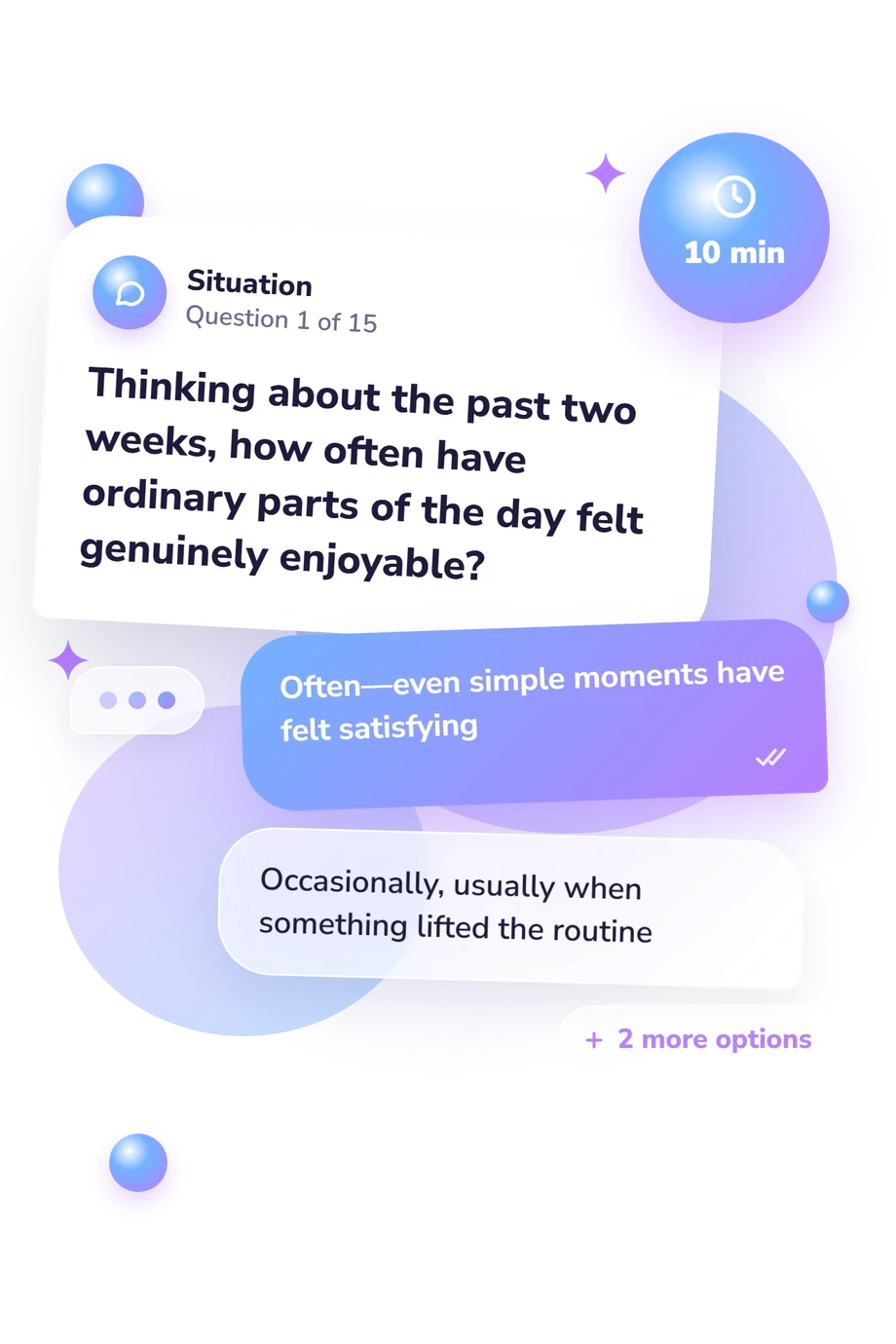
- Often—even simple moments have felt satisfying
- Occasionally, usually when something lifted the routine
- Rarely; most days have felt more functional than enjoyable
- Fairly often, although enjoyment has varied from day to day
- Several important parts align, but major gaps remain
- Very little of my time feels connected to what matters most
- Most of my time reflects priorities I genuinely value
- One or two parts align, though much of my time feels disconnected
- A mixture of worthwhile and unsatisfying moments
- Mostly depletion or a sense that little felt rewarding
- Some relief that the day is over, with one or two decent moments
- A sense that the day contained things I was glad to experience
Life Satisfaction Quiz - Description and methodology of the test
For readers who want to understand whether their everyday life feels rewarding and personally workable, the Life Satisfaction Quiz provides a structured reflection on present well-being. It separates enjoyment from fit, agency, meaning, and direction rather than reducing experience to one overall impression. This life satisfaction assessment can show which parts of experience feel supported and which may deserve closer attention.
What This Assessment Explores
Questions cover ordinary pleasure, draining versus replenishing experiences, relationships, responsibilities, environment, choices, and future aims. Viewed as an everyday well-being questionnaire, it suits anyone seeking a clearer snapshot of present well-being, including where you feel able to influence change and where circumstances seem difficult to influence.
The result is organized around three complementary dimensions:
- Daily Enjoyment (0-15) reflects pleasure, contentment, and emotional nourishment in ordinary life. Bands are Limited enjoyment (0-5), Mixed enjoyment (6-10), and Strong enjoyment (11-15).
- Life Fit and Agency (0-15) reflects how well relationships, responsibilities, environment, and choices suit present needs, together with your felt ability to influence change. Bands are Significant mismatch (0-5), Partial fit (6-10), and Strong fit (11-15).
- Meaning and Direction (0-15) reflects whether activities, choices, and future direction align with what matters to you. Bands are Direction unclear (0-5), Emerging alignment (6-10), and Strong alignment (11-15).
Methodology and Scientific Basis
Each item presents a concrete situation or reflection prompt with four answer choices. Some options describe enjoyment and workable adjustment; others describe depletion, mismatch, uncertainty, or limited influence. Select the statement closest to your current experience or likely response.
Results are summarized across the displayed dimensions, but the questionnaire does not state a point value for each response. As a life satisfaction test, it offers reflective bands rather than clinical thresholds; interpret them alongside context, recent events, and your own understanding.
The structure is conceptually consistent with the Satisfaction With Life Scale (Diener et al., 1985), while its wider coverage also echoes Diener et al.’s well-being measures, Ryff’s model of psychological well-being, and Steger et al.’s work on meaning in life. The cited instruments provide conceptual context for its questions about enjoyment, fit, agency, meaning, and direction, not evidence that this questionnaire itself has been standardized or validated.
Self-report answers can shift with mood, memory, self-awareness, and pressure to present oneself favorably. Use the profile to identify topics worth examining; it cannot by itself establish a fixed identity or explain the causes of a score.
- Diener, Ed, Robert A. Emmons, Randy J. Larsen, and Sharon Griffin. “The Satisfaction With Life Scale.” Journal of Personality Assessment 49, no. 1 (1985): 71-75. 10.1207/s15327752jpa4901_13
- Diener, Ed, Derrick Wirtz, William Tov, Chu Kim-Prieto, Dong-won Choi, Shigehiro Oishi, and Robert Biswas-Diener. “New Well-being Measures: Short Scales to Assess Flourishing and Positive and Negative Feelings.” Social Indicators Research 97, no. 2 (2010): 143-156. 10.1007/s11205-009-9493-y
- Ryff, Carol D. “Happiness Is Everything, or Is It? Explorations on the Meaning of Psychological Well-Being.” Journal of Personality and Social Psychology 57, no. 6 (1989): 1069-1081. 10.1037/0022-3514.57.6.1069
- Steger, Michael F., Patricia Frazier, Shigehiro Oishi, and Matthew Kaler. “The Meaning in Life Questionnaire: Assessing the Presence of and Search for Meaning in Life.” Journal of Counseling Psychology 53, no. 1 (2006): 80-93. 10.1037/0022-0167.53.1.80
Updated: