
Computer Science Quiz
How the Scales are Structured
Who Usually Takes This Test?
See How You Compare
Below is a preview of how scores are typically distributed across each scale.
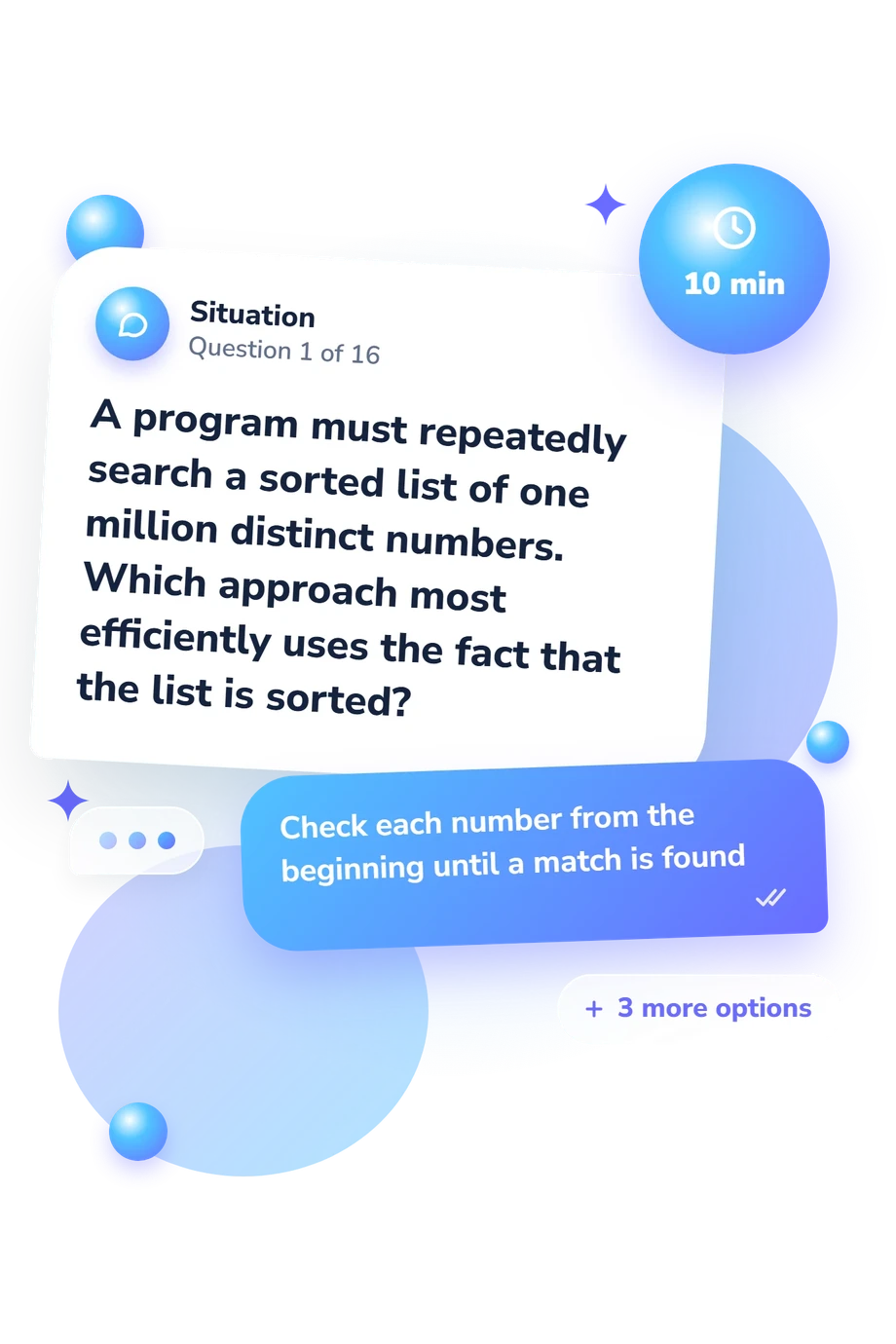
Example Questions From the Test
- A stack, removing the most recently added job first
- A set, selecting any stored job next
- A tree, always removing the job with the longest name
- A queue, removing the earliest added job first
- Dimensionality reduction without labels
- Unsupervised learning
- Reinforcement learning
- Supervised learning
- CROSS JOIN
- LEFT JOIN
- INNER JOIN
- FULL OUTER JOIN
Computer Science Quiz - Description and methodology of the test
Students, career changers, and curious learners can use this computer science test to see how comfortably they apply foundational concepts in short scenarios and decide which area deserves review first. Working through the computer science quiz questions gives learners a practical snapshot of how they connect ideas across unfamiliar problems. This computer science assessment can support study planning, orientation, or general self-reflection.
What This Assessment Measures
The questions examine whether a learner can apply foundational ideas in computing situations. They suit introductory learners and people refreshing prior learning. The assessment presents technical quiz questions with answers in computer science, pairing each prompt with four alternatives and one best answer, so the result reflects choices across domains rather than essay writing or coding performance.
These groups show what each result area represents:
- Algorithms and complexity assess efficient search, graph traversal, and growth rates.
- Programming and logic cover compilation, recursion, Boolean equivalence, and execution.
- Data structures and databases examine queues, joins, and normalization.
- Systems and computer architecture cover cache locality, memory, and virtual memory.
Together, these domains form the Computer Science Knowledge scale, scored from 0-16. Foundation Building (0-6) indicates concepts to review; Developing Knowledge (7-12) reflects understanding of many essentials; Strong Knowledge (13-16) indicates broad command of the sampled foundations.
Methodology and Evidence Base
In this computer science knowledge test, each item offers four answer choices and asks the learner to select the best one. These computer science multiple choice questions cover choosing a search method, tracing recursion, interpreting an HTTP code, selecting a database join, and recognizing a deadlock. One point is awarded for each correct response, so the score reflects answer accuracy rather than confidence.
Coverage is conceptually consistent with the NACK, a language-independent CS1 knowledge assessment discussed by Parker, Guzdial, and Engleman, and foundational areas identified in ACM, IEEE, and AAAI guidance. These sources support topic selection, but this questionnaire is not an adaptation, replication, or validation of those published instruments.
Interpret the result as study guidance: stronger performance suggests wider command of the sampled fundamentals, while a lower result identifies concepts worth revisiting. Guessing, prior coursework, wording, and concentration can affect performance. The bands are informal and describe performance on this questionnaire; they offer a learning snapshot, not norm-referenced standing or a formal credential.
- Peteranetz, Markeya S., and Anthony D. Albano. 2020. Development and Evaluation of the Nebraska Assessment of Computing Knowledge. Frontiers in Computer Science 2:11. 10.3389/fcomp.2020.00011
- Parker, Miranda C., Mark Guzdial, and Shelly Engleman. 2016. Replication, Validation, and Use of a Language Independent CS1 Knowledge Assessment. Proceedings of the 2016 ACM Conference on International Computing Education Research, 93-101. 10.1145/2960310.2960316
- Kumar, Amruth N., Rajendra K. Raj, Sherif G. Aly, Monica D. Anderson, Brett A. Becker, Richard L. Blumenthal, Eric Eaton, Susan L. Epstein, Michael Goldweber, Pankaj Jalote, Douglas Lea, Michael J. Oudshoorn, Marcelo Pias, Susan Reiser, Christian Servin, Rahul Simha, Titus Winters, and Qiao Xiang. 2023. Computer Science Curricula 2023. ACM Press, IEEE Computer Society Press, and AAAI Press. 10.1145/3664191
Updated: