
Julius Caesar Act 2 Quiz
How the Scales are Structured
Who Usually Takes This Test?
See How You Compare
Below is a preview of how scores are typically distributed across each scale.
Example Questions From the Test
- Stand along Caesar’s route and hand it directly to him
- Read it aloud to the Senate before Caesar arrives
- Send it to Mark Antony through Lucius
- Hide it in Brutus’s orchard for Portia to find
- She has forgotten where Brutus has gone.
- Her anxiety is straining her effort to remain composed.
- She intends Lucius to warn Caesar about every conspirator.
- She no longer believes Brutus is involved in anything dangerous.
- Keep Mark Antony away from Caesar’s house
- Convince Cicero to join the conspiracy
- Deliver Artemidorus’s letter to the Senate
- Persuade Caesar to go to the Capitol despite any reluctance
Julius Caesar Act 2 Quiz - Description and methodology of the test
Students, teachers, and independent readers can use the Julius Caesar Act 2 Quiz to connect Act 2’s events with its motives and dramatic tensions. A Julius Caesar Act II quiz is especially useful before class discussion, an essay, or a focused rereading. The result indicates your overall level of command and suggests whether reviewing Act 2 details may help as you check recall or prepare to discuss Shakespeare’s choices.
What This Assessment Explores
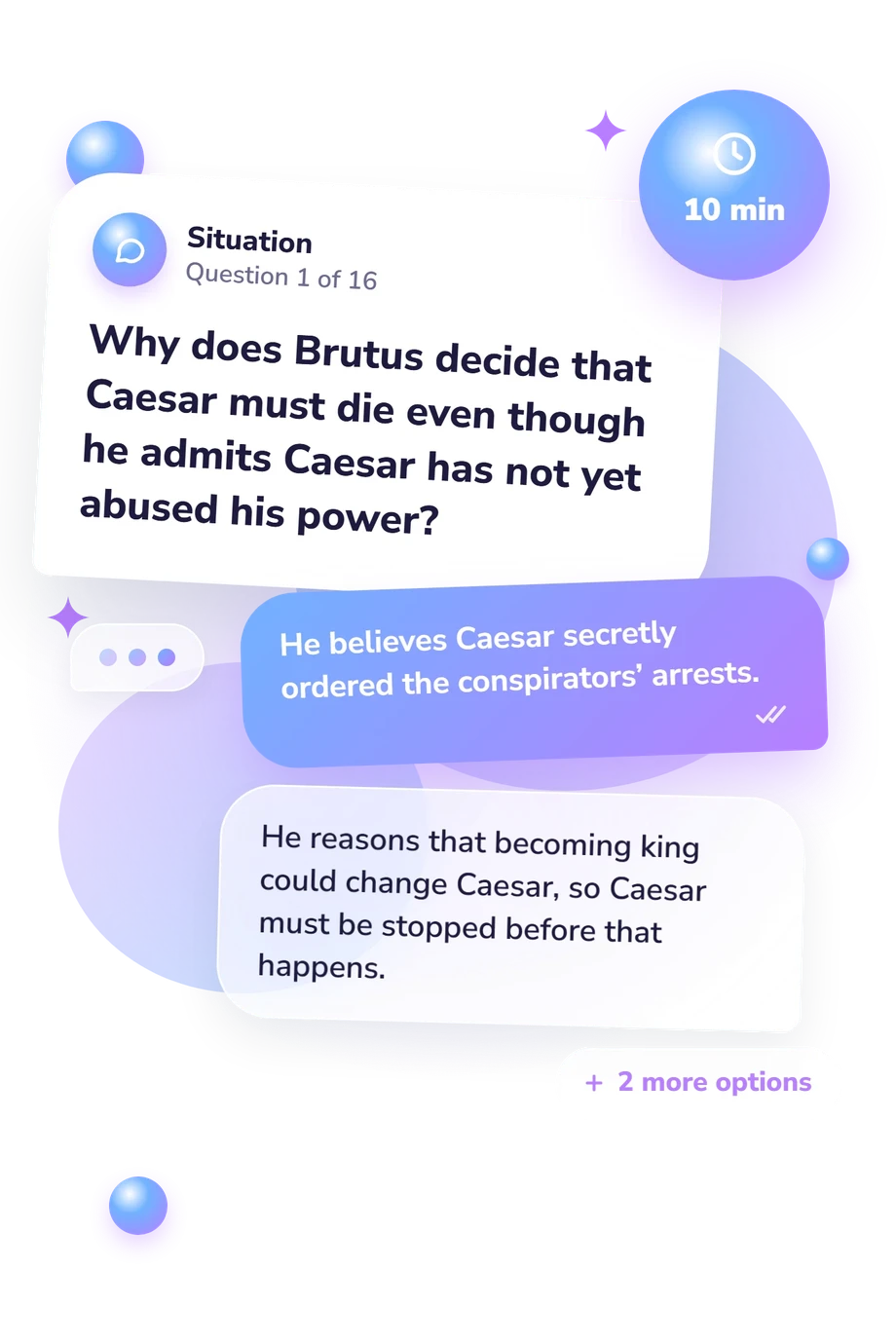
At its core, this Julius Caesar Act 2 test checks comprehension and interpretation of the act’s crucial decisions. It follows Brutus’s pre-emptive reasoning, the conspirators’ choices, Portia’s resolve, Calpurnia’s fear, and Caesar’s susceptibility to persuasion. Dreams, letters, omens, reputation, and dramatic irony link private choices to the approaching assassination.
The result appears on the Julius Caesar Act 2 Knowledge scale: Foundation to Review (0-6), Developing Command (7-12), or Strong Command (13-16). These bands indicate how clearly you grasp Act 2’s events, imagery, motives, and thematic tensions.
The categories cover these areas:
- Conspiracy reasoning shows why Brutus supports preventive action.
- Character motives reveal how loyalty, honor, fear, and status guide choices.
- Omens and warnings test understanding of dreams, letters, signs, and interventions.
- Dramatic irony measures whether you separate audience knowledge from character knowledge.
Methodology and Evidence Base
Each item presents a short question with four answer choices and one best answer. The set covers the conspirators’ meeting, Portia, Calpurnia’s dream, warnings, and Decius’s persuasion, testing recall alongside motive and dramatic effect.
The questionnaire reports a 0-16 performance score, and no weighting or norming information is specified. It summarizes performance on the selected questions, including recall of plot details and interpretation of motives, warnings, and dramatic irony.
Julius Caesar supplies the plot, dialogue, images, and sequence used to construct the questions. The questionnaire is conceptually consistent with Harold Fisch’s 1999 discussion of political ideals, public identity, and human judgment in the play, but it is not an adaptation of that study.
Because this Act 2 Shakespeare quiz depends on recall and prior reading, results can vary with memory, familiarity with Shakespearean language, and current preparation. The bands identify material to review; a strong score indicates command of the selected Act 2 content, not broad literary expertise, and an incorrect answer does not by itself explain the underlying misunderstanding.
- Shakespeare, William. Julius Caesar. Edited by Marvin Spevack, introduction by Jeremy Lopez. 3rd ed., The New Cambridge Shakespeare, Cambridge University Press, 2019. 10.1017/9781316105108
- Fisch, Harold. "Julius Caesar: Stones or Men?" The Biblical Presence in Shakespeare, Milton, and Blake: A Comparative Study, Oxford University Press, 1999, pp. 2-34. 10.1093/acprof:oso/9780198184898.003.0001
Updated: