
Library Quiz
How the Scales are Structured
Who Usually Takes This Test?
See How You Compare
Below is a preview of how scores are typically distributed across each scale.
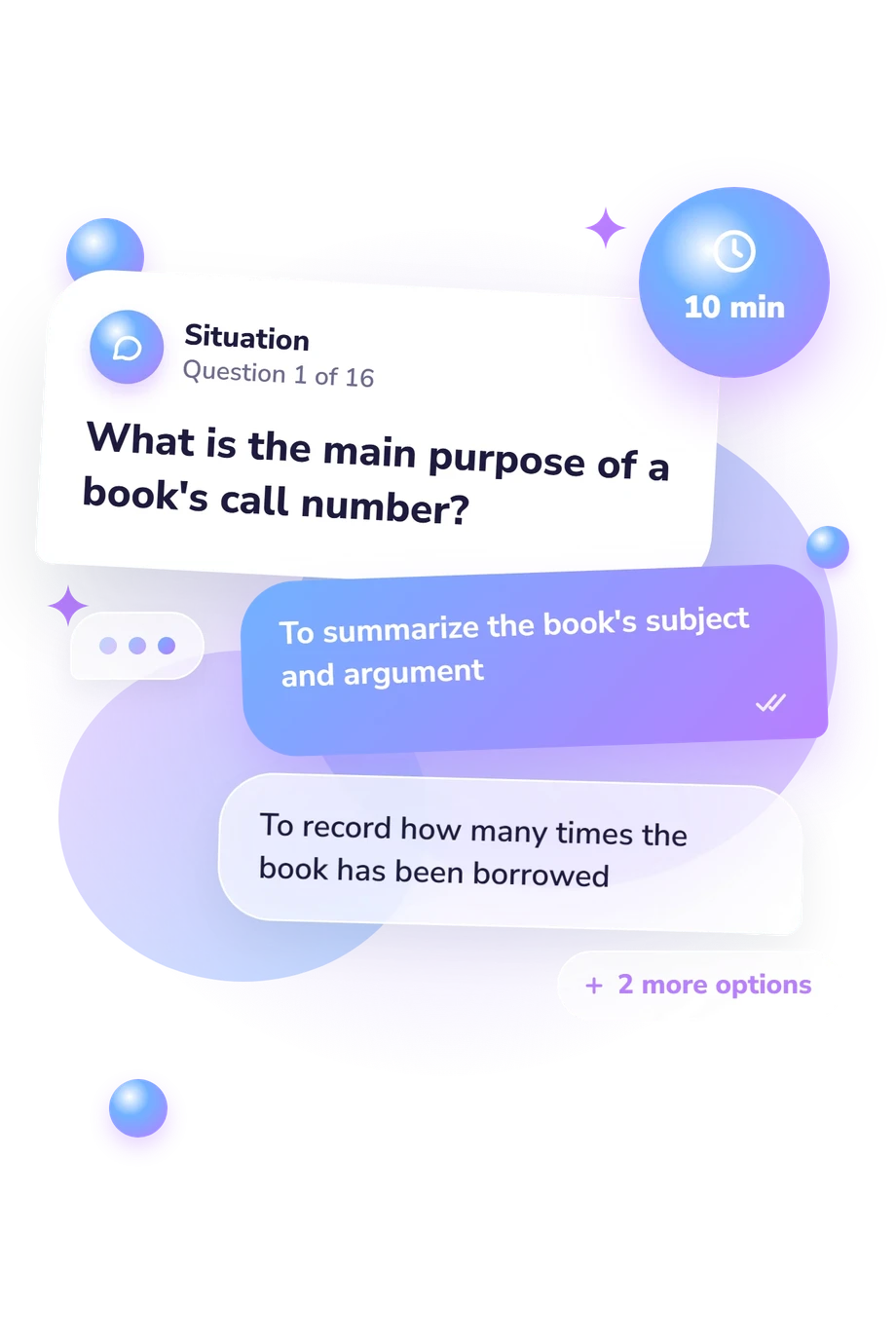
Example Questions From the Test
- To summarize the book's subject and argument
- To record how many times the book has been borrowed
- To identify the book's current borrower
- To show where the book belongs on the shelves
- In the circulating fiction collection
- In the reference collection
- In the book-return area
- In the reserved-items pickup area
- Adds you to a queue to borrow an available copy
- Extends the current borrower's loan indefinitely
- Purchases a personal copy using your library account
- Converts a reference copy into a circulating copy
Library Quiz - Description and methodology of the test
For readers who want a practical check of everyday information skills, the library quiz offers a focused way to see how comfortably they handle common library situations. It suits students, independent researchers, and curious readers who want a clearer starting point for improving their routines. A library skills quiz can make strengths and gaps visible across borrowing, searching, and source use.
What This Assessment Explores
Items link physical organization with digital research practice. They cover call numbers, reference collections, borrowing, catalogs, citation, copyright, peer review, database operators, classification, and source authority, asking for the best action, resource, or judgment in each situation.
A library knowledge test like this shows which routines are secure and where practice may help. The Library Knowledge scale runs from 0-16 and reflects knowledge of library spaces, services, research tools, and information practices.
The tested skill groups are:
- Organization and access shows how you use shelves, call numbers, classification, holds, renewals, and interlibrary loan.
- Research sources shows how you handle primary sources, peer review, citation, and copyright.
- Searching and evaluation shows how you use catalogs, database logic, refinement, and source authority.
Starting Shelf (0-6) marks basic recognition; Capable Explorer (7-12) indicates common-tool understanding; Library Navigator (13-16) signals strong practical knowledge across physical and digital settings.
Methodology and Scientific Basis
The format is a four-choice, best-answer knowledge assessment: each item presents a concrete question and asks the respondent to select the most accurate option. Answers combine into one overall total; because no additional weighting scheme is stated, interpretation should stay with the published bands rather than an invented point calculation.
Conceptually, this library research skills assessment is consistent with Library Skills Assessment (Fain, 2011), which examines information-literacy development. Its content also aligns with competencies described by Cameron, Wise, and Lottridge (2007) and the ACRL framework. Those sources support the selected domains, but this online questionnaire is not presented as a direct adaptation or standardized administration of their instruments.
Results are best read as a snapshot of performance in the situations represented by the items. Prior coursework, familiarity with a particular library system, guessing, and wording can affect answers, while one total cannot capture every research habit or context-specific skill. No population norms, reliability estimates, or diagnostic classifications are stated for this questionnaire, so the bands offer descriptive guidance and can identify topics to practise next.
- Fain, Margaret. (2011). Assessing Information Literacy Skills Development in First Year Students: A Multi-Year Study. The Journal of Academic Librarianship, 37(2), 109-119. 10.1016/j.acalib.2011.02.002
- Cameron, Lynn, Steven L. Wise, and Susan M. Lottridge. (2007). The Development and Validation of the Information Literacy Test. College & Research Libraries, 68(3), 229-236. 10.5860/crl.68.3.229
- Association of College and Research Libraries. (2000). Information Literacy Competency Standards for Higher Education. Chicago, IL: Association of College and Research Libraries.
Updated: