
Favorite Sport Quiz
How the Scales are Structured
Who Usually Takes This Test?
See How You Compare
Below is a preview of how scores are typically distributed across each scale.
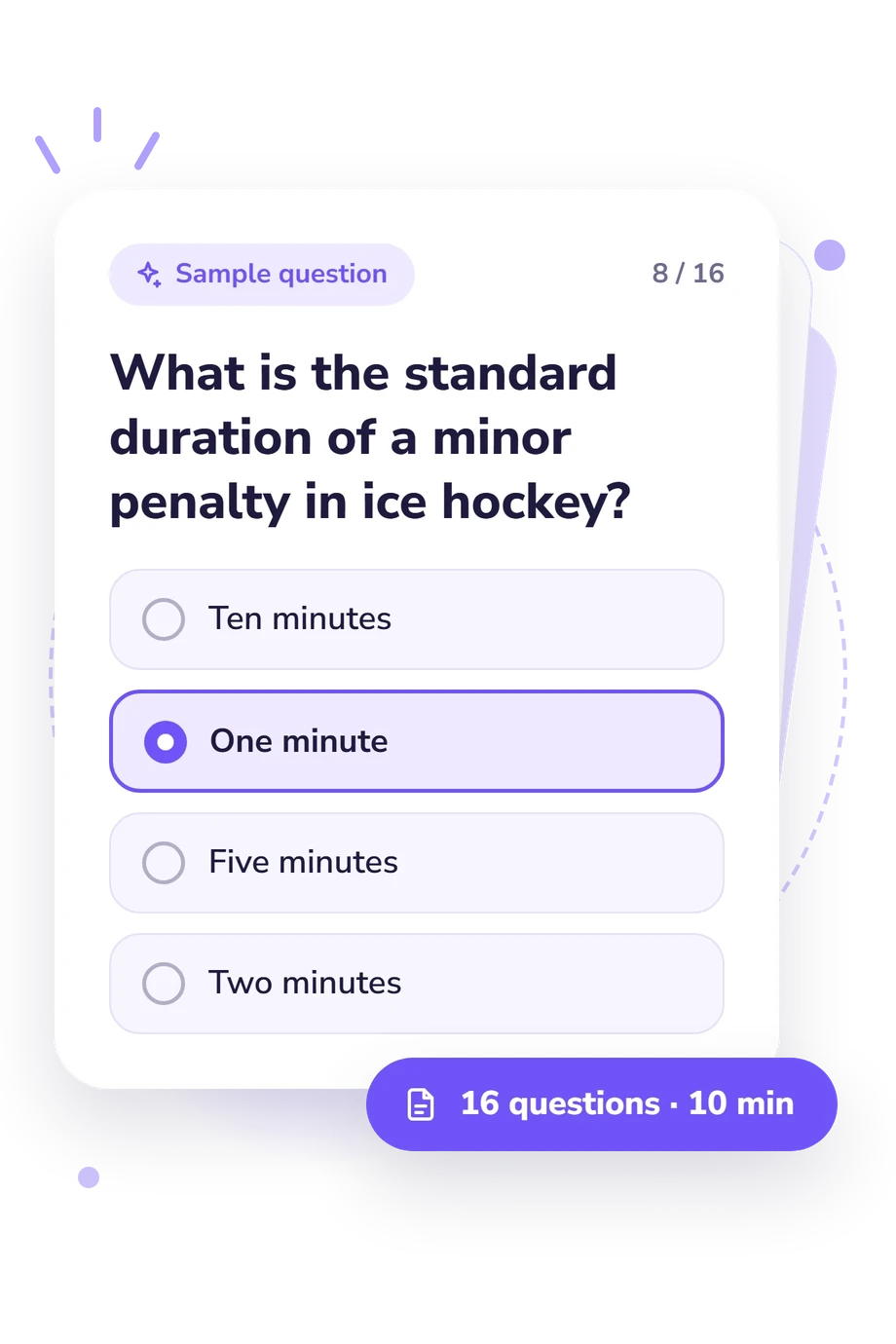
Example Questions From the Test
- Cycling, swimming, running
- Swimming, cycling, running
- Swimming, running, cycling
- Running, cycling, swimming
- Backstroke, breaststroke, butterfly, freestyle
- Freestyle, butterfly, backstroke, breaststroke
- Butterfly, backstroke, breaststroke, freestyle
- Breaststroke, backstroke, freestyle, butterfly
- Win the next rally
- Reach 25 points, regardless of the margin
- Win a five-rally tiebreak
- Gain a two-point lead
Favorite Sport Quiz - Description and methodology of the test
People who enjoy comparing rules across games can use this assessment to check how accurately they recognize common sporting conventions. The favorite sport quiz is intended for readers who want a broad knowledge snapshot rather than a profile of ability, fitness, or fan loyalty. As a sports rules quiz, it places overall cross-sport knowledge in a broad descriptive band.
What This Assessment Explores
Questions cover broad rule and scoring knowledge rather than athletic skill, team allegiance, or preference. Situations from individual and team sports ask you to identify an order, penalty, score, boundary, rotation, or tactical outcome. The result from this sports knowledge assessment places overall cross-sport knowledge in a broad band.
The result contains one broad measure:
- Favorite Sport Knowledge (0-16) summarizes knowledge across the sports sampled, not expertise in one sport. Starting Line (0-6) marks emerging fundamentals; Versatile Fan (7-12) reflects a solid cross-sport foundation; and All-Round Sports Scholar (13-16) indicates accurate use of rules and scoring across many sports.
A higher band indicates more accurate performance on this set, while a lower band indicates that the sampled conventions may merit further review. The result does not measure intelligence, athletic potential, or sporting commitment.
Methodology and Scientific Basis
Each item presents a sporting situation with four answer choices. The respondent selects the option matching the standard rule or convention, and the displayed total summarizes performance across the knowledge items. This sports quiz favors recognition and applied recall: knowing a rule in context matters more than naming a sport or describing personal experience.
Conceptually, the questionnaire is consistent with research by Bruett et al. (2018) on sports expertise and incidentally learned associations, but it is not presented as an adaptation of that research. He, Ward, and Wang (2018) provide an example of structured assessment of common content knowledge within soccer; this questionnaire is not an adaptation of that test. Chubbuck, Curley, and King (2016) indicate that subject-matter familiarity can affect performance on content-based questions.
The score is a snapshot of rule knowledge under self-administered conditions. The displayed bands are descriptive categories for this test, not universal ability levels. Familiarity with particular sports, memory, language, and attention can influence performance, making honest responses important.
- Bruett, H., Fang, X., Kamaraj, D. C., Haley, E., & Coutanche, M. N. (2018). Expertise Moderates Incidentally Learned Associations Between Words and Images. Frontiers in Psychology, 9, 2085. 10.3389/fpsyg.2018.02085
- He, Y., Ward, P., & Wang, X. (2018). Validation of a Common Content Knowledge Test for Soccer. Journal of Teaching in Physical Education, 37(4), 407-412. 10.1123/jtpe.2017-0204
- Chubbuck, K., Curley, W. E., & King, T. C. (2016). Who’s on First? Gender Differences in Performance on the SAT® Test on Critical Reading Items With Sports and Science Content. ETS Research Report Series, 2016(2), 1-116. 10.1002/ets2.12109
Updated: