
How to Survive a School Shooting Quiz
How the Scales are Structured
Who Usually Takes This Test?
See How You Compare
Below is a preview of how scores are typically distributed across each scale.
Example Questions From the Test
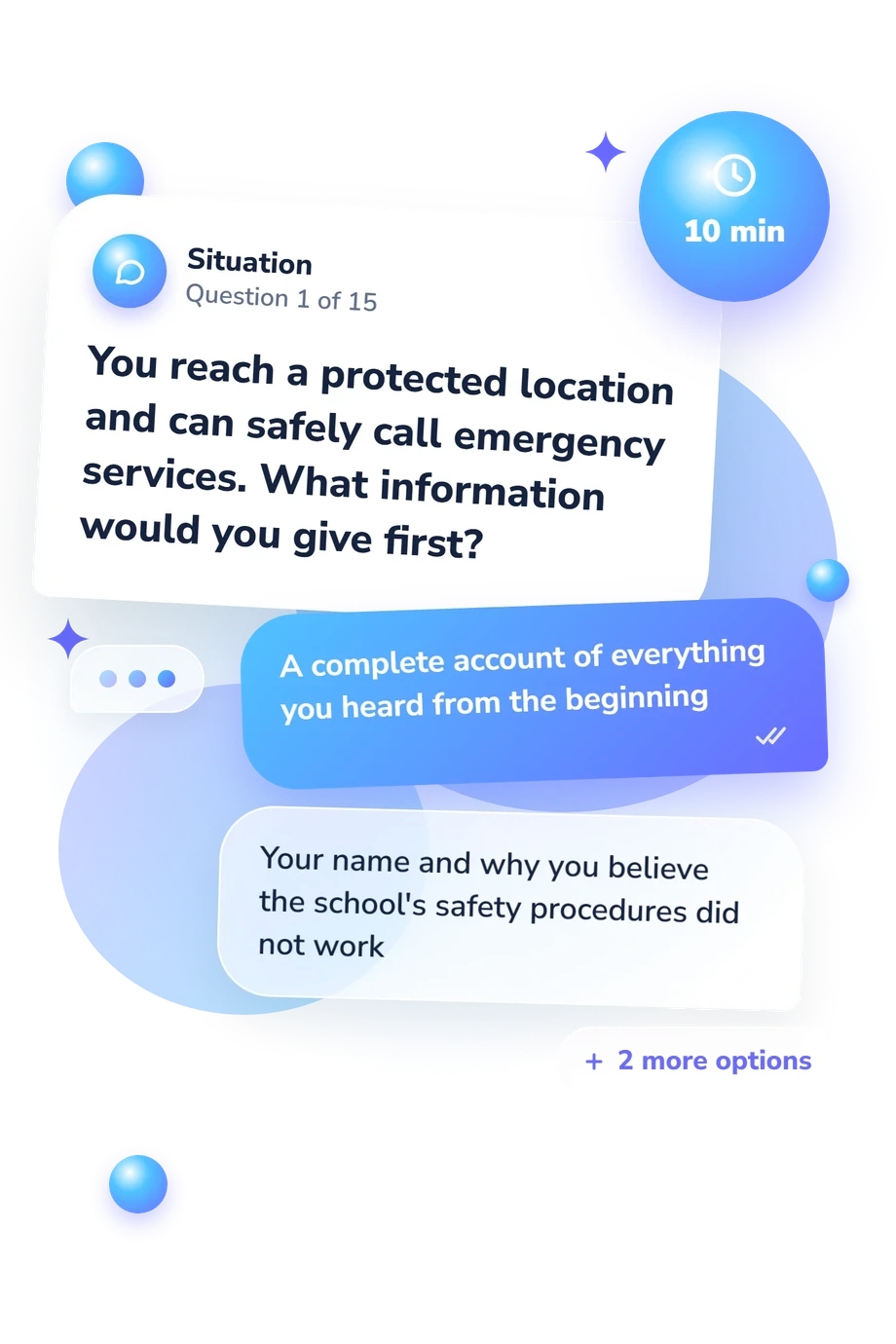
- A complete account of everything you heard from the beginning
- Your name and why you believe the school's safety procedures did not work
- The school location, your specific location, what you directly observed, and any known injuries or suspect details
- The school location and the most recent information shared by other students
- Wait beside the blockage for the route to reopen
- Try to pass through quickly before more people arrive
- Return to the last protected location and stay there without considering another route
- Change to a known route away from danger, or enter a securable space if no safe exit remains
- Wait for a public-address announcement before deciding whether to move
- Use the clear exterior route immediately, leaving belongings and moving away from the danger
- Step into the interior hallway to determine exactly where the sounds came from
- Take temporary protection near the exterior door while checking whether an official alert confirms the situation
How to Survive a School Shooting Quiz - Description and methodology of the test
People deciding whether to use this questionnaire can rehearse safer decisions during a school emergency through situations where information is incomplete and circumstances shift. The How to Survive a School Shooting Quiz invites reflection on choices a person might make under pressure. Its result summarizes preparedness rather than predicting survival; whether you would survive a school shooting becomes a prompt for reflection.
What This Assessment Explores
The scenarios examine choices made when information is incomplete, routes change, a room must be secured, or another person needs help. Together, they examine school emergency preparedness through practical judgment: recognizing credible instructions, moving away from danger, protecting a group, communicating useful facts, and maintaining accountability after evacuation.
The displayed result uses three summaries; each label and band describes a preparedness area:
- Emergency Communication and Aftermath (0-15) covers reporting, responder visibility, aid, and reunification. Bands are Needs rehearsal (0-5); Developing coordination (6-10); and More practiced (11-15).
- Protective Action While Sheltering (0-15) covers securing space, concealment, silence, protection, and adaptation. Bands are Needs rehearsal (0-5); Developing response (6-10); and More practiced (11-15).
- Threat Recognition and Evacuation Decisions (0-15) covers alerts, exits, distance, routes, and verified information. Bands are Needs rehearsal (0-5); Developing judgment (6-10); and More practiced (11-15).
Methodology and Evidence Base
Each item presents a high-pressure situation with four response options and asks what the respondent would be most likely to do. The choices address protective action, information verification, movement, communication, and post-event coordination. The questionnaire functions as an active shooter preparedness assessment, turning selected responses into displayed summaries; because answer-to-point weighting is not stated, no extra scoring rule can be inferred.
The scenario content is conceptually consistent with the School Emergency Operations Planning Guide (2013), FBI guidance (2018), Blair, Nichols, Burns, and Curnutt (2013), and the Hartford Consensus (2013). Those sources emphasize emergency planning, verified communication, evacuation or sheltering, responder interaction, bleeding control, and reunification. They are neither the questionnaire’s source instrument nor validation evidence for its displayed summaries.
Read the bands as prompts for rehearsal against local procedures, not universal cutoffs. Self-report may vary with stress, memory, drill familiarity, and assumptions about the setting, while real events change rapidly. The result is an unvalidated preparedness reflection: useful for discussion, but not a substitute for hands-on instruction or current responder guidance when an actual threat or injury occurs.
- U.S. Department of Education, U.S. Department of Health and Human Services, U.S. Department of Homeland Security, and U.S. Department of Justice. (2013). Guide for Developing High-Quality School Emergency Operations Plans. Washington, DC: U.S. Department of Education.
- Federal Bureau of Investigation. (2018). Active Shooter Event Quick Reference Guide. Washington, DC: U.S. Department of Justice.
- Blair, John P., Terry Nichols, David Burns, and John R. Curnutt. (2013). Active Shooter Events and Response. Boca Raton, FL: CRC Press.
- Jacobs, Lenworth M., Norman E. McSwain Jr., Michael F. Rotondo, David Wade, William Fabbri, Alexander L. Eastman, Frank K. Butler Jr., and John Sinclair. (2013). Improving survival from active shooter events: The Hartford Consensus. Journal of Trauma and Acute Care Surgery, 74(6), 1399-1400. 10.1097/TA.0b013e318296b237
Updated: