
Korean Beauty Standards Quiz
How the Scales are Structured
Who Usually Takes This Test?
See How You Compare
Below is a preview of how scores are typically distributed across each scale.
Example Questions From the Test
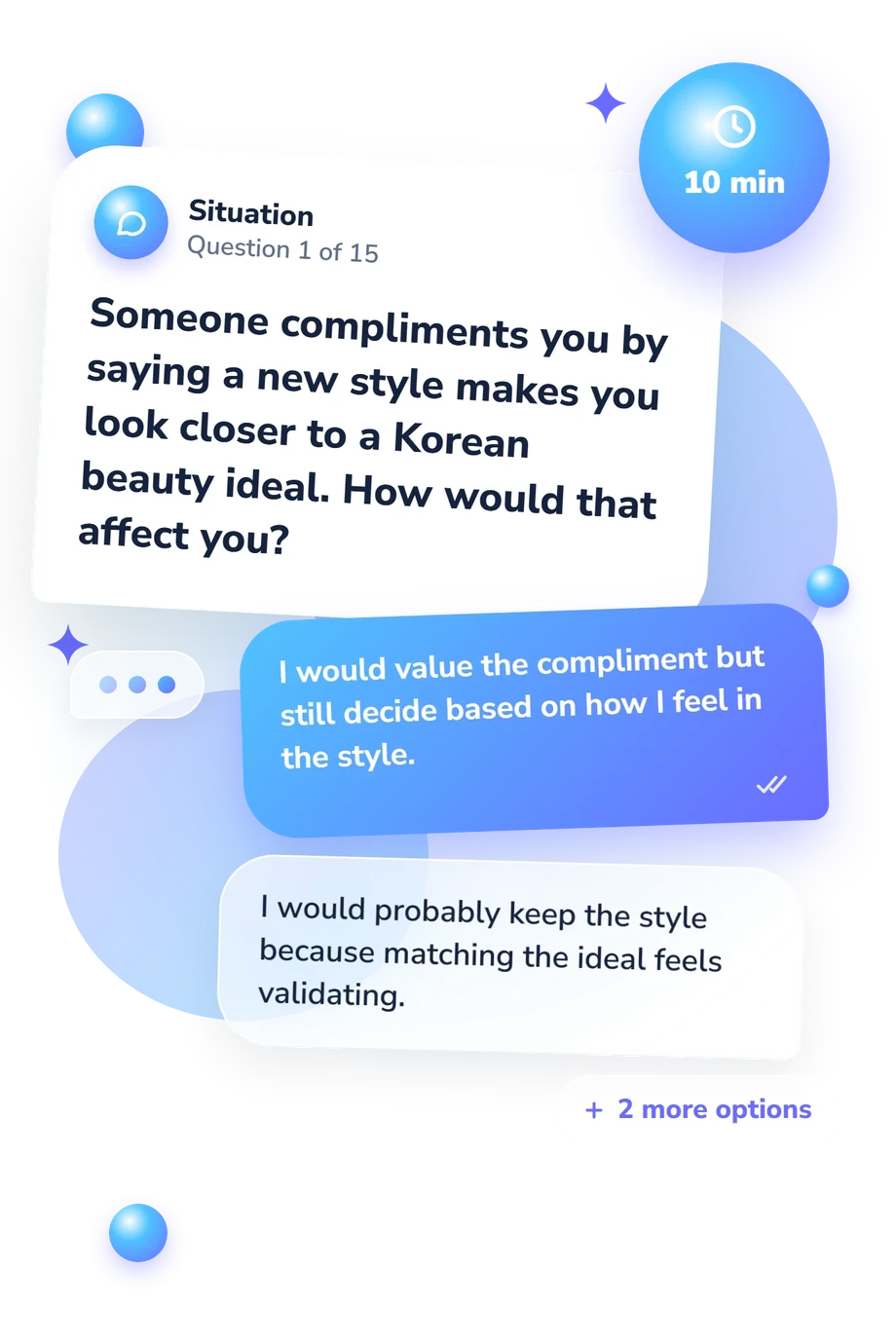
- I would value the compliment but still decide based on how I feel in the style.
- I would probably keep the style because matching the ideal feels validating.
- I would feel encouraged, while also wondering whether the style reflects my own taste.
- I would take it as a useful signal about what appearance works socially.
- Consider it meaningful, but wait for more context before drawing a conclusion.
- Look for evidence, disclosure of editing or sponsorship, and a range of user experiences.
- Assume the brand has a reasonable basis for describing a common result.
- Use the featured result as the standard the product should help me reach.
- The featured finish, because that is the main reason to follow the routine.
- A close version of the routine, with a small adjustment for my circumstances.
- Products suited to my circumstances, even if the final look differs from the trend.
- The general technique, adapted where I already know the original products may not fit.
Korean Beauty Standards Quiz - Description and methodology of the test
Readers who want to examine how Korean beauty imagery is interpreted and how appearance choices are made when social ideals are present can use this assessment for a reflective profile. It suits people comparing media ideals with their own comfort, resources, and tastes, including those exploring K-beauty standards. The Korean Beauty Standards Quiz examines interpretation, routine adaptation, and personal choice rather than giving an attractiveness verdict.
What This Assessment Explores
This questionnaire examines three connected aspects of responding to Korean beauty culture: interpreting imagery and claims, adapting routines to real circumstances, and keeping personal preferences active when ideals are present. The profile is useful to readers reflecting on Korean beauty ideals, products, and styling.
The result organizes those themes into three profile scales:
- Beauty Media Discernment (0-15) measures critical interpretation: Trend-Led Viewing (0-5) means impressions may follow curation; Context-Aware Viewing (6-10) notices some context; Nuanced Viewing (11-15) separates trends from universal standards.
- Routine Fit and Sustainability (0-15) measures adaptation to skin, time, climate, and budget: Ideal-First Routine (0-5) prioritizes the image; Partly Adapted (6-10) makes some adjustments; Fit-First Routine (11-15) prioritizes suitability.
- Self-Directed Beauty Choices (0-15) measures personal preference amid ideals: Approval-Focused (0-5) gives external standards more weight; Negotiated (6-10) balances taste and feedback; Self-Directed (11-15) lets personal preferences lead.
Methodology and Scientific Basis
Each prompt presents a situation involving compliments, advertising claims, polished images, routines, products, or event styling. Four answer choices represent different responses, from accepting an ideal to checking context, adapting a practice, or preserving personal preference. The task examines judgment, not factual knowledge about Korea.
Responses are grouped into the displayed dimensions, and the Korean beauty assessment reports the scales and result bands. It does not specify how choices are converted into points or provide standardization data; the profile should therefore be read as an interpretive result rather than a population norm.
Kim and Lee's study of human beauty values links beauty decisions with personal and social values. Research by Treviños-Rodríguez and Díaz-Soloaga addresses Korean cosmetic imagery, while a study by Bissell and Chung connects media exposure with sociocultural attitudes toward ideal beauty. The questionnaire is conceptually consistent with these studies, but it is not adapted from them or validated by them; its labels are interpretive rather than research norms. Self-report results can shift with context and self-awareness, so treat the profile as a current snapshot.
- Kim, Sunwoo, and Yuri Lee. "Why do women want to be beautiful? A qualitative study proposing a new ‘human beauty values’ concept." PLOS ONE 13, no. 8 (2018): e0201347. DOI 10.1371/journal.pone.0201347
- Treviños-Rodríguez, Doris, and Paloma Díaz-Soloaga. "Ideal feminine beauty according to Korean cosmetic brand’s Instagram profiles." Media Asia 50, no. 3 (2023): 440-457. DOI 10.1080/01296612.2022.2159154
- Bissell, Kim L., and Jee Young Chung. "Americanized beauty? Predictors of perceived attractiveness from US and South Korean participants based on media exposure, ethnicity, and socio-cultural attitudes toward ideal beauty." Asian Journal of Communication 19, no. 2 (2009): 227-247. DOI 10.1080/01292980902827144
Updated: