
Love Addiction Quiz
How the Scales are Structured
Who Usually Takes This Test?
See How You Compare
Below is a preview of how scores are typically distributed across each scale.
Example Questions From the Test
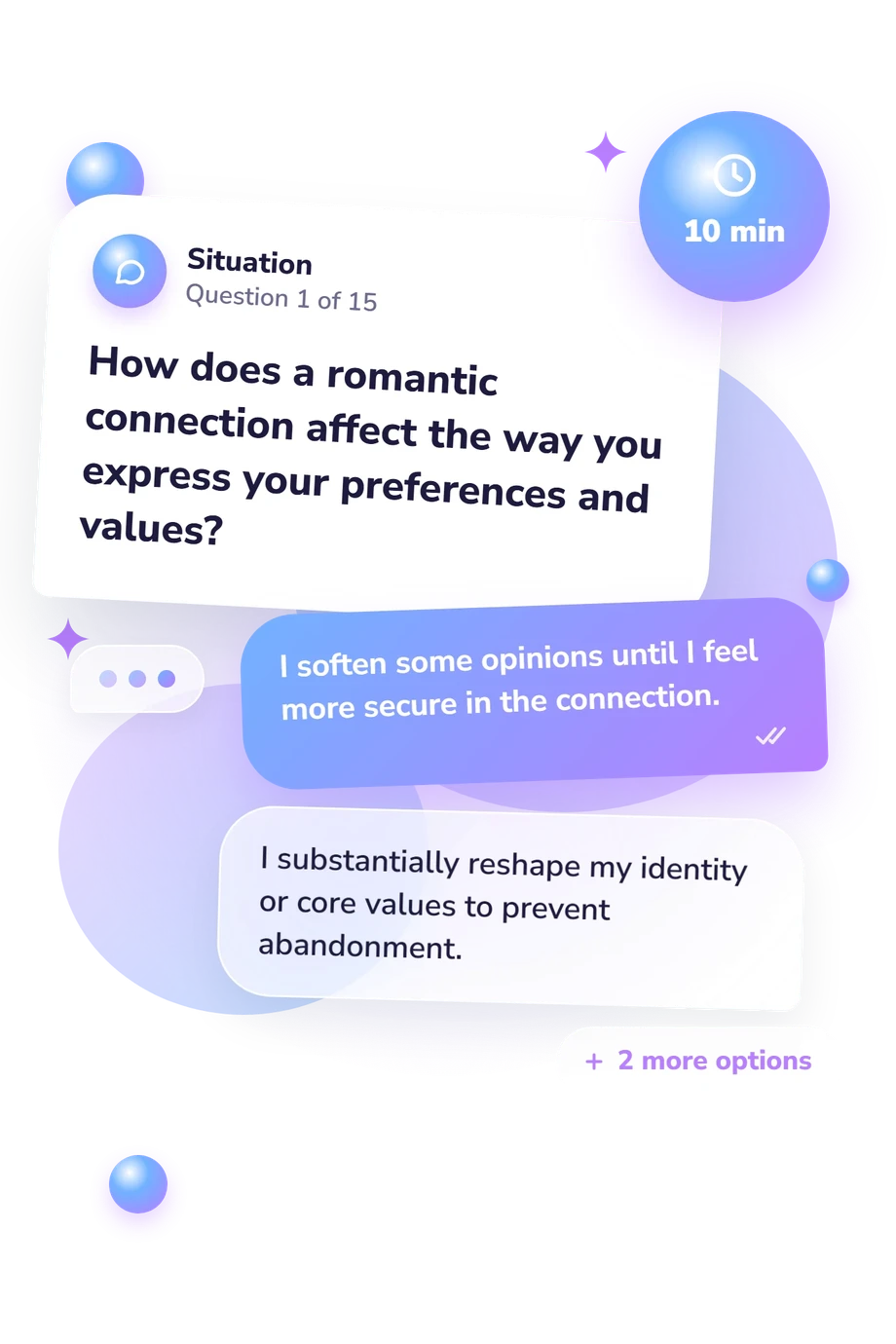
- I soften some opinions until I feel more secure in the connection.
- I substantially reshape my identity or core values to prevent abandonment.
- I can express meaningful differences while remaining respectful.
- I hide important differences because honesty seems likely to cost me the relationship.
- I seek reassurance once, then try to tolerate not knowing.
- I repeatedly ask for reassurance or search messages and online activity for clues.
- I reflect on the available information and allow time before responding.
- The need to pursue certainty feels impossible to resist, even when my actions are harming me or the relationship.
- I can make space for the feeling without urgently finding a relationship.
- I seek company or distraction while still considering whether a connection suits me.
- I pursue or maintain a poor-fit connection mainly to escape the distress of being alone.
- I enter or return to a relationship I believe is unsafe because being without it feels intolerable.
Love Addiction Quiz - Description and methodology of the test
For readers trying to understand why romantic attachment can crowd out personal limits, this love addiction quiz offers a structured self-reflection exercise. It can help examine when relationship addiction begins to shape reassurance-seeking, fear of rejection, or difficulty disengaging. The questions invite you to consider whether attachment is influencing choices that matter to you, especially during uncertainty, separation, or conflict.
What This Assessment Explores
For people examining romantic attachment, this love addiction test considers self-silencing, reassurance-seeking, checking, isolation, disrupted responsibilities, and difficulty leaving harmful connections. The result is grouped into three dimensions, distinguishing boundary concerns, emotional impact, and pursuit urgency:
- Boundaries and Personal Autonomy (0-15) shows whether fear of loss leads to surrendered values, time, support, or limits; bands are Not endorsed here (0), Worth noticing (1-2), and Prompt attention (3-15).
- Emotional Reliance and Life Impact (0-15) shows how attention, distance, or rejection affects stability and functioning; bands are Not endorsed here (0), Worth noticing (1-2), and Prompt attention (3-15).
- Preoccupation and Pursuit Urgency (0-15) shows repetitive thoughts, checking, reassurance-seeking, and difficulty slowing pursuit; bands are Not endorsed here (0-0), Worth noticing (1-2), and Prompt attention (3-15).
The result is useful for identifying where attachment may be competing with autonomy, wellbeing, or other relationships.
Methodology and Scientific Basis
Each item describes a relationship situation and offers four response choices. Options range from little impact to stronger preoccupation, loss of control, interference, or safety concerns; select the statement closest to your usual experience.
Items cover autonomy, emotional consequences, and pursuit-related attention. Responses feed the three displayed scales, but no point value for each option is stated, so an extra scoring rule should not be inferred. The bands are unvalidated reflective summaries, not severity or diagnostic cutoffs.
Its themes are conceptually consistent with the Love Addiction Inventory by Costa and colleagues, the Relationship Addiction Scale by Lee and Yang, and Griffiths’s components model of addiction. Together, these sources help frame the concerns examined here: preoccupation, emotional regulation, difficulty stopping, and conflict with everyday life; this online questionnaire is not an adaptation of those instruments.
Self-report results from this love addiction assessment can shift with current distress, recall, self-awareness, or pressure to answer favorably. Interpret concerning responses independently of the total: a single score-3 red flag overrides the total, and safety-related experiences warrant immediate support even when the overall pattern seems mixed.
- Costa, S., Barberis, N., Griffiths, M. D., Benedetto, L., & Ingrassia, M. (2021). The Love Addiction Inventory: Preliminary Findings of the Development Process and Psychometric Characteristics. International Journal of Mental Health and Addiction, 19(3), 651-668. 10.1007/s11469-019-00097-y
- Lee, InJae, & Yang, Nan-Mee. (2020). Development and Validation of Relationship Addiction Scale. Korean Journal of Health Psychology, 25(2), 311-336. 10.17315/kjhp.2020.25.2.001
- Griffiths, Mark D. (2005). A ‘components’ model of addiction within a biopsychosocial framework. Journal of Substance Use, 10(4), 191-197. 10.1080/14659890500114359
Updated: