
Have You Ever Sex Quiz
How the Scales are Structured
Who Usually Takes This Test?
See How You Compare
Below is a preview of how scores are typically distributed across each scale.
Example Questions From the Test
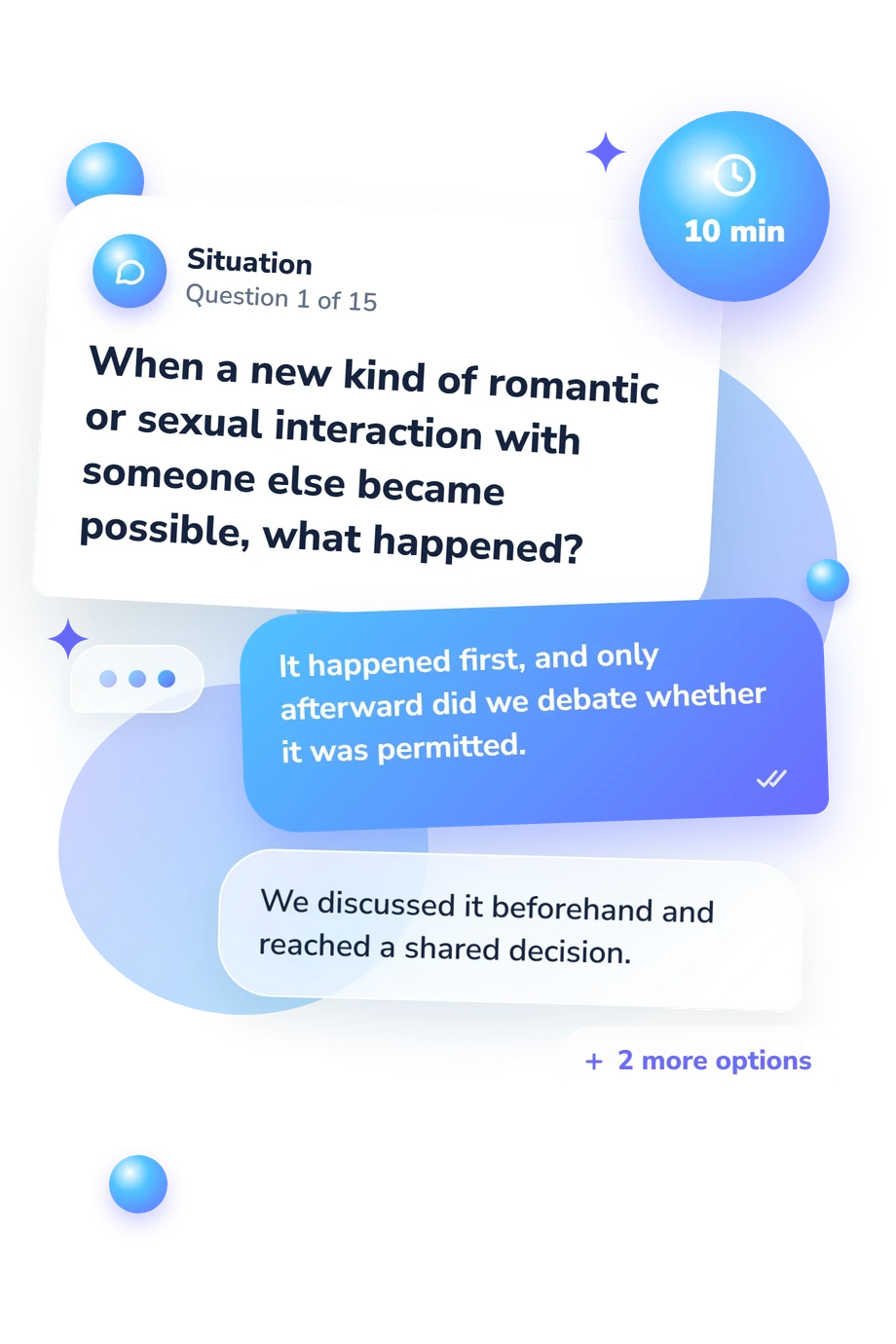
- It happened first, and only afterward did we debate whether it was permitted.
- We discussed it beforehand and reached a shared decision.
- The possibility was avoided or postponed because we could not agree.
- A clearly stated boundary was knowingly crossed.
- We can discuss sexual-health implications and arrange appropriate testing or protection.
- We have acknowledged the issue and intend to address testing or protection soon.
- I am handling testing or protection largely alone because communication remains unclear.
- A serious sexual-health concern remains unaddressed because discussion or cooperation repeatedly breaks down.
- We explicitly agreed on the relationship structure and what it allowed.
- We discussed the general structure but left some situations undefined.
- One of us expressed expectations, but we never reached a clear mutual agreement.
- We relied on conflicting assumptions and still have not resolved them.
Have You Ever Sex Quiz - Description and methodology of the test
For people facing relationship trust concerns, the result can help structure a decision about whether to seek clarification, set a limit, or ask for support. The Have You Ever Sex Quiz connects consent, disclosure, trust, and personal strain to that decision, offering a focused way to discuss specific events and agreements.
What This Assessment Explores
Rather than issuing a yes/no verdict, it examines exclusivity or consensual non-exclusivity, outside contact, secrecy, changing explanations, sexual-health cooperation, and uncertainty’s effects on intimacy, attention, and daily functioning. It suits people sorting through relationship boundaries and trust concerns. By connecting reported situations with current experience, the format helps relate relationship boundary questions to their personal impact.
These are the three result dimensions:
- Agreement and Boundary Strain (0-15) shows agreement clarity or strain: Defined Ground (0-5), Gray Areas (6-10), and Boundary Strain (11-15) mark increasing ambiguity or known crossings.
- Disclosure and Consistency Concerns (0-15) reflects coherence in the reported account: Mostly Coherent (0-5), Unresolved Questions (6-10), and Repeated Inconsistency (11-15) mark increasing omissions or contradictions.
- Trust and Personal Impact (0-15) shows how uncertainty affects trust, intimacy, attention, or wellbeing: Contained Impact (0-5), Active Strain (6-10), and Significant Disruption (11-15) mark increasing impact.
Methodology and Evidence Base
As a structured self-report, each item offers four response choices spanning clearly discussed situations, ambiguity, inconsistency, or personal disruption. The format connects reported relationship details with the respondent’s reaction, so results reflect boundary interpretation and perceived impact. Responses are organized into relevant scales, whose bands organize patterns rather than establish what happened.
The questionnaire is conceptually consistent with Thompson and O’Sullivan’s 2016 infidelity-judgment measure, which links judgments to behavior and understood relationship rules. Hangen, Crasta, and Rogge (2020) place consent at the center of consensual nonmonogamy, while Roggensack and Sillars (2014) address honesty and deception rules. These sources support the constructs but do not make this questionnaire an adaptation of those instruments.
To interpret concerns about possible cheating, read results at item level: relate each result to the specific event, agreement, and current impact; distinguish communication difficulty from safety or sexual health concerns. The bands are unvalidated reflections, not proof of cheating, lie detection, or clinical severity. Self-report depends on memory, context, self-awareness, and openness; Blow and Hartnett (2005) support cautious interpretation. Threats, coercion, or urgent health concerns require action regardless of score.
- Thompson, A. E., & O'Sullivan, L. F. (2016). Drawing the Line: The Development of a Comprehensive Assessment of Infidelity Judgments. Journal of Sex Research, 53(8), 910-926. 10.1080/00224499.2015.1062840
- Hangen, F., Crasta, D., & Rogge, R. D. (2020). Delineating the Boundaries Between Nonmonogamy and Infidelity: Bringing Consent Back into Definitions of Consensual Nonmonogamy With Latent Profile Analysis. The Journal of Sex Research, 57(4), 438-457. 10.1080/00224499.2019.1669133
- Roggensack, K. E., & Sillars, A. (2014). Agreement and Understanding About Honesty and Deception Rules in Romantic Relationships. Journal of Social and Personal Relationships, 31(2), 178-199. 10.1177/0265407513489914
- Blow, A. J., & Hartnett, K. (2005). Infidelity in Committed Relationships I: A Methodological Review. Journal of Marital and Family Therapy, 31(2), 183-216. 10.1111/j.1752-0606.2005.tb01555.x
Updated: