
Parts of a Sentence Quiz
How the Scales are Structured
Who Usually Takes This Test?
See How You Compare
Below is a preview of how scores are typically distributed across each scale.
Example Questions From the Test
- It completes the meaning of a linking verb.
- It names the people performing the action.
- It receives the action of the verb.
- It modifies “practiced” by telling when the action occurred.
- heavy rain interrupted
- rain and game
- interrupted the game
- Thunder and heavy rain
- yesterday
- arrived
- we
- package
Parts of a Sentence Quiz - Description and methodology of the test
Learners who want to strengthen sentence analysis can use the Parts of a Sentence Quiz to check grammatical relationships in context. It suits anyone strengthening sentence analysis through practical examples. As a sentence parts quiz, this assessment focuses on functional roles rather than isolated definitions. The result indicates whether the tested grammar areas may need further review.
What This Assessment Explores
Questions examine how words, phrases, and clauses function. Items cover subjects, predicates, objects, complements, conjunctions, modifiers, appositives, and compound elements.
As a quiz for identifying parts of a sentence, it links labels to functions. It suits learners reviewing English grammar for classwork or study. The result reflects tested recognition, not overall writing ability.
These themes shape the result:
- Sentence roles show subjects, predicates, and objects.
- Clause relationships show complete, dependent, and joined thoughts.
- Modifiers and complements show description, renaming, timing, and roles.
The displayed scale is Parts of a Sentence Knowledge: 0-16. Foundations to review (0-6) reflects partial recognition, with possible confusion about names or functions. Developing command (7-12) shows analysis of common patterns, though complements, modifiers, or multiword elements may need practice. Strong command (13-16) indicates accurate identification of major parts and application of grammar concepts across varied structures.
Methodology and Evidence Base
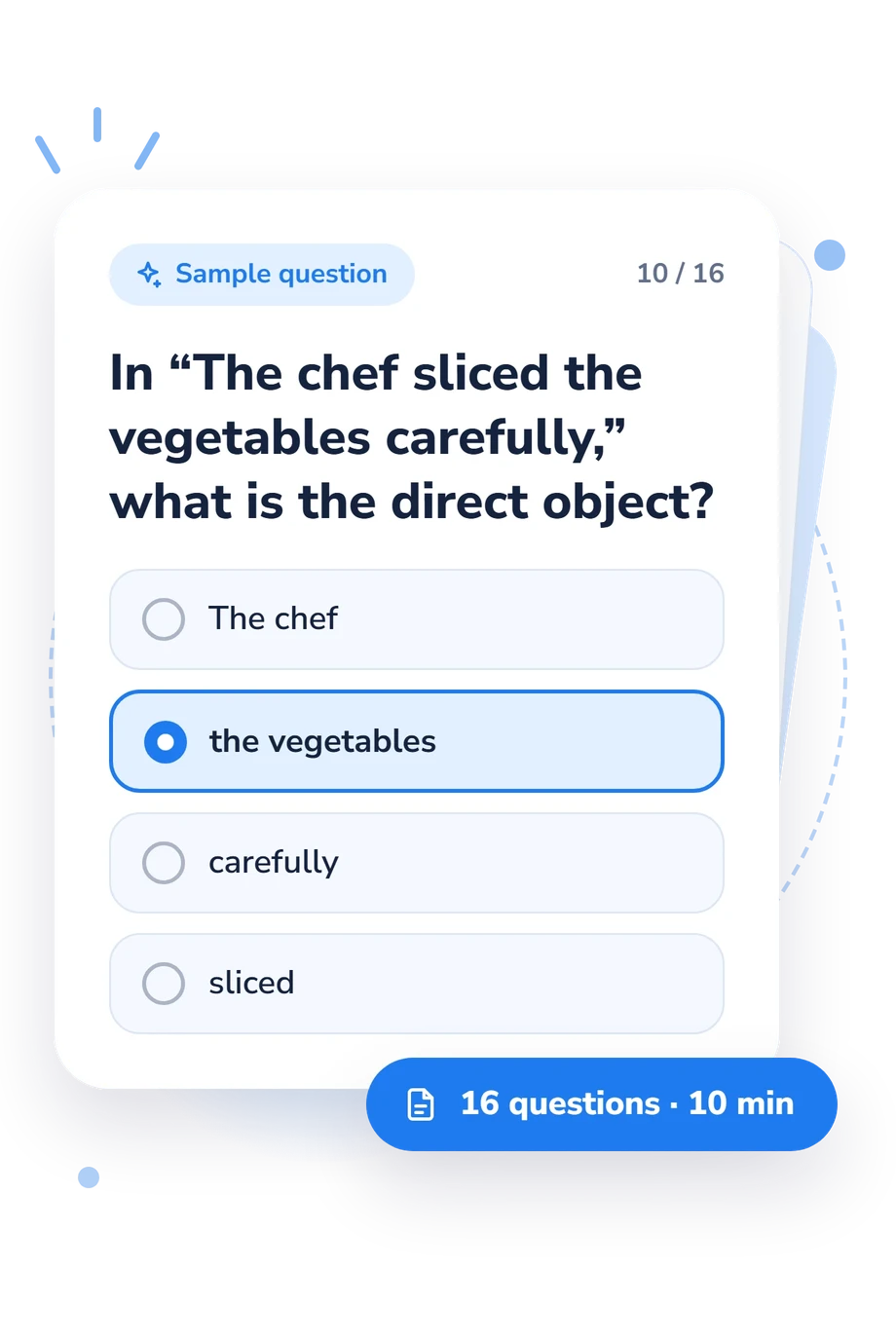
Each item presents a sentence, asks about one grammatical relationship, and offers four answer choices. The learner selects the option that best identifies the requested function, so success depends on reading the construction rather than spotting a word alone. Items range from subjects and predicates to clauses, modifiers, complements, and multiword elements.
In practice, this parts of sentence test uses a direct performance format. The questionnaire reports a 0-16 result and assigns it to the three displayed interpretive bands.
Its terminology is conceptually consistent with Huddleston and Pullum (2002), whose descriptive treatment supports distinctions among clauses, complements, and sentence functions. It also aligns with Huddleston, Pullum, and Reynolds (2022), while Aarts, Chalker, and Weiner (2014) supports terms such as apposition, predicates, and clause types. The questionnaire is conceptually consistent with the grammatical descriptions in these works, while the books do not constitute validation evidence for this online questionnaire.
Because performance can vary with attention, prior instruction, and familiarity with grammatical terminology, one result is best used alongside examples, written work, or teacher feedback.
- Huddleston, Rodney, and Geoffrey K. Pullum, in collaboration with Laurie Bauer, Betty Birner, Ted Briscoe, Peter Collins, David Denison, David Lee, Anita Mittwoch, Geoffrey Nunberg, Frank Palmer, John Payne, Peter Peterson, Lesley Stirling, and Gregory Ward. 2002. The Cambridge Grammar of the English Language. Cambridge: Cambridge University Press. 10.1017/9781316423530
- Huddleston, Rodney, Geoffrey K. Pullum, and Brett Reynolds. 2022. A Student's Introduction to English Grammar, 2nd ed. Cambridge: Cambridge University Press. 10.1017/9781009085748
- Aarts, Bas, Sylvia Chalker, and Edmund Weiner. 2014. The Oxford Dictionary of English Grammar, 2nd ed. Oxford: Oxford University Press.
Updated: