
Robotics Quiz
How the Scales are Structured
Who Usually Takes This Test?
See How You Compare
Below is a preview of how scores are typically distributed across each scale.
Example Questions From the Test
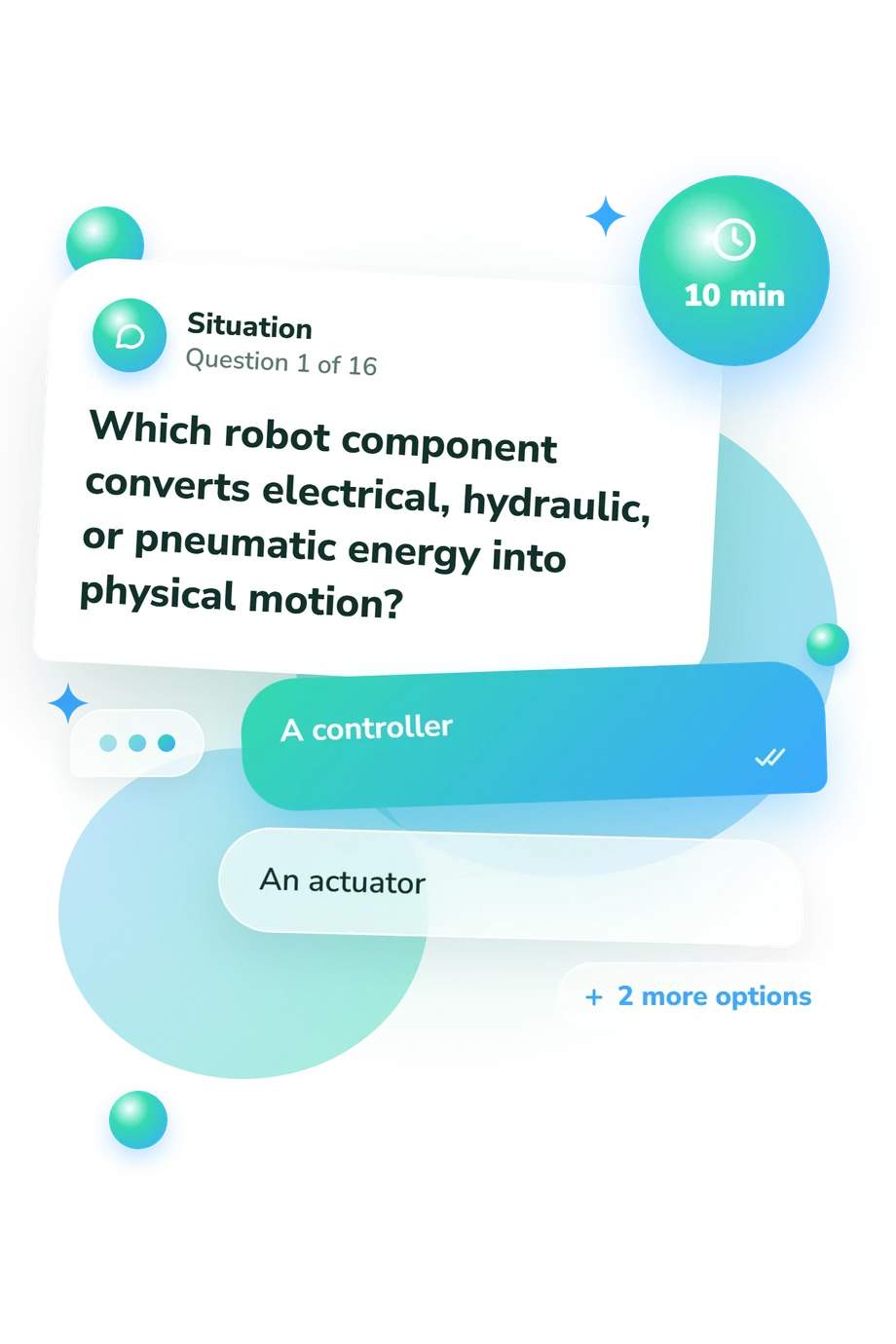
- A controller
- An actuator
- A sensor
- A power regulator
- Their application still requires a task-specific risk assessment
- They can operate beside people without any safeguards or limits
- They are defined solely by having a lightweight arm
- They cannot use grippers or other powered tools
- A higher-resolution navigation map
- A higher maximum motor speed
- A rigid open-loop closing command
- Closed-loop force or tactile feedback
Robotics Quiz - Description and methodology of the test
Learners revisiting fundamentals, educators checking course coverage, and hobbyists planning a project can use this robotics quiz when deciding what to study next. It suits readers who want to test preparation against practical decisions rather than a personality profile. Questions about robotics in this quiz place readers in short engineering scenarios involving components, energy, control, sensing, motion, and safe operation. The result helps identify topics for follow-up.
What This Assessment Explores
The assessment checks whether someone can recognize core concepts and apply them to brief engineering situations, rather than recall isolated definitions. It is suitable for readers building foundational knowledge or revisiting familiar material.
The questions sample these connected areas:
- Sensing and feedback show how well you connect encoders, LiDAR, tactile input, and closed-loop information with reliable robot behavior.
- Motion and kinematics show whether you can reason about wheel commands, joint angles, stability, and end effectors.
- Control and computation test distinctions among PID terms, finite-state logic, mapping, and battery energy.
- Operation and safety show whether you understand teleoperation, emergency stops, and safeguards around collaborative robots.
The result is reported on the Robotics Knowledge scale (0-16): Foundation Building (0-6), Developing Knowledge (7-12), or Strong Knowledge (13-16). This robotics knowledge test gives a compact indication of conceptual readiness, while practical dexterity and design judgment remain separate abilities.
Methodology and Evidence Base
Each item presents a short concept or scenario with four answer choices. The respondent selects the option that best fits, and the questionnaire reports one overall result across sensing, actuation, kinematics, control, energy, navigation, teleoperation, and safety rather than separate subscores.
The closest content reference is Robotics content knowledge quiz (Mallik et al., 2023), which distinguishes robotics knowledge from familiarity and self-efficacy. This questionnaire is conceptually consistent with that work, not an adaptation of its study instrument. Siciliano et al. (2009) supplies the technical framework for kinematics, planning, feedback control, and operation. ISO/TS 15066:2016 anchors the collaborative-robot safety context. Recognizing a correct answer does not demonstrate hands-on operating skill or design ability.
The displayed bands classify performance on the selected knowledge items. Guessing and prior technical exposure can affect the result, so this robotics assessment is most useful when it guides targeted review through practice, troubleshooting, or project work.
- Mallik, Abhidipta, Dongdong Liu, and Vikram Kapila. (2023). Analyzing the outcomes of a robotics workshop on the self-efficacy, familiarity, and content knowledge of participants and examining their designs for end-of-year robotics contests. Education and Information Technologies, 28(6), 7225-7264. DOI 10.1007/s10639-022-11400-1
- Lane, Jacqueline N., Zoe Szajnfarber, Jason Crusan, and Michael Menietti. (2026). Beyond feasibility filters: How expertise heterogeneity enables innovation recognition. Strategic Management Journal, 47(5), 1368-1432. DOI 10.1002/smj.70060
- Siciliano, Bruno, Lorenzo Sciavicco, Luigi Villani, and Giuseppe Oriolo. (2009). Robotics: Modelling, Planning and Control. Springer London. DOI 10.1007/978-1-84628-642-1
- International Organization for Standardization. (2016). ISO/TS 15066:2016, Robots and robotic devices - Collaborative robots. International Organization for Standardization.
Updated: