
Logo Alphabet Quiz
How the Scales are Structured
Who Usually Takes This Test?
See How You Compare
Below is a preview of how scores are typically distributed across each scale.
Example Questions From the Test
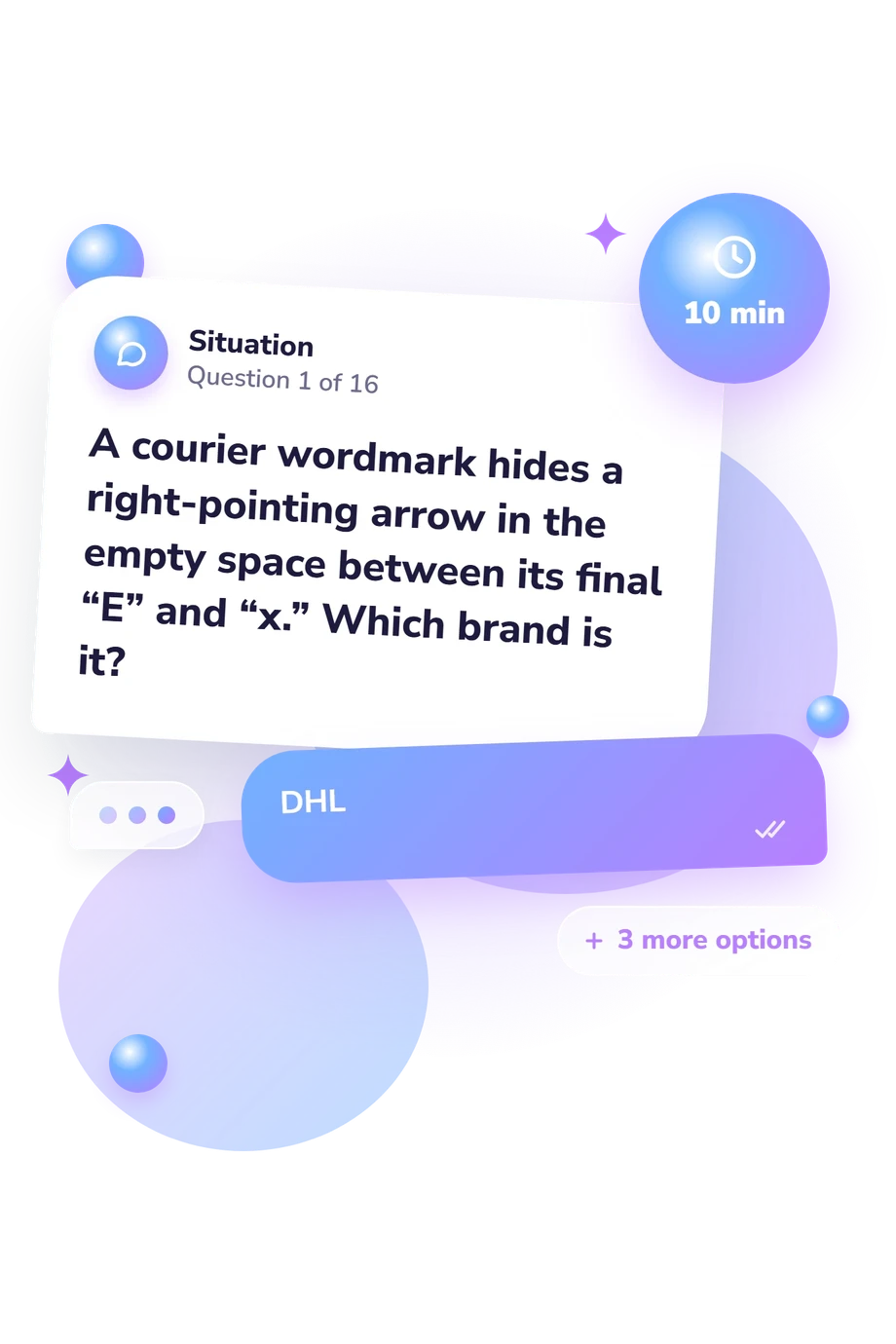
- DHL
- FedEx
- UPS
- TNT
- Volvo
- VinFast
- Vauxhall
- Volkswagen
- Celine
- Coach
- Cartier
- Chanel
Logo Alphabet Quiz - Description and methodology of the test
People who enjoy branding, visual puzzles, or design trivia can use this logo alphabet quiz to examine how readily they connect familiar marks with letters, wordforms, and hidden graphic ideas. It suits readers who want a structured logo recognition test rather than casual guessing and presents an overall recognition level for the displayed clues.
What This Assessment Explores
Recognition is broader than recalling a company name: as a brand alphabet quiz, the assessment connects brand knowledge with letter placement, negative space, monograms, and typographic treatment. Its result describes familiarity with alphabet-based branding, not artistic talent. Areas include:
- Hidden symbols reveal whether you notice arrows, smiles, numbers, faces, or technical references formed within lettering.
- Letterforms and monograms show how confidently you connect mirrored initials, tilted characters, and stylized capitals with brands.
- Brand identification and logo categories show whether you can name the company and classify its design as a lettermark, wordmark, emblem, or pictorial mark.
The displayed Logo Alphabet Knowledge scale runs from 0-16. Emerging Recognition (0-6) indicates some cue recognition with possible confusion; Developing Recognition (7-12) indicates broader familiarity with room for finer distinctions; Strong Recognition (13-16) indicates broad knowledge of alphabet-based logos, typographic clues, and visual wordplay.
Methodology and Scientific Basis
Each item pairs a logo clue or design question with four answer choices. Prompts ask for a brand, identify a logo category, or name a technique such as negative space. Framed as an alphabet logo test, the questionnaire combines applied recognition with basic logo literacy.
The result is reported on the displayed scale and should be read as performance across these items, while the bands function as descriptive levels rather than population norms or clinical thresholds.
A car-logo memory study by Mayas examines recall, recognition, and naming with car brand logos. Perea and colleagues link letter visual similarity with brand-name identification, and Whatley and colleagues show that familiar-logo features can be misremembered. Henderson and Cote contribute a framework for evaluating logo elements and distinctiveness. Together, these studies provide conceptual parallels; this questionnaire is neither based on nor an adaptation of them, and they do not validate this exact online version or provide its norms.
Prior exposure to international brands, attention, language familiarity, and guessing can influence performance, so the result is a snapshot of current logo knowledge.
- Mayas, J., Prieto, A., & Montoro, P. R. (2024). Memory and metamemory in everyday settings: Assessing recall, recognition, and naming using car brand logos. Applied Cognitive Psychology, 38(1), e4138. 10.1002/acp.4138
- Perea, M., Baciero, A., Labusch, M., Fernández-López, M., & Marcet, A. (2022). Are brand names special words? Letter visual-similarity affects the identification of brand names, but not common words. British Journal of Psychology, 113(3), 835-852. 10.1111/bjop.12557
- Whatley, M. C., Schwartz, S. T., Block, J. B., & Castel, A. D. (2023). Memory, metamemory, and false memory for features of the Apple logo. Applied Cognitive Psychology, 37(5), 904-918. 10.1002/acp.4088
- Henderson, P. W., & Cote, J. A. (1998). Guidelines for Selecting or Modifying Logos. Journal of Marketing, 62(2), 14-30. 10.1177/002224299806200202
Updated: