
Protein Quiz
How the Scales are Structured
Who Usually Takes This Test?
See How You Compare
Below is a preview of how scores are typically distributed across each scale.
Example Questions From the Test
- Insulin
- Bile
- Pepsin
- Lactase
- Leucine
- Lysine
- Tryptophan
- Methionine
- 9 grams of protein per 50-gram serving
- 12 grams of protein per 80-gram serving
- 20 grams of protein per 200-gram serving
- 18 grams of protein per 90-gram serving
Protein Quiz - Description and methodology of the test
People seeking a clearer grasp of everyday nutrition can use this protein quiz to examine how they reason about food sources, digestion, amino acids, labels, and meal planning. It suits learners, shoppers, and anyone checking whether familiar protein advice rests on sound principles. Its nutrition quiz about protein turns correct and incorrect choices into a practical snapshot of what to review next.
What This Assessment Measures
This assessment focuses on applied knowledge rather than personal intake. Questions cover plant and animal sources, complete and complementary proteins, essential amino acids, digestion, cooking, biological roles, energy values, protein density, label arithmetic, and meal distribution. It suits readers comparing foods or checking common nutrition claims. As a protein knowledge test, the result shows alignment with core concepts, not whether a diet is adequate.
One scale reports Protein Knowledge: 0-16. The catalogue uses three bands:
- Foundations to build (0-6) means core sources, amino acids, and label comparisons need review.
- Developing knowledge (7-12) shows many core ideas with room to improve practical comparisons.
- Strong knowledge (13-16) reflects solid command of sources, functions, and food choices.
This educational score does not assess intake, health, or individual dietary needs.
Methodology and Evidence Base
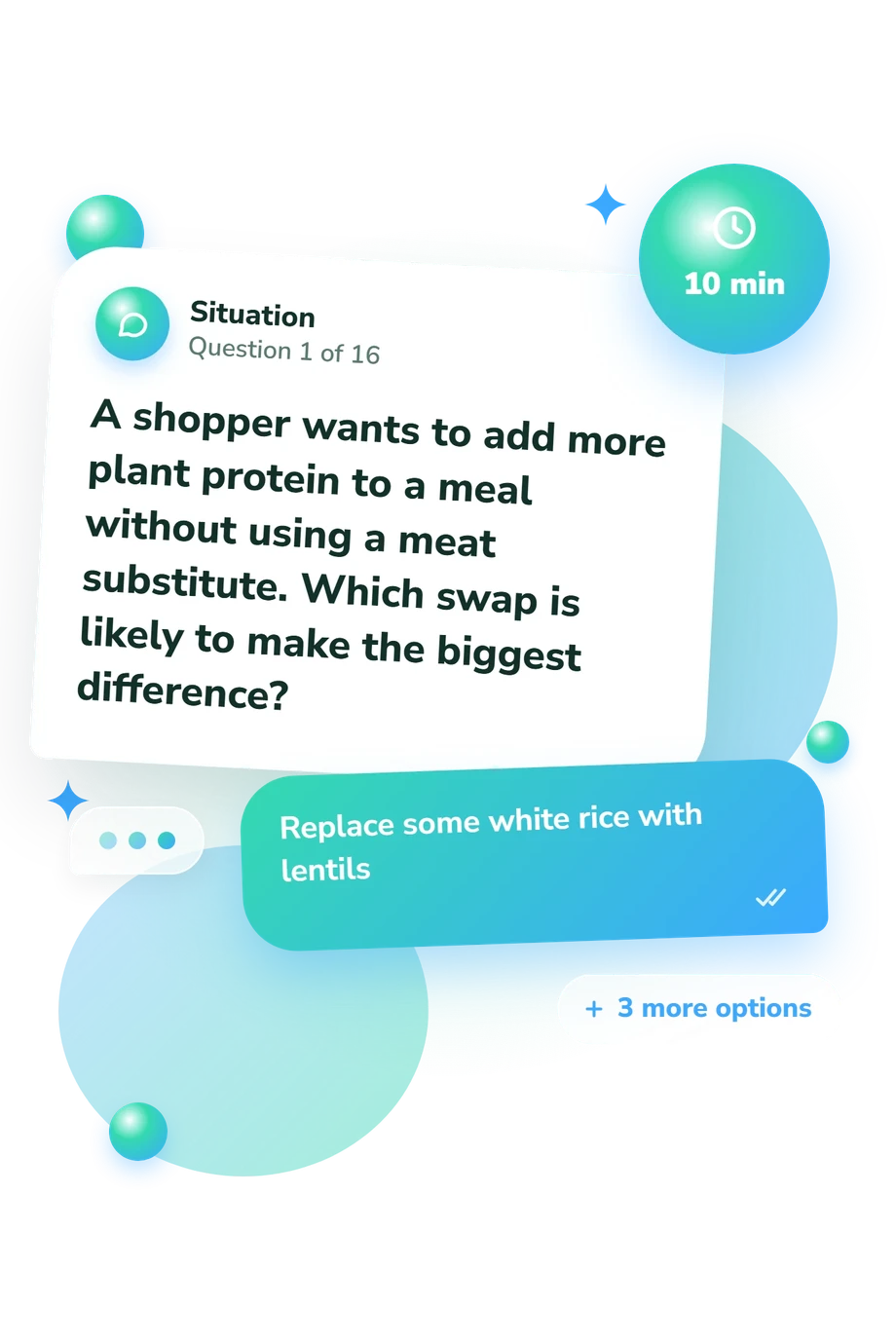
Each item presents a nutrition question with four answer choices, asking you to select the option that best fits an established protein fact or practical food-choice problem. The set combines recall, comparison, calculation, and application: a respondent may identify pepsin, compare protein per serving, judge amino-acid completeness, or calculate whether label servings reach a target.
Scoring is straightforward: each correct answer contributes one point to the total. The resulting level describes performance on this questionnaire rather than a population norm, so a stronger result means more accurate responses across the covered topics. Read it as a guide to learning priorities and topic review.
The evidence base is conceptually consistent with the Dietary Protein Assessment Questionnaire (DPAQ) described by Gutjahr, Warren, and Miketinas (2023), with protein-knowledge work by Visser, Hung, and Verbeke (2021), and with the general nutrition framework of Parmenter and Wardle (1999). This protein assessment quiz is not an adaptation of those published instruments. Its online result has no population norms; guessing, attention, prior learning, and familiarity with nutrition terms can affect multiple-choice performance.
- Gutjahr P, Warren C, Miketinas D. Construct validity of a dietary protein assessment questionnaire to explore college students’ knowledge and attitudes towards dietary protein. Frontiers in Nutrition. 2023;10:1289946. 10.3389/fnut.2023.1289946
- Visser M, Hung Y, Verbeke W. Protein Knowledge of Older Adults and Identification of Subgroups with Poor Knowledge. Nutrients. 2021;13(3):1006. 10.3390/nu13031006
- Parmenter K, Wardle J. Development of a general nutrition knowledge questionnaire for adults. European Journal of Clinical Nutrition. 1999;53(4):298-308. 10.1038/sj.ejcn.1600726
Updated: