
Population Quiz
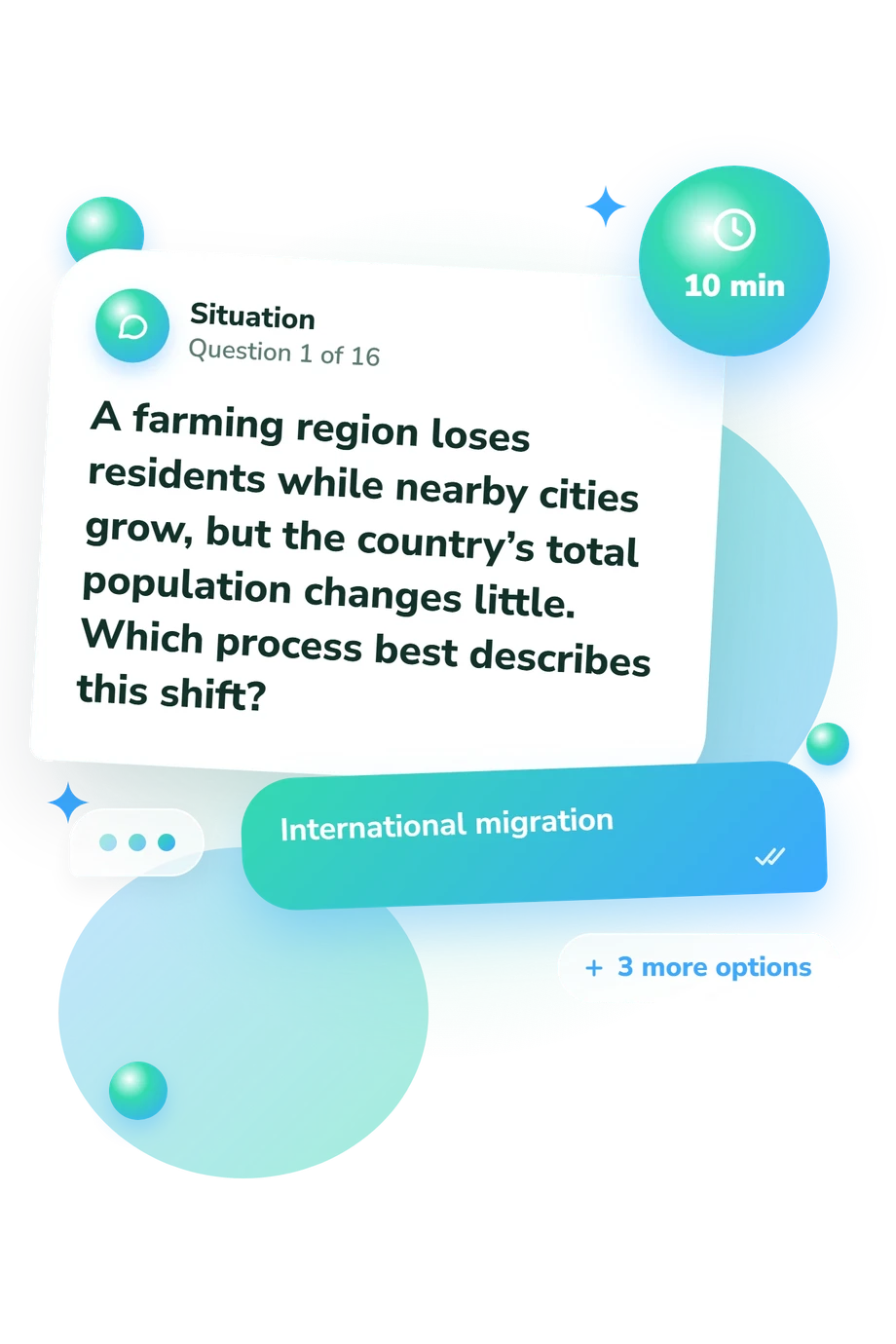
How the Scales are Structured
Who Usually Takes This Test?
See How You Compare
Below is a preview of how scores are typically distributed across each scale.
Example Questions From the Test
- Nigeria
- Ghana
- Kenya
- Angola
- A decrease of 300,000
- No change, because migration is unknown
- An increase of 1.5 million
- An increase of 300,000
- Portugal
- Mozambique
- Brazil
- Angola
Population Quiz - Description and methodology of the test
Students, teachers, and curious geography readers can use this assessment when deciding whether to review population geography before moving to more advanced study. The population quiz provides a compact way to check readiness for lessons, revision, or informal learning. Readers can use it as a population geography quiz that connects place recognition with demographic reasoning through short, answerable tasks.
What This Assessment Explores
Items connect demographic processes with spatial patterns, asking respondents to distinguish natural change from migration, interpret fertility and age structure, compare density, identify countries from geographic clues, and recognize census undercounting.
Learners can connect textbook vocabulary with real places. A higher band reflects performance across these themes, not general academic ability.
The main themes are:
- Demographic change links births, deaths, fertility, and ageing with growth or decline.
- Migration and urbanization explain how movement and city growth reshape settlement.
- Distribution and place reasoning connect location, density, regional concentration, and landscape clues.
Population Knowledge spans 0-16: Foundations (0-6) reflects pattern recognition, with demographic terms and major settlement regions to review; Developing Knowledge (7-12) reflects understanding of many concepts and clues, with comparisons and calculations to sharpen; Strong Knowledge (13-16) reflects a well-rounded command of population geography and demographic reasoning. Reviewing quiz questions about population can guide further practice.
Methodology and Scientific Basis
Each item presents a demographic scenario or country clue with four answer choices. The respondent selects the best answer, sometimes by recalling a place or concept and sometimes by applying arithmetic to births and deaths, net migration, or population density. This population knowledge quiz therefore emphasizes applied geography as well as factual recognition.
The total reflects correct responses across the 16 items, and the result should be read through the displayed score bands. Its format is descriptive: it summarizes performance on these questions.
The Knowledge of Geography (KOG) Test offers a conceptual comparison for the questionnaire’s geography-knowledge format, without establishing that this set is an adaptation or administration of that instrument. Population-geography concepts represented in the items, including migration, fertility, density, and age structure, correspond to concepts discussed in Newbold’s population-geography work, while census undercounting connects with the United Nations census framework.
Performance can be affected by prior study, language familiarity, guessing, attention, and how confidently a person interprets the scenarios. The displayed bands are performance ranges for this set, so the result is best used to guide self-directed review and broader learning.
- Nelson, Burton D., Robert H. Aron, and Debra A. Poole. (1999). Underprediction of Female Performance from Standardized Knowledge Tests: A Further Example from the Knowledge of Geography Test. Sex Roles, 41(7-8), 529-540.
- Henrie, Roger L., Robert H. Aron, Burton D. Nelson, and Debra A. Poole. (1997). Gender-Related Knowledge Variations Within Geography. Sex Roles, 36(9-10), 605-623. 10.1023/A:1025618024694
- Newbold, K. Bruce. (2026). Population Geography: Tools and Issues (5th ed.). Bloomsbury Academic.
- United Nations, Department of Economic and Social Affairs, Statistics Division. (2017). Principles and Recommendations for Population and Housing Censuses, Revision 3. United Nations, New York. Sales No. 15.XVII.10.
Updated: