
Patronus Quiz
How the Scales are Structured
Who Usually Takes This Test?
See How You Compare
Below is a preview of how scores are typically distributed across each scale.
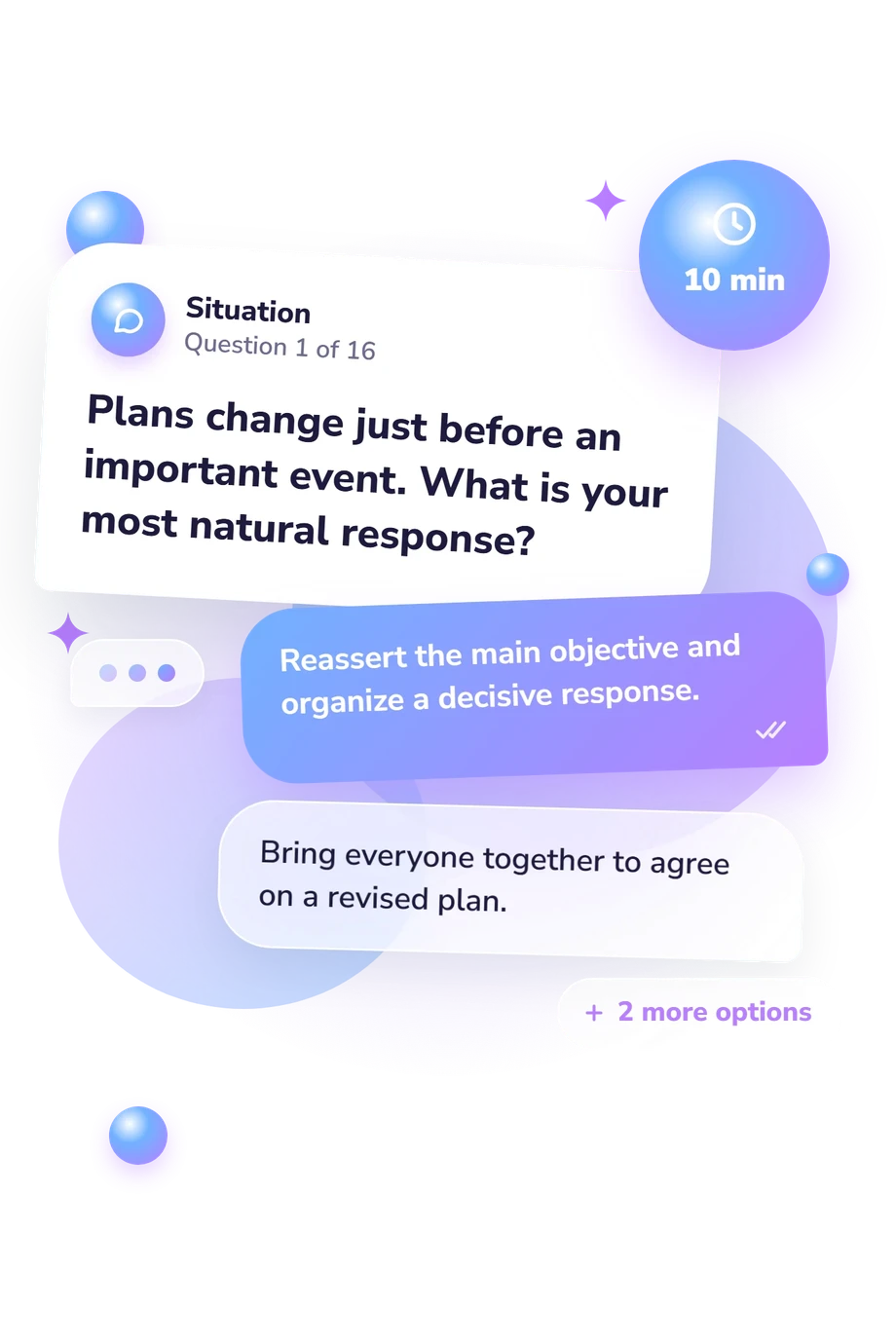
Example Questions From the Test
- Reassert the main objective and organize a decisive response.
- Bring everyone together to agree on a revised plan.
- Test an amusing or unconventional possibility.
- Scan the new situation quickly and adjust your own route.
- Who appears ready to take responsibility.
- What looks unusual, interesting, or open to exploration.
- Where you could quietly observe without committing too soon.
- How people relate to one another and where you might fit.
- Standing visibly for a principle even when challenged.
- Staying loyal when a group is under pressure.
- Keeping hope alive through curiosity and humor.
- Trusting your perception and taking an unconventional path alone.
Patronus Quiz - Description and methodology of the test
Designed for readers who enjoy the Harry Potter world, the patronus quiz turns everyday choices into a symbolic profile rather than a formal personality assessment. Readers asking what is my Patronus can use the result to consider responses to change, responsibility, friendship, and uncertainty. It offers a playful starting point for self-reflection, not a permanent identity.
What This Assessment Explores
Situations involving change, conflict, support, moral choice, and persistence reveal four response styles. Presented as a Harry Potter quiz about Patronuses, it suits readers seeking a themed reflection on noticing circumstances, handling pressure, and relating to groups. The result describes an affinity, not a permanent type.
The displayed bands are:
- Hare Patronus (0-12) reflects alert independence, imagination, and swift adaptation: Quiet Echo (0-4), Emerging Hare (5-8), Hare Affinity (9-12).
- Otter Patronus (0-12) reflects curiosity, playful intelligence, and warm resourcefulness: Quiet Echo (0-4), Emerging Otter (5-8), Otter Affinity (9-12).
- Stag Patronus (0-12) reflects principled courage, visible leadership, and protective resolve: Quiet Echo (0-4), Emerging Stag (5-8), Stag Affinity (9-12).
- Wolf Patronus (0-12) reflects loyalty, group awareness, and resilient cooperation: Quiet Echo (0-4), Emerging Wolf (5-8), Wolf Affinity (9-12).
The highest score shows the strongest affinity; a result within one point creates a blend.
Methodology and Thematic Basis
Each item presents a situation with four contrasting options about change, group strain, support, moral choice, observation, or inventive problem-solving. The format asks which response feels natural rather than testing knowledge. Readers asking what's my Patronus can treat the profile as a summary of recurring preferences.
Displayed scoring aggregates responses into four affinity scores; the ranges do not establish another point rule. The strongest result is the clearest pattern, while a near-tie produces a blend. A quiz about the Patronus charm keeps the interpretation imaginative rather than fixed.
The framework is conceptually consistent with the Pottermore Patronus experience (Rowling, 2016) and the symbolic role of Patronuses in Rowling's 2003 and 2005 novels. Jakob and colleagues' 2019 Sorting Hat analysis offers adjacent evidence about themed quizzes, personality, and values, but did not validate this Patronus scoring system.
As an online self-report questionnaire rather than a standardized personality inventory, it can reflect mood, context, self-awareness, and answer candor as well as recurring preferences. Read the result alongside lived experience as a reflection prompt, not a definitive classification.
- Pottermore. (2016, September 22). Discover your Patronus on Pottermore.
- Rowling, J. K. (2003). Harry Potter and the Order of the Phoenix. Bloomsbury.
- Rowling, J. K. (2005). Harry Potter and the Half-Blood Prince. Bloomsbury.
- Jakob, Lea, Eduardo Garcia-Garzon, Hannes Jarke, and Fabian Dablander. (2019). The Science Behind the Magic? The Relation of the Harry Potter “Sorting Hat Quiz” to Personality and Human Values. Collabra: Psychology, 5(1), 31. 10.1525/collabra.240
Updated: