
Middle East Capitals Quiz
How the Scales are Structured
Who Usually Takes This Test?
See How You Compare
Below is a preview of how scores are typically distributed across each scale.
Example Questions From the Test
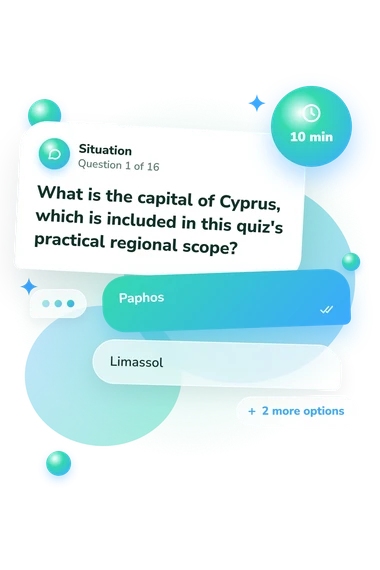
- Paphos
- Limassol
- Larnaca
- Nicosia
- Abu Dhabi
- Sharjah
- Dubai
- Doha
- Lebanon — Amman
- Lebanon — Beirut
- Lebanon — Tripoli
- Lebanon — Damascus
Middle East Capitals Quiz - Description and methodology of the test
People who want to strengthen regional geography can use the Middle East Capitals Quiz to test practical recall of national capitals and country-capital relationships. It suits learners, travelers, students, and curious adults who prefer a focused regional exercise to a broad survey of world geography. Covering Middle Eastern countries and their capitals, this Middle East countries and capitals quiz shows which pairings feel secure and where targeted review may help.
What This Assessment Measures
This assessment checks capital-city recall across a practical regional scope. Items cover Gulf states, Levantine countries, Türkiye, Iran, Iraq, Egypt, Saudi Arabia, Jordan, Cyprus, and neighboring pairings. In practical terms, this Middle East cities quiz asks for a capital within direct, travel, diplomatic, conference, or itinerary scenarios.
The displayed scale, Middle East Capitals Knowledge (0-16), reflects accuracy with the covered country-capital pairings, not exhaustive regional expertise. Results are grouped as follows:
- Foundations to Build (0-6) indicates recognition of some capitals but possible confusion among neighboring countries or prominent non-capital cities.
- Developing Knowledge (7-12) shows many pairings are known while less familiar regional examples may need review.
- Strong Knowledge (13-16) suggests nearly all covered capitals are identified accurately, including in comparison and travel contexts.
This capital knowledge check describes current recall, not a permanent measure of ability.
Methodology and Evidence Base
Each item uses a multiple-choice format with four answer options. Prompts ask directly for a capital, reverse the pairing, request two capitals in order, or place the fact in a travel, diplomatic, conference, or itinerary situation.
Together, the items form an online multiple-choice knowledge check focused on country-capital knowledge. The questionnaire reports one overall knowledge score with the displayed bands; no separate Gulf, Levant, or country-level subscores are reported. The result describes performance across these items rather than establishing broader geographic expertise.
This is a factual recall exercise, so the displayed bands describe performance on these items rather than a psychological trait. Attention, guessing, prior study, self-confidence, and regional definitions can affect the result, so interpret it as a practical self-check of recall at the time of completion. That makes it useful for directing review toward particular country-capital pairings within the tested regional scope.
- De Witte, Benjamin, Vincent Reynaert, Jerome Hutain, Danny Kieken, Joseph Jabbour, and Jalal Possik. "Immersive learning of factual knowledge while assessing the influence of cognitive load and spatial abilities." Computers & Education: X Reality, vol. 5, 2024, article 100085. 10.1016/j.cexr.2024.100085
- Friedman, William J., and Patricia A. deWinstanley. "The mental representation of countries." Memory, vol. 14, no. 7, 2006, pp. 853-871. 10.1080/09658210600782925
- United Nations Statistics Division and United Nations Group of Experts on Geographical Names. "UNGEGN World Geographical Names Database." United Nations, 2012.