
MCYT Quiz
How the Scales are Structured
Who Usually Takes This Test?
See How You Compare
Below is a preview of how scores are typically distributed across each scale.
Example Questions From the Test
- Dodgebolt
- Sky Battle
- Survival Games
- Battle Box
- TommyInnit and Wilbur Soot
- Sapnap and Quackity
- BadBoyHalo and Skeppy
- Dream and GeorgeNotFound
- Grian
- Mumbo Jumbo
- Generikb
- Xisumavoid
MCYT Quiz - Description and methodology of the test
Fans who follow Minecraft creators, shared servers, and competitive events can use this Minecraft creator quiz to check how well they recognize recurring names, formats, lore, and terminology. The MCYT Quiz suits a curious newcomer or an established viewer wanting a quick snapshot of familiarity. The result focuses on knowledge of the community, not personality, identity, or personal fandom style.
What This Assessment Measures
The questions sample familiarity with MCYT culture: creator names, visual identities, SMP premises, major events, game formats, server mechanics, and viewer vocabulary. Some items ask for direct recall, while others describe a concept and require the best matching project or creator. That makes the questionnaire a practical MCYT knowledge test while still covering multiplayer storytelling and competition.
The single MCYT Knowledge scale (0-16) groups the result into these bands:
- New Explorer (0-6) indicates recognition of parts of the wider MCYT world, with less familiarity across creators, events, and server concepts.
- Developing Fan (7-12) indicates a solid base across several areas of MCYT culture, with room to explore less familiar series.
- MCYT Expert (13-16) indicates broad, detailed knowledge of prominent creators, formats, and multiplayer projects.
The result describes familiarity rather than enthusiasm or worth; a lower band may reflect limited exposure.
Methodology and Context
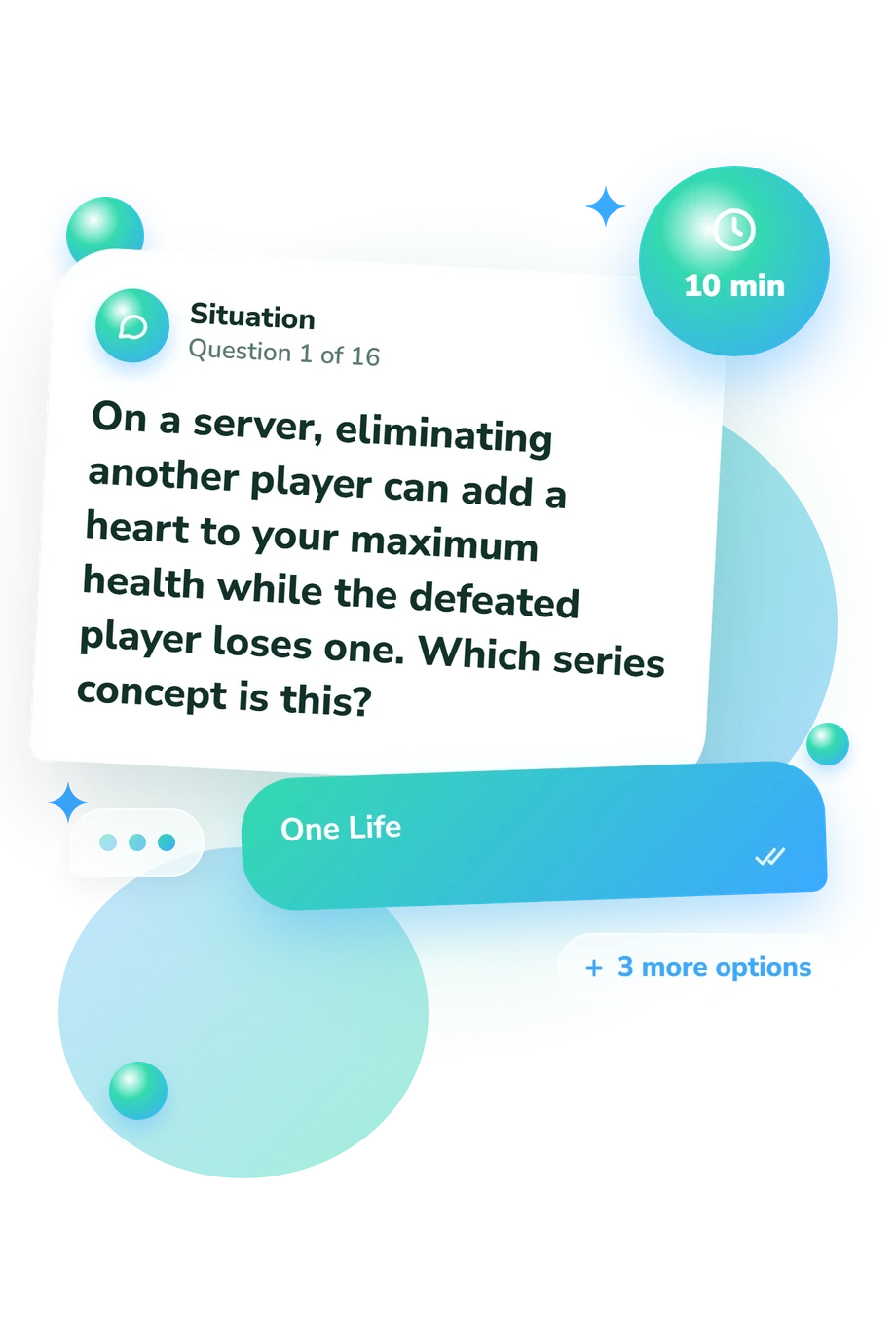
Each item presents four answer choices and uses direct recall or a short scenario to identify a creator, project, event, format, or term. Related distractors test recognition and discrimination rather than open-ended writing. Prompts about server lore and mechanics give it the practical shape of a Minecraft SMP quiz.
This is factual recognition rather than a personality-trait model; the questionnaire reports one aggregate knowledge result, and no independent item-weighting system is established.
This is an original online knowledge check rather than an adaptation of a published psychological instrument or theoretical model. Research on Minecraft creator communities, fan identity, learning, and collaborative participation provides context for the subject, but it does not establish this questionnaire’s scoring, validity, or construct.
The displayed bands are descriptive categories for this questionnaire rather than validated population norms. Results may vary with recent viewing, memory, guessing, and familiarity with creator communities, so the score is best read as a snapshot of current knowledge.
- Samsudin, Mohd Ali, and Goh Kok Ming. "Gaming on Social Media: An X- and YouTube-Driven Social Network Analysis of Minecraft Conversations." In Oxford Intersections: Social Media in Society and Culture. Oxford University Press, 2026. 10.1093/9780198945253.003.0004
- Potts, Amanda. "‘LOVE YOU GUYS (NO HOMO)’: How Gamers and Fans Play with Sexuality, Gender, and Minecraft on YouTube." Critical Discourse Studies, vol. 12, no. 2, 2015, pp. 163-186. 10.1080/17405904.2014.974635
- Niemeyer, Dodie J., and Hannah R. Gerber. "Maker Culture and 'Minecraft': Implications for the Future of Learning." Educational Media International, vol. 52, no. 3, 2015, pp. 216-226. 10.1080/09523987.2015.1075103
- Walker, Justice T., Stefan Slater, and Yasmin B. Kafai. "A Scaled Analysis of How Minecraft Gamers Leverage YouTube Comment Boxes to Participate and Collaborate." In A Wide Lens: Combining Embodied, Enactive, Extended, and Embedded Learning in Collaborative Settings, 13th International Conference on Computer Supported Collaborative Learning (CSCL 2019), vol. 1, 2019, pp. 440-447. International Society of the Learning Sciences.
Updated: