
Hypothyroidism Quiz
How the Scales are Structured
Who Usually Takes This Test?
See How You Compare
Below is a preview of how scores are typically distributed across each scale.
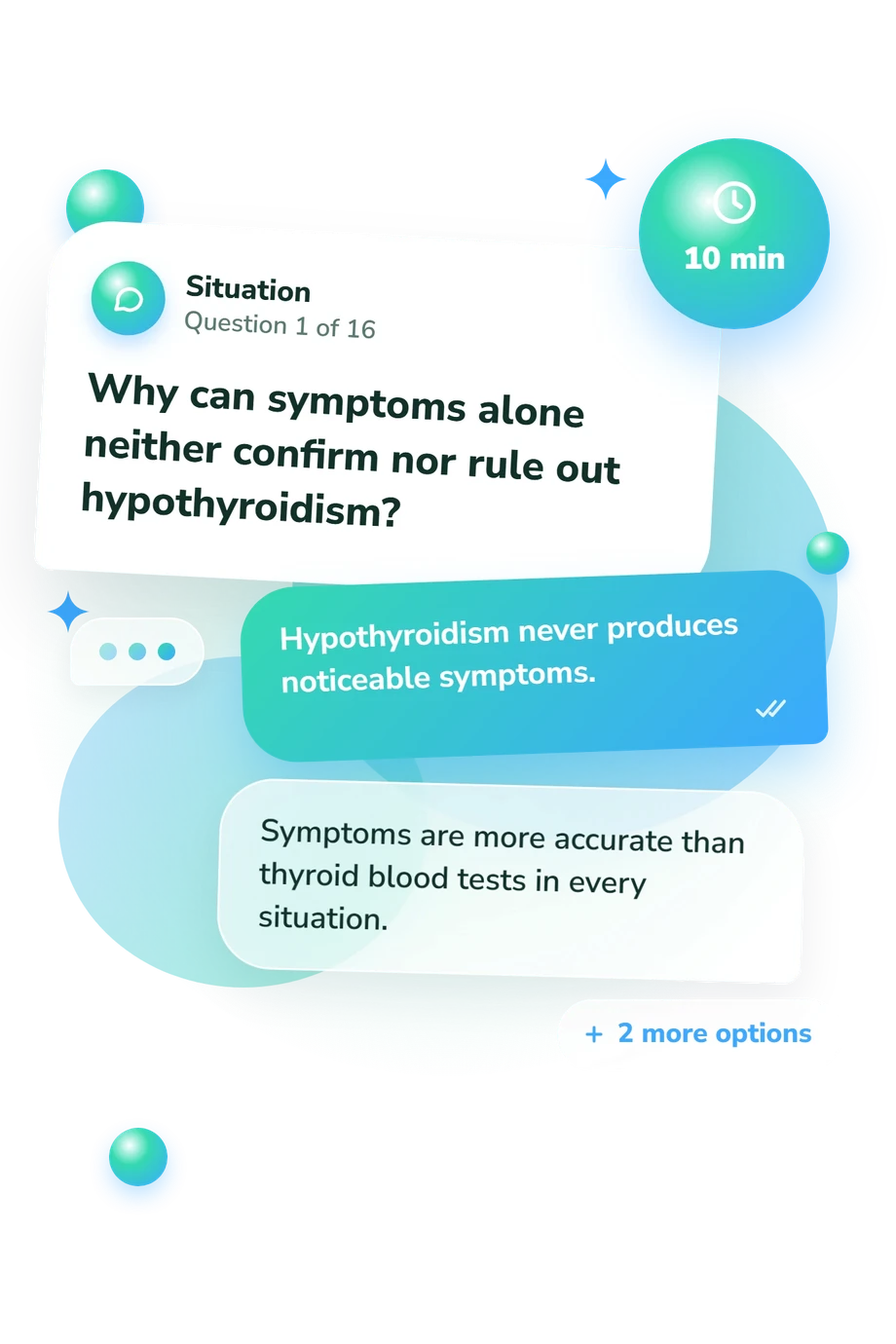
Example Questions From the Test
- Thyroid-stimulating hormone (TSH)
- Cortisol
- Insulin
- Parathyroid hormone (PTH)
- Low TSH with low free T4
- Low TSH with high free T4
- Normal TSH with low free T4
- Elevated TSH with free T4 still within the reference range
- Graves’ disease
- Type 1 diabetes
- Hashimoto’s thyroiditis
- Cushing syndrome
Hypothyroidism Quiz - Description and methodology of the test
For readers who want a clearer grasp of thyroid health, this hypothyroidism quiz organizes knowledge about symptoms, laboratory patterns, causes, treatment routines, and safety issues. It helps learners choose topics for further study or discussion with a healthcare professional. As a thyroid quiz, it emphasizes understanding of the subject.
What This Assessment Measures
These questions examine how low thyroid hormone activity is recognized and managed. They cover overlapping symptoms, TSH and free T4 patterns, primary and central disease, subclinical and overt findings, congenital and postpartum conditions, iodine, levothyroxine, pregnancy, and medication absorption.
The focus is educational: a hyperthyroidism quiz would center on excessive thyroid activity, while this assessment asks readers to reason about insufficient activity and safe next steps. The result describes knowledge, not health status.
Its single scale is Hypothyroidism Knowledge, scored from 0-16. The displayed bands are:
- Foundations to build (0-6) indicates that basic thyroid roles, testing patterns, or treatment precautions need review.
- Developing knowledge (7-12) shows many core ideas with some causes, laboratory findings, or care points to revisit.
- Strong knowledge (13-16) reflects a well-rounded grasp of common hypothyroidism concepts.
A result can help someone asking whether they have hypothyroidism identify misconceptions, but symptoms alone cannot establish the cause of common complaints.
Methodology and Evidence Base
Each item presents four answer choices and asks for the most accurate response to a symptom, laboratory pattern, cause, treatment situation, or safety concern. The format tests recognition and reasoning instead of asking respondents to rate their own symptoms.
Perros et al. (2025) is the closest published evidence for this subject because it documents knowledge gaps in hypothyroidism diagnosis and treatment. This questionnaire is conceptually consistent with that work, but it is not the published survey or a validated adaptation. Garber et al. (2012) and Jonklaas et al. (2014) support distinctions involving biochemical interpretation, pregnancy, levothyroxine use, medication timing, and treatment monitoring.
No standardization or clinical norms are stated for this online questionnaire, and the score bands should be read as descriptions of knowledge. The displayed scoring method also gives no weighting rule for individual answer choices, so a per-answer point value should not be inferred.
This quiz can address questions about whether someone has Hashimoto’s disease, but that topic is only one part of broader hypothyroidism knowledge. Prior education, guessing, attention, and current context can all affect performance.
- Perros P, Poots A, Nagy EV, Papini E, Hay H, Abad-Madroñero J, Tallett A, Lakwijk P, Hegedüs L. Knowledge gaps about the diagnosis and treatment of hypothyroidism: an international patient survey. Front Endocrinol (Lausanne). 2025;16:1663497. 10.3389/fendo.2025.1663497
- Garber JR, Cobin RH, Gharib H, Hennessey JV, Klein I, Mechanick JI, Pessah-Pollack R, Singer PA, Woeber KA. Clinical practice guidelines for hypothyroidism in adults: cosponsored by the American Association of Clinical Endocrinologists and the American Thyroid Association. Endocr Pract. 2012;18(6):988-1028. 10.4158/EP12280.GL
- Jonklaas J, Bianco AC, Bauer AJ, Burman KD, Cappola AR, Celi FS, Cooper DS, Kim BW, Peeters RP, Rosenthal MS, Sawka AM. Guidelines for the treatment of hypothyroidism: prepared by the American Thyroid Association task force on thyroid hormone replacement. Thyroid. 2014;24(12):1670-1751. 10.1089/thy.2014.0028
Updated: