
Human Trafficking Quiz
How the Scales are Structured
Who Usually Takes This Test?
See How You Compare
Below is a preview of how scores are typically distributed across each scale.
Example Questions From the Test
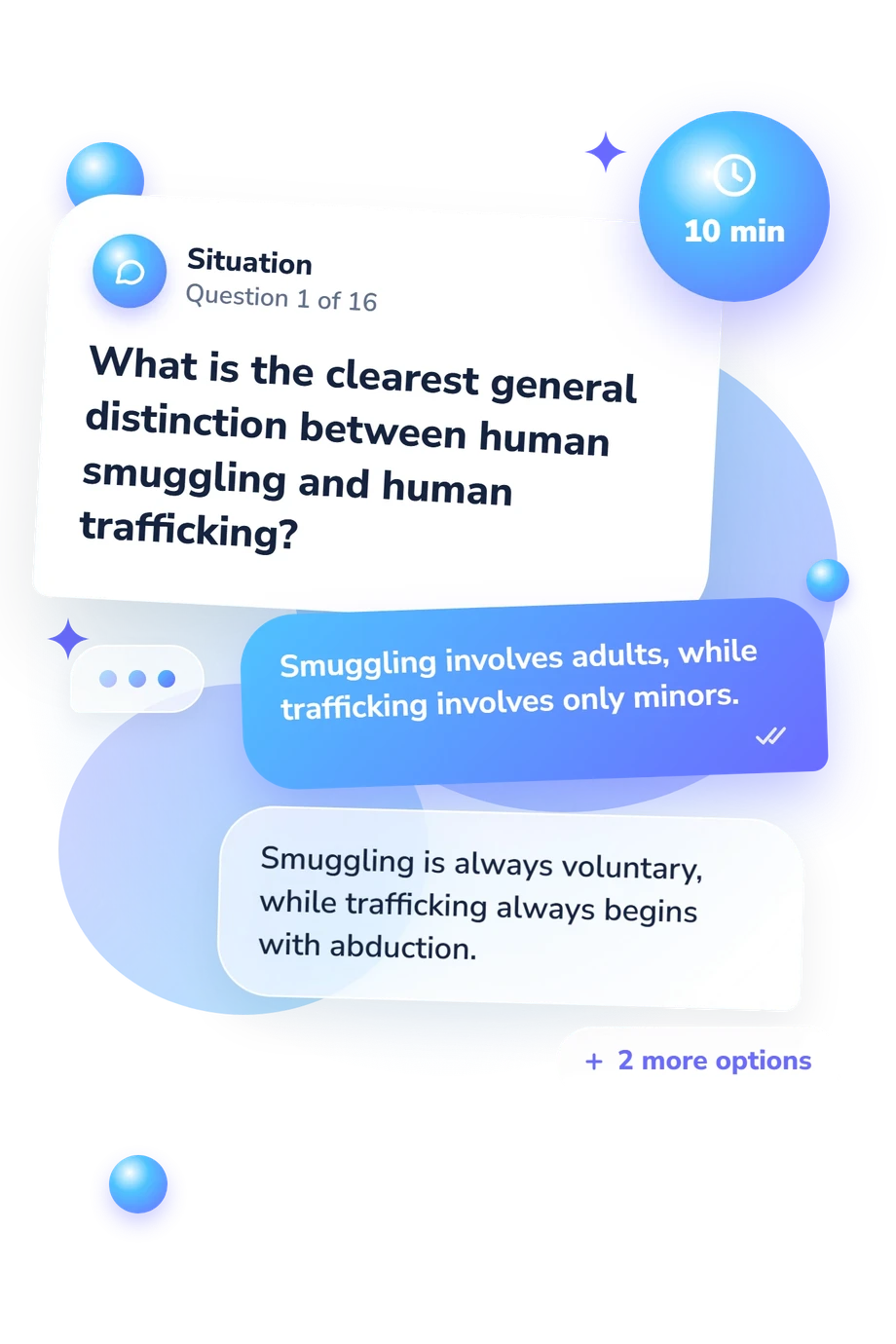
- Smuggling involves adults, while trafficking involves only minors.
- Smuggling is always voluntary, while trafficking always begins with abduction.
- Smuggling centers on facilitating unlawful border entry, while trafficking centers on exploitation and compelled activity.
- Smuggling is a state offense, while trafficking is exclusively a federal offense.
- Gather enough evidence to prove the offense before contacting anyone.
- Contact emergency services, avoid confrontation, and follow instructions that protect the person and others from further danger.
- Travel to the worksite and confront the people responsible.
- Wait until the person can provide a complete written account of every event.
- Because trafficking can be identified only after a criminal conviction
- Because warning signs matter only when physical injuries are also visible
- Because individual signs may have other explanations, while patterns, context, and the person’s account can clarify the concern.
- Because each indicator is relevant only if the person has crossed a border
Human Trafficking Quiz - Description and methodology of the test
Readers who want to examine their understanding of exploitation, coercion, and safer responses can use this human trafficking quiz as a focused educational check-in. It suits learners, community members, and professionals who want a structured refresher. Used as a human trafficking awareness quiz, the exercise clarifies which concepts feel secure, which require review, and how confidently the respondent recognizes risk without relying on stereotypes.
What This Assessment Explores
The questionnaire examines how trafficking is recognized in context rather than through a stereotype. It covers legal distinctions, exploitation, coercive control, deceptive recruitment, warning signs, and safer responses. Learners, community members, and professionals can use it as a refresher.
The questions cover four areas:
- Definitions and legal distinctions explain how trafficking differs from smuggling and how federal protections apply.
- Indicators and context show why patterns, circumstances, and a person's account matter together.
- Recruitment and coercion show how deception, threats, debt, or control can restrict freedom.
- Safer responses emphasize avoiding confrontation and using safeguarding or support procedures.
As a human trafficking knowledge test, it measures understanding rather than a personal trait. The Human Trafficking Knowledge scale runs from 0-16: Foundation Building (0-6) calls for review, Developing Knowledge (7-12) reflects incomplete understanding, and Strong Knowledge (13-16) indicates a well-developed grasp of the subject.
Methodology and Evidence Base
Each item presents a knowledge question or scenario with four answer choices. Topics move from definitions and warning signs to recruitment, coercion, and safer action. One point is awarded for each correct answer, so the total reflects knowledge of the tested concepts rather than a clinical trait.
The wording tests recall and judgment together: some items ask for legal distinctions, while others require a safety-conscious response to a described situation. Reviewing quiz answers about human trafficking can reveal gaps in definitions, indicators, or response principles.
The legal framework follows the TVPA's definitions, and indicator content is consistent with UNODC guidance. Ross et al. (2015) provides a close reference because it examines professionals' contact with trafficking. Lee et al. (2021) supports structured education as a way to improve knowledge and attitudes among healthcare professionals. This questionnaire is conceptually consistent with those sources, not an adaptation or validation of them.
Because this is an unvalidated educational measure, prior exposure, attention, interpretation of scenarios, and current context can affect performance; the score cannot confirm or rule out trafficking, and real-world concerns require independent attention to circumstances and safety.
- Ross C, Dimitrova S, Howard LM, Dewey M, Zimmerman C, Oram S. Human trafficking and health: a cross-sectional survey of NHS professionals’ contact with victims of human trafficking. BMJ Open. 2015;5(8):e008682. 10.1136/bmjopen-2015-008682
- Lee H, Geynisman-Tan J, Hofer S, Anderson E, Caravan S, Titchen K. The Impact of Human Trafficking Training on Healthcare Professionals’ Knowledge and Attitudes. Journal of Medical Education and Curricular Development. 2021;8:1-7. 10.1177/23821205211016523
- Trafficking Victims Protection Act of 2000, 22 U.S.C. § 7102 (Definitions).
- United Nations Office on Drugs and Crime. Anti-human trafficking manual for criminal justice practitioners, Module 2: Indicators of trafficking in persons. New York: United Nations; 2009.
Updated: