
How Mature Are You Quiz
How the Scales are Structured
Who Usually Takes This Test?
See How You Compare
Below is a preview of how scores are typically distributed across each scale.
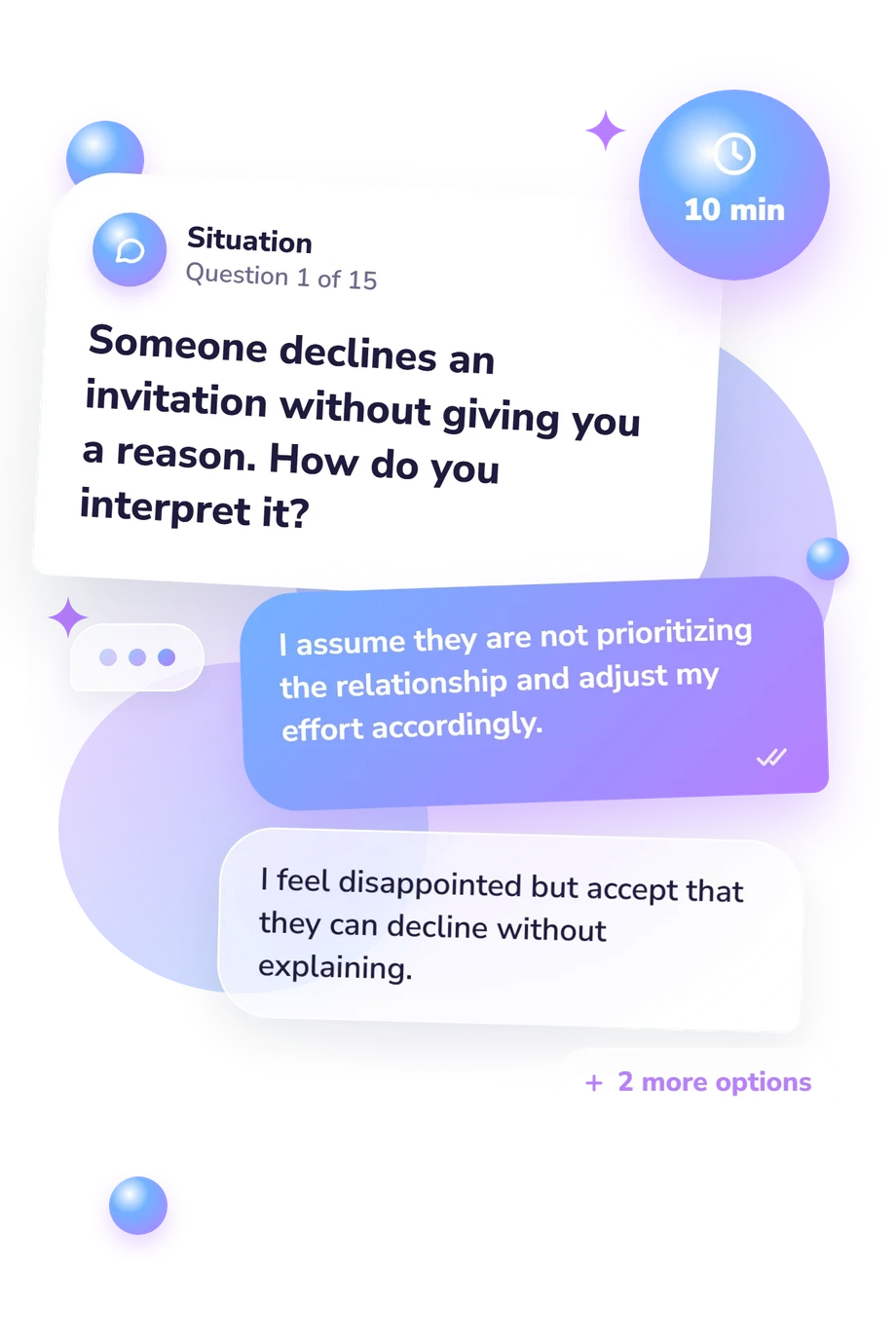
Example Questions From the Test
- I assume they are not prioritizing the relationship and adjust my effort accordingly.
- I feel disappointed but accept that they can decline without explaining.
- I accept the answer, though I spend time wondering what it means about me.
- I ask for a reason because understanding would help me feel settled.
- I feel disappointed but shift fairly quickly toward what can still be done.
- I focus on why it should not have happened and struggle to change direction.
- I need time to absorb it before I can consider alternatives.
- I distract myself from the disappointment and revisit the problem later, if needed.
- Ask how they reached their view and explain mine without requiring agreement.
- Avoid the subject so the disagreement does not affect the friendship.
- Listen to their reasoning, though I mainly look for points I can challenge.
- Keep pressing my case because an important issue should not be left unresolved.
How Mature Are You Quiz - Description and methodology of the test
People who want a clearer picture of their responses under pressure may use the How Mature Are You Quiz to examine everyday patterns rather than receive a single verdict. It is intended for anyone reflecting on responsibility, emotional reactions, disagreement, and relationships. As a maturity quiz, it can organize those observations into a profile of strengths, recurring friction, and areas where more deliberate choices may help.
What This Assessment Explores
The items place maturity in situations involving commitments, mistakes, emotional surges, disagreement, boundaries, and repair. They show how a person interprets events and chooses a response, so the result describes tendencies in self-management and relationships, not an all-or-nothing identity. Readers can use this as an am i mature quiz to identify where pressure narrows choice.
The three result dimensions are:
- Accountability and Repair (0-15) reflects responsibility for commitments, mistakes, influence, and repair: Emerging ownership (0-5), Developing ownership (6-10), or Established ownership (11-15).
- Emotional Regulation (0-15) reflects noticing, managing, and recovering from reactions: Emerging awareness (0-5), Developing regulation (6-10), or Established regulation (11-15).
- Perspective and Respect (0-15) reflects room for viewpoints, needs, boundaries, and shared decisions: Emerging (0-5), Developing (6-10), or Established (11-15).
Together, these dimensions treat maturity as context-sensitive patterns, not a permanent label.
Methodology and Evidence Base
Each item presents an everyday scenario and four response options. The choices contrast pausing with reacting, acknowledging impact with defending intent, and adapting after uncertainty. The respondent selects the option closest to their usual response, and choices are organized across the three dimensions.
The questionnaire reports scores on the three displayed scales but does not state how many points each response contributes. This maturity level quiz should therefore be interpreted through the named bands and the pattern across dimensions, without inferring an additional scoring rule.
The closest conceptual reference is Greenberger and colleagues’ work on measuring psychosocial maturity. Secondary conceptual parallels include Cauffman and Steinberg’s judgment-maturity framework, the DERS, and Davis’s multidimensional empathy model. It is an online self-reflection questionnaire using three displayed scales; the cited instruments serve as conceptual reference points.
The profile helps respondents consider their own maturity alongside concrete examples from their lives, so the how mature am i quiz remains a prompt for reflection rather than a single label. Self-report can shift with memory, self-awareness, current stress, and impression management, while the reflective bands are not clinical judgments.
- Cauffman, E., & Steinberg, L. (2000). (Im)maturity of judgment in adolescence: Why adolescents may be less culpable than adults. Behavioral Sciences & the Law, 18(6), 741-760. 10.1002/bsl.416
- Greenberger, E., Josselson, R., Knerr, C., & Knerr, B. (1975). The measurement and structure of psychosocial maturity. Journal of Youth and Adolescence, 4(2), 127-143. 10.1007/BF01537437
- Gratz, K. L., & Roemer, L. (2004). Multidimensional assessment of emotion regulation and dysregulation: Development, factor structure, and initial validation of the Difficulties in Emotion Regulation Scale. Journal of Psychopathology and Behavioral Assessment, 26(1), 41-54. 10.1023/B:JOBA.0000007455.08539.94
- Davis, M. H. (1983). Measuring individual differences in empathy: Evidence for a multidimensional approach. Journal of Personality and Social Psychology, 44(1), 113-126. 10.1037/0022-3514.44.1.113
Updated: