
Othello Quiz
How the Scales are Structured
Who Usually Takes This Test?
See How You Compare
Below is a preview of how scores are typically distributed across each scale.
Example Questions From the Test
- He refuses to fight the Turkish fleet
- He becomes drunk and participates in a brawl
- He admits that he helped Desdemona elope
- He challenges Othello’s authority before the Senate
- First in Cyprus, then mainly in Venice
- First in Venice, then mainly in Cyprus
- First in Verona, then mainly in Rhodes
- First in Rome, then mainly in Crete
- Challenge Othello to a formal duel
- Return to Venice and appeal to Brabantio
- Ask Desdemona to persuade Othello to restore him
- Expose Roderigo’s involvement in the brawl
Othello Quiz - Description and methodology of the test
Readers who want to test their grasp of Shakespeare’s tragedy can use the Othello Quiz to connect remembered scenes with the motives and misunderstandings that drive them. It works as a Shakespeare play quiz for students, theatre audiences, and anyone returning to the text. The result indicates whether familiarity is introductory, developing, or detailed, while pointing toward scenes that deserve closer rereading.
What This Assessment Measures
This assessment checks knowledge of Othello’s plot, characters, motives, and consequences. The questions and answers about Othello trace Iago’s manipulation, the responses of other characters, and the movement from Venice to Cyprus. They also examine how objects and staged conversations acquire dangerous meanings, especially Desdemona’s handkerchief, Cassio’s dismissal, and the scene involving Bianca.
It suits readers preparing for class, rehearsal, discussion, or rereading. The result describes performance on the selected content rather than literary talent. Othello Knowledge runs from 0-16 correct answers, with three displayed bands:
- Opening Act 0-6 indicates recognition of some plot and character elements, with room for review.
- Developing Scholar 7-12 shows a solid grasp of major events and several of Iago’s schemes.
- Venetian Expert 13-16 reflects detailed knowledge of plot, motives, dramatic irony, and consequences.
Together, these levels show how securely the respondent can follow events, motives, dramatic irony, and consequences.
Methodology and Evidence Base
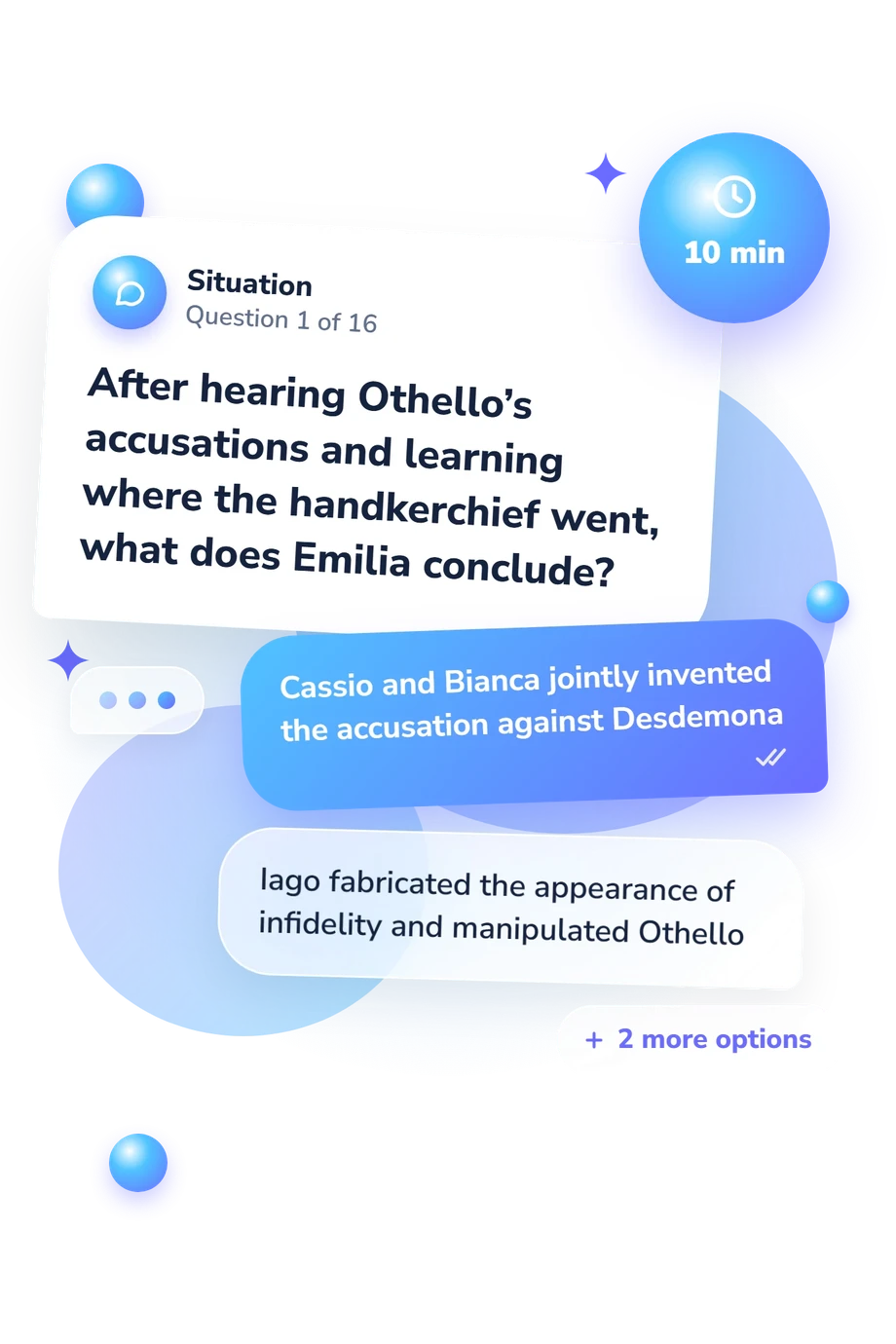
The response format is straightforward: each item presents a scene, motive, relationship, or symbolic detail with four answer choices. The participant selects the option that best matches the play, so the score counts correct recognitions rather than personal opinions. This makes it an Othello multiple-choice quiz that checks recall and interpretation together.
Its literary reference point is Othello (Shakespeare), which supplies the narrative sequence, character motives, and consequences tested by the items. The questionnaire is also conceptually consistent with Maurianne S. Adams’s 1964 analysis of ocular proof: several questions examine how seeing, seeming, and misleading evidence shape Othello’s jealousy. This relationship is conceptual; the online questionnaire is not presented as an adaptation or validation of Adams’s study.
The result is a descriptive profile for this question set. The questionnaire is an online content check rather than a standardized psychometric measure; no population norms, reliability estimate, or clinical cutoff are stated. Performance may vary with rereading, edition, prior exposure, and guessing, so the score is best used to identify scenes worth revisiting and discuss why each answer follows from the drama.
- Shakespeare, William. Othello. Edited by Norman Sanders; introduction by Christina Luckyj. The New Cambridge Shakespeare. Cambridge University Press, 2018. 10.1017/9781316416051
- Adams, Maurianne S. “Ocular Proof” in Othello and its Source. PMLA, vol. 79, no. 3, 1964, pp. 234-241. 10.2307/461024
Updated: