
Would You Survive Quiz
How the Scales are Structured
Who Usually Takes This Test?
See How You Compare
Below is a preview of how scores are typically distributed across each scale.
Example Questions From the Test
- Walk into the water first to test whether the road is intact
- Drive through slowly while keeping the engine at high speed
- Turn around and use a route that is not flooded
- Follow another vehicle closely so it breaks the current
- Rinse the wound continuously until the bleeding slows
- Raise the arm and avoid touching the wound
- Apply firm, direct pressure with clean cloth or dressing
- Remove each soaked dressing before adding another
- Thirst, sweating, and warm red skin
- Persistent shivering, confusion, and loss of coordination
- Sneezing, itchy eyes, and a sore throat
- Muscle soreness that improves during activity
Would You Survive Quiz - Description and methodology of the test
People who want to review their knowledge of common emergency responses can use the Would You Survive Quiz to consider which actions are generally recognized as sound in urgent scenarios. It suits curious readers, households reviewing basic preparedness, and anyone refreshing first-aid knowledge. An emergency preparedness quiz of this kind can support decisions about which safety topics to study or practise next.
What This Assessment Explores
The questions focus on actions that reduce harm during an emergency. Scenarios cover bleeding, burns, collapse, heat illness, hypothermia, smoke, carbon monoxide, earthquakes, floods, wildfires, lightning, rip currents and unsafe water. They also examine judgment under pressure: stopping instead of wandering, choosing a safe exit, recognizing urgent illness, following evacuation orders and prioritizing essential supplies. The assessment describes knowledge of sound emergency responses rather than physical toughness or a personal survival forecast.
Across the scenarios, four thematic areas receive attention:
- First aid shows whether urgent responses to injury or illness are recognized.
- Environmental hazards indicate how safely weather, fire, water and air risks are handled.
- Evacuation and shelter reveal whether danger is identified early and safer movement is chosen.
- Preparedness shows how immediate needs, especially potable water, are prioritized.
This emergency survival quiz emphasizes safer options rather than endurance, courage or equipment.
Methodology and Evidence Base
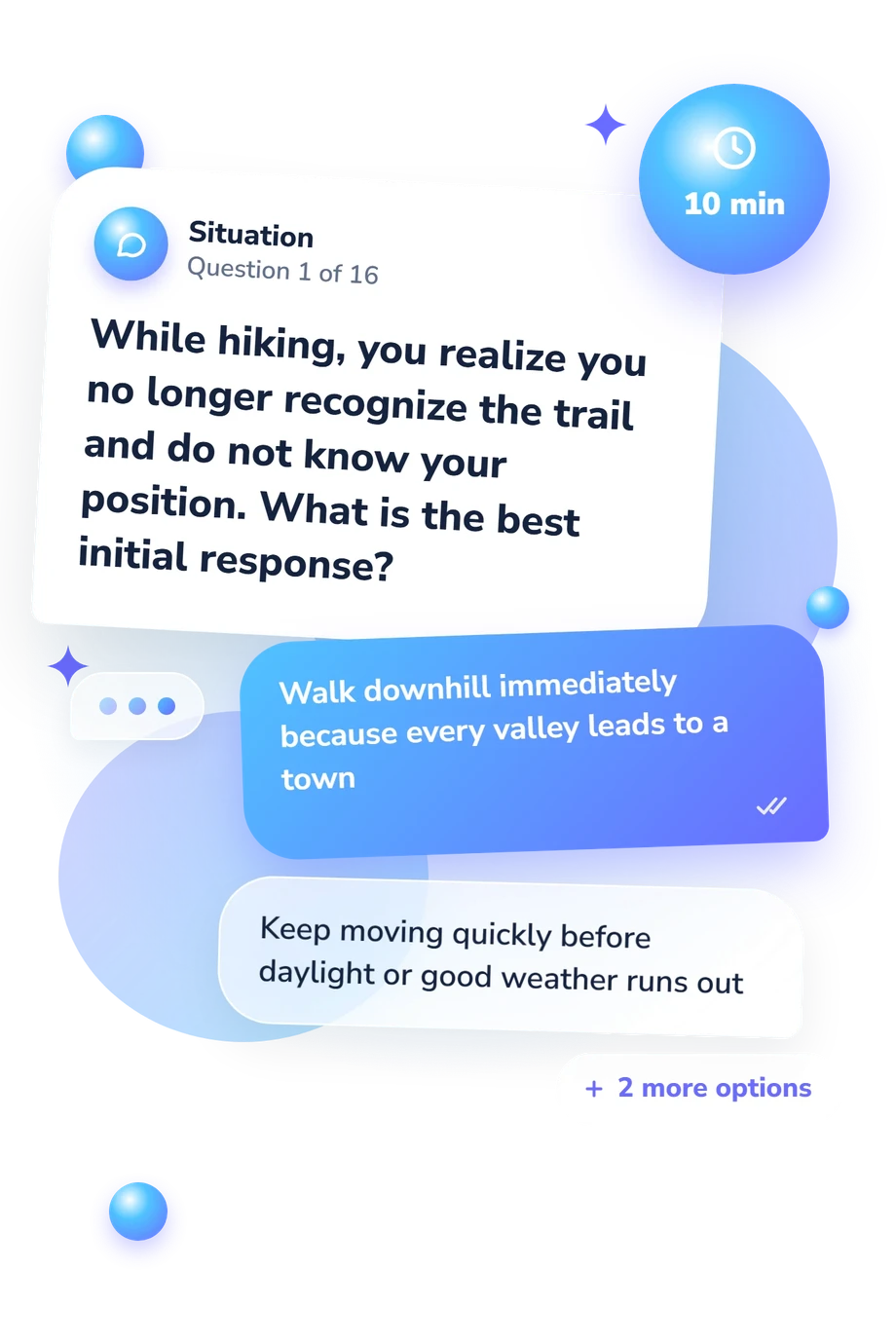
Each item presents an emergency scenario with four answer choices. The selected options are summarized on the displayed knowledge scale, without a separate score for each thematic area. This is an educational self-report exercise about practical decisions.
The result is reported on one scale, Emergency Survival Knowledge: 0-16. Its bands are Foundation to Build (0-6), Developing Knowledge (7-12), and Strong Knowledge (13-16). They distinguish unfamiliar essential responses, knowledge with reviewable gaps, and a solid grasp of common emergency actions.
Conceptually, the questionnaire is consistent with first-aid knowledge themes examined in a community-based first-aid training study, the 2024 AHA-Red Cross guidance, and Delphi work on household emergency preparedness. These sources support its first-aid and preparedness themes; they do not establish that this questionnaire adapts any one instrument.
When used as a survival skills quiz, the result can identify topics to practise, such as bleeding control, evacuation choices or water safety. This questionnaire has no established population norms or reported reliability estimates, so scores can be affected by memory, self-awareness and attention.
- Yan, Shijiao, Wenning Fu, Ping Tan, Chang Su, Xuan Deng, Jinlong Wang, Chuanzhu Lyu, and Yanhong Yang. “Changes in knowledge and attitude after community-based first-aid training: a prospective study with a 12-month follow-up.” World Journal of Emergency Medicine 17, no. 3 (2026): 215-222. 10.5847/wjem.j.1920-8642.2026.029
- Hewett Brumberg, Elizabeth K., Matthew J. Douma, Kostas Alibertis, Nathan P. Charlton, Michael P. Goldman, Katrina Harper-Kirksey, Seth C. Hawkins, Amber V. Hoover, Amy Kule, Stefan Leichtle, Sarah Frances McClure, George Sam Wang, Mark Whelchel, and Eric J. Lavonas, on behalf of the American Heart Association and American Red Cross. “2024 American Heart Association and American Red Cross Guidelines for First Aid.” Circulation 150 (2024): e519-e579. 10.1161/CIR.0000000000001281
- Heagele, Tara N., Charleen C. McNeill, Lavonne M. Adams, and Danita M. Alfred. “Household Emergency Preparedness Instrument Development: A Delphi Study.” Disaster Medicine and Public Health Preparedness 16, no. 2 (2022): 570-582. 10.1017/dmp.2020.292
Updated: