
Chinese Labor Prediction Quiz
How the Scales are Structured
Who Usually Takes This Test?
See How You Compare
Below is a preview of how scores are typically distributed across each scale.
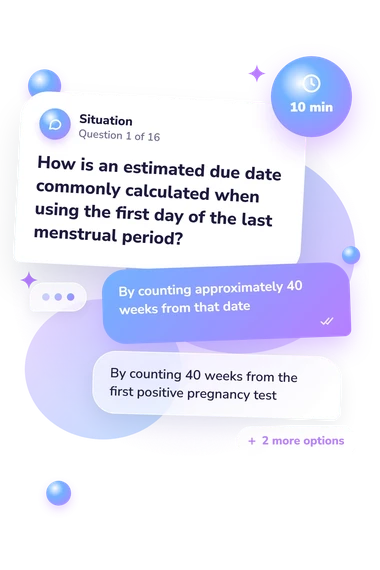
Example Questions From the Test
- By counting approximately 40 weeks from that date
- By counting 40 weeks from the first positive pregnancy test
- By adding nine calendar months to the date fetal movement began
- By counting 38 weeks from the first prenatal appointment
- It is reliable only during the first trimester
- It has not been shown to perform reliably beyond chance
- It is medically useful when combined with a due date
- It becomes accurate when lunar dates are converted correctly
- Recalculate the estimated due date
- Seek urgent assessment from maternity or emergency services
- Monitor it until the next routine appointment
- Wait until contractions are five minutes apart
Chinese Labor Prediction Quiz - Description and methodology of the test
Readers distinguishing pregnancy folklore from dependable maternity information can use the Chinese Labor Prediction Quiz as a structured learning exercise. Some readers treat it as a when will my baby be born quiz, but it addresses curiosity about due-date estimates, labor signs, and traditional birth-chart claims. The result reflects knowledge of folklore, labor signs, and appropriate information-seeking rather than assessing a current pregnancy or actual safety.
What This Assessment Explores
The assessment tests whether readers separate folklore-based timing claims from established pregnancy information. Scenarios cover due dates, Braxton Hicks contractions, induction, reduced movement, bleeding, leaking fluid, preterm labor, and urgent symptoms. The due-date items show why this delivery date prediction quiz cannot establish timing. Chart questions test what a Chinese birth chart claims to predict; the result measures knowledge, not birth timing. Labor scenarios make it a baby labor prediction quiz about knowledge, not forecasting.
The displayed scale is Chinese Labor Prediction Knowledge (0-16), with three result bands:
- Foundation needed (0-6) indicates that core distinctions among folklore, due-date estimates, and meaningful symptoms need review.
- Developing knowledge (7-12) shows recognition of many ideas while some practical distinctions remain uncertain.
- Strong knowledge (13-16) reflects sound understanding of the topic and its limits.
They are educational labels, not medical cutoffs.
Methodology and Evidence Base
Each item presents a pregnancy or birth-chart scenario with answer choices. The multiple-choice format asks readers to identify educationally supported information rather than unsupported prediction or unsafe action, while the result reports knowledge of the topic.
The questionnaire is conceptually consistent with findings from Grech and Savona-Ventura (2006), who found no reliable fetal-sex prediction beyond chance. It is not an adaptation of that published method. Due-date content aligns with ACOG’s 2017 guidance on estimating due dates, and triage content reflects ACOG’s 2016 guidance on hospital-based obstetric triage.
The format makes it a fun labor prediction quiz that organizes folklore claims for examination; answers may be shaped by memory, anxiety, or misunderstanding, so the result describes quiz performance rather than complete pregnancy knowledge.
The quiz cannot establish when labor will start; reduced movement, bleeding, leaking fluid, severe symptoms, and possible preterm labor call for prompt maternity advice regardless of the score.
- Eduardo Villamor, Louise Dekker, Tobias Svensson, and Sven Cnattingius. Accuracy of the Chinese lunar calendar method to predict a baby's sex: a population-based study. Paediatric and Perinatal Epidemiology. 2010;24(4):398-400. 10.1111/j.1365-3016.2010.01129.x
- American College of Obstetricians and Gynecologists. Committee Opinion No. 700: Methods for Estimating the Due Date. Obstetrics & Gynecology. 2017;129(5):e150-e154. 10.1097/AOG.0000000000002046
- American College of Obstetricians and Gynecologists. Committee Opinion No. 667: Hospital-Based Triage of Obstetric Patients. Obstetrics & Gynecology. 2016;128(1):e16-e19. 10.1097/AOG.0000000000001524