
Do I Have a Chance with My Crush Quiz
How the Scales are Structured
Who Usually Takes This Test?
See How You Compare
Below is a preview of how scores are typically distributed across each scale.
Example Questions From the Test
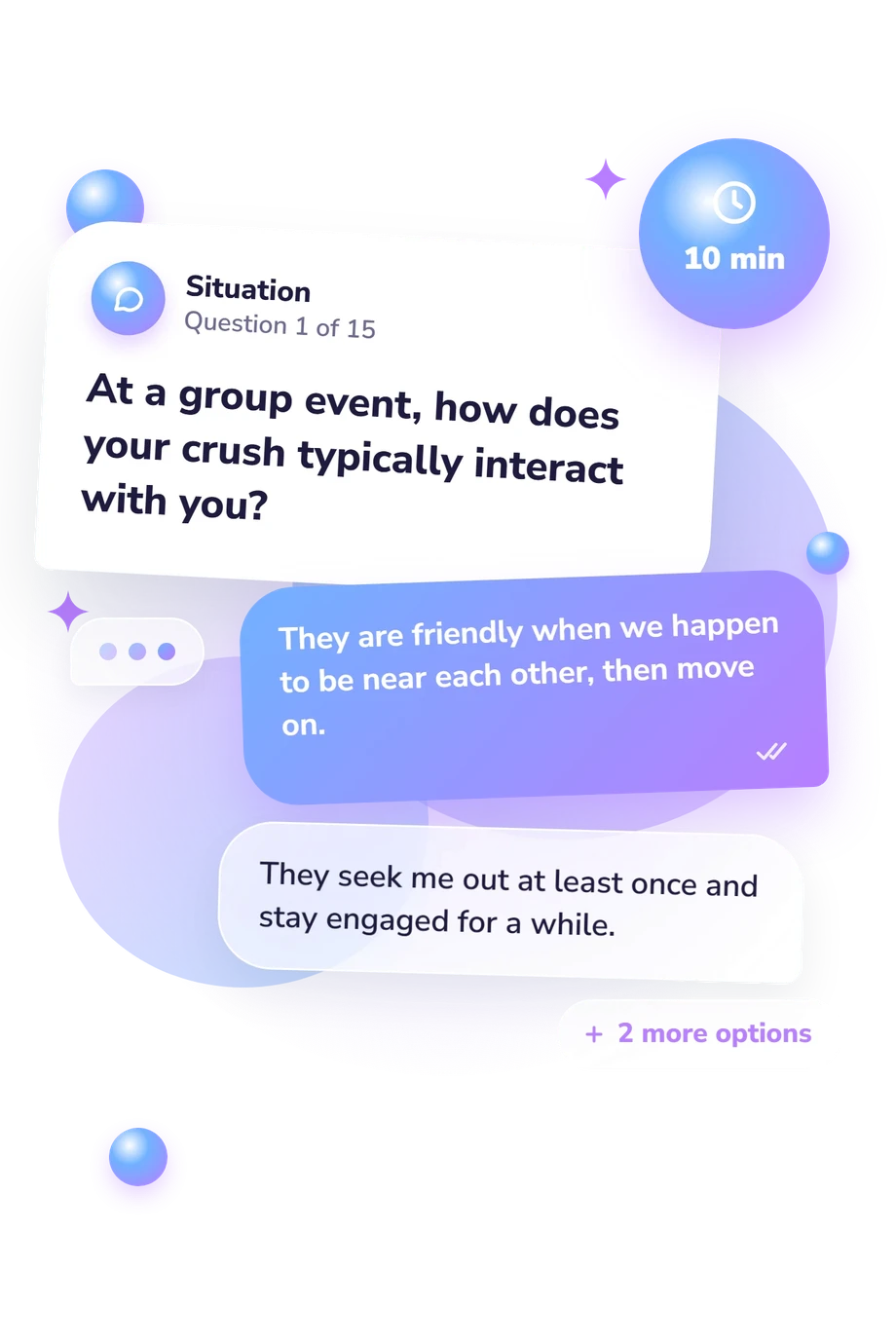
- They are friendly when we happen to be near each other, then move on.
- They seek me out at least once and stay engaged for a while.
- They circulate among everyone without showing particular interest in returning to me.
- They repeatedly find reasons to reconnect with me or extend our time together.
- We tend to avoid differences because they make the interaction noticeably strained.
- We have not interacted enough for me to know how we handle disagreement.
- We can stay respectful, although finding common ground sometimes takes effort.
- We become curious about each other’s view and remain comfortable despite the difference.
- They reply willingly, but I usually begin the conversation.
- They regularly initiate and later return to topics we discussed.
- Our exchanges are almost entirely required or situational.
- We both initiate personal conversations from time to time.
Do I Have a Chance with My Crush Quiz - Description and methodology of the test
People who feel drawn to someone but cannot tell whether interest is mutual can use the Do I Have a Chance with My Crush Quiz to organize what they know. It is intended for anyone considering an invitation, protecting a private crush, or interpreting mixed signals. This crush compatibility test weighs present evidence, readiness, and a respectful next step.
What This Assessment Explores
The questionnaire examines readiness to explore clearly, tolerate uncertainty, communicate respectfully, and respect both people’s boundaries; practical fit; and observable signs of reciprocal interest. Questions cover initiation, attention, priorities, scheduling, disagreement, one-to-one plans, and responses to refusal. Together, the result gives a crush readiness profile covering readiness, practical fit, and the other person’s investment; it cannot determine whether the relationship will happen.
These result dimensions show what each score means:
- Clarity and Respectful Readiness (0-15) reflects clear, boundary-respecting readiness: Private for now (0-5), Tentative readiness (6-10), and Grounded readiness (11-15).
- Connection and Practical Fit (0-15) reflects current workable, mutual fit: Limited foundation (0-5), Emerging fit (6-10), and Established fit (11-15).
- Reciprocal Interest (0-15) summarizes observable investment without proving romance: Limited evidence (0-5), Mixed evidence (6-10), and Stronger evidence (11-15).
Methodology and Evidence Base
Each item presents a situation with four response options describing different levels of knowledge, opportunity, readiness, fit, or observed interest. The prompts address initiation, compatibility, boundaries, emotional preparation, and social signals. The questionnaire displays totals and result bands, but does not state how each response is converted into points.
The method is a structured self-report mutual interest assessment. The 2012 study by Birnbaum and Reis is the closest conceptual comparator for responsiveness and emerging interest in early acquaintance. Reis and colleagues (2011) address familiarity and interaction, while Berscheid, Snyder, and Omoto (1989) and Buhrmester and colleagues (1988) offer perspectives on closeness and interpersonal competence. These are conceptual comparators only: the online questionnaire’s bands are descriptive, and the cited studies do not provide norms, reliability, or validation for this online questionnaire.
Interpret the bands as a reflection aid about present circumstances. Current emotion, memory, wishful interpretation, limited opportunity, and response bias can shape self-report, while actions may have several explanations. Direct words and boundaries override any inferred interest total; any discomfort, refusal, boundary, or power imbalance overrides every score and means there should be no further pressure.
- Birnbaum, G. E., & Reis, H. T. (2012). When does responsiveness pique sexual interest? Attachment and sexual desire in initial acquaintanceships. Personality and Social Psychology Bulletin, 38(7), 946-958. 10.1177/0146167212441028
- Reis, H. T., Maniaci, M. R., Caprariello, P. A., Eastwick, P. W., & Finkel, E. J. (2011). Familiarity does indeed promote attraction in live interaction. Journal of Personality and Social Psychology, 101(3), 557-570. 10.1037/a0022885
- Berscheid, E., Snyder, M., & Omoto, A. M. (1989). The Relationship Closeness Inventory: Assessing the Closeness of Interpersonal Relationships. Journal of Personality and Social Psychology, 57(5), 792-807. 10.1037/0022-3514.57.5.792
- Buhrmester, D., Furman, W., Wittenberg, M. T., & Reis, H. T. (1988). Five domains of interpersonal competence in peer relationships. Journal of Personality and Social Psychology, 55(6), 991-1008. 10.1037/0022-3514.55.6.991
Updated: