
Bathroom Quiz
How the Scales are Structured
Who Usually Takes This Test?
See How You Compare
Below is a preview of how scores are typically distributed across each scale.
Example Questions From the Test
- Before the tile is installed, following the system instructions
- After the shower has been used to locate leaks
- Only if the finished tile develops cracks
- After the tile has been grouted
- Normal expansion caused by warm lighting
- Excessive water pressure inside the cabinet panels
- The sink trap is drawing air through the cabinet base
- The cabinet material has absorbed moisture from the leak
- The sink's drain trap
- The toilet's fill valve
- The vanity cabinet's wall anchors
- The showerhead for mineral buildup or blockage
Bathroom Quiz - Description and methodology of the test
For homeowners, renters, students, and anyone planning a renovation, the bathroom quiz offers a focused way to check practical understanding before acting on a design or repair idea. It is useful for readers who want to distinguish sound preparation from attractive but risky shortcuts. As a bathroom style quiz, this assessment connects technical choices with comfort, usability, maintenance, and safer decision-making.
What This Assessment Measures
The questionnaire checks whether a reader can recognize sound choices in common bathroom projects. It covers moisture management, plumbing safety, waterproofing, wet-area materials, ventilation, lighting, accessibility, fixture stability, and layout planning. As a bathroom renovation quiz, it highlights familiar principles and topics that deserve review.
The displayed scale is Bathroom Remodeling Knowledge (0-16), with Foundations to Build (0-6), Developing Remodeler (7-12), and Bathroom-Savvy (13-16). It summarizes performance across these decisions as an educational measure of current knowledge.
The result draws on four practical areas:
- Moisture and waterproofing show whether you recognize leaks, drying needs, flexible joints, and protection beneath tile.
- Plumbing and fixtures reflect understanding of shutoffs, traps, flow, stability, and hidden moisture.
- Surfaces, lighting, and ventilation indicate attention to slip resistance, visibility, condensation, and finishes.
- Accessibility and planning capture clearances, thresholds, circulation, and vanity fit.
Methodology and Evidence Base
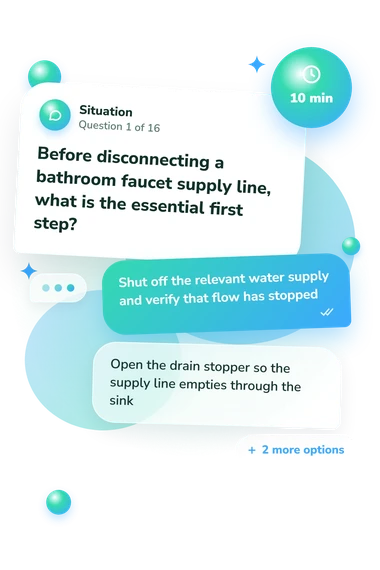
Each item presents a bathroom situation with four answer choices. It asks the reader to identify a suitable first step or principle, such as shutting off water, placing waterproofing beneath tile, or checking exhaust performance. This is a knowledge-check format, not a self-report inventory.
The displayed result summarizes performance across the questions. As a bathroom remodeling test, it presents an educational score with descriptive bands that show levels of current knowledge rather than trade competence, code compliance, or product suitability; local requirements and manufacturer instructions still govern actual work.
The questions ask readers to recognize safe sequences, material functions, moisture causes, and practical planning constraints. Its content is conceptually consistent with Bath Planning, which addresses planning, codes, standards, and usability. National Kitchen & Bath Association guidance supports access and function; the Tile Council of North America handbook supports substrate preparation, waterproofing, grout, and tile installation; and research by Kim and Yang adds a building-performance perspective on exhaust and moisture removal. These works support the domains but do not validate this exact questionnaire.
- Parrott, Kathleen R., Julia Beamish, JoAnn Emmel, and Mary Jo Peterson. Bath Planning: Guidelines, Codes, Standards, 2nd ed. Hoboken, NJ: John Wiley & Sons, 2013.
- National Kitchen & Bath Association. Bathroom Planning Guidelines with Access Standards. Bethlehem, PA: National Kitchen & Bath Association, 2022.
- Tile Council of North America. 2024 TCNA Handbook for Ceramic, Glass, and Stone Tile Installation. Anderson, SC: Tile Council of North America, 2024.
- Kim, Ok, and Jeong-Hoon Yang. On the Design to Improve the Bathroom Exhaust Performance in Multi-Unit Residential Buildings. Journal of Asian Architecture and Building Engineering, 15(2), 349-356, 2016. 10.3130/jaabe.15.349