
Should I Ask Her Out Quiz
How the Scales are Structured
Who Usually Takes This Test?
See How You Compare
Below is a preview of how scores are typically distributed across each scale.
Example Questions From the Test
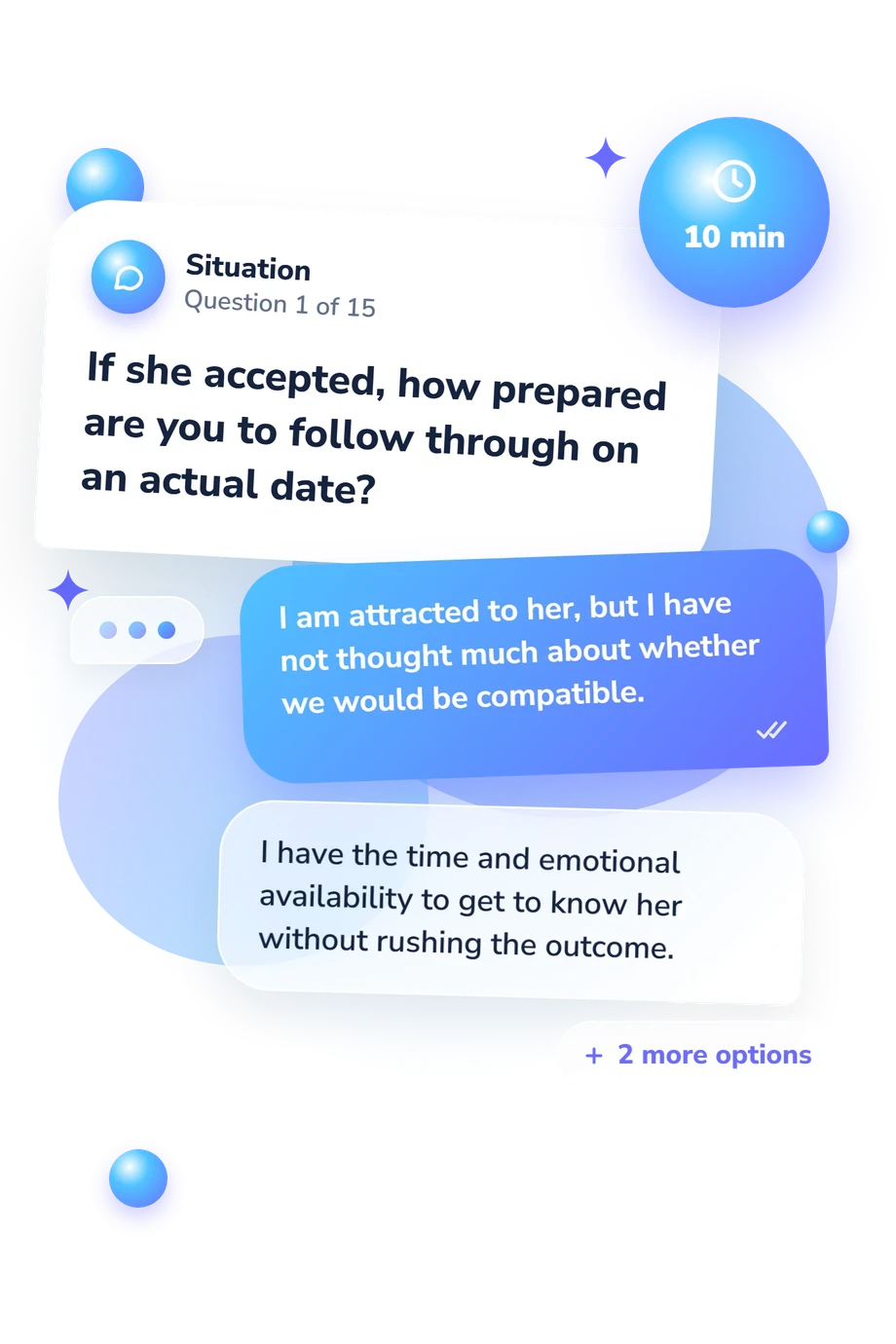
- I am attracted to her, but I have not thought much about whether we would be compatible.
- I have the time and emotional availability to get to know her without rushing the outcome.
- I mainly like the fantasy of being chosen and am unsure whether I want a real relationship.
- I am interested, although practical demands could make scheduling or consistency difficult.
- She gave a reason but did not suggest another time.
- She proposed a specific alternative or later followed up about rescheduling.
- She declined politely, or no invitation has happened yet, so there is little evidence either way.
- She repeatedly avoided the subject or left invitations unanswered.
- Mostly my impression of our chemistry or the hope that she feels the same.
- Directly flirtatious or future-oriented comments supported by her actions.
- Someone else thinks she might be interested, but I have noticed little myself.
- A repeated pattern of her choosing my company, initiating contact, or showing personal curiosity.
Should I Ask Her Out Quiz - Description and methodology of the test
People weighing attraction against uncertainty can use this assessment to separate observable interaction from hope and choose a respectful next step. The Should I Ask Her Out Quiz is intended for someone considering an invitation and wanting to think clearly about her responses, their own readiness, and the surrounding context. It also offers guidance about how to ask her out without turning a yes into a verdict on anyone’s worth.
What This Assessment Measures
Items examine initiation, follow-up, engagement, availability, boundaries, motives, and reactions to refusal. They distinguish observable reciprocity from hopeful interpretation and consider whether an invitation fits the relationship and moment. Here, observable reciprocity indicates whether a simple invitation has a reasonable basis; only her response can clarify her interest.
The three dimensions are:
- Mutual Interest Evidence (0-15) reads reciprocity: Limited evidence (0-5) is sparse or unclear; Mixed evidence (6-10) is warm but ambiguous; Consistent evidence (11-15) shows repeated engagement or future-oriented signals.
- Outcome Readiness (0-15) reads readiness: More grounding first (0-5), Mostly ready (6-10), and Steady enough to ask (11-15) show increasing ability to handle uncertainty and respect either answer.
- Respectful Invitation Fit (0-15) reads context: Pause and reconsider (0-5) flags boundary or timing concerns; Adjust the setup (6-10) calls for less pressure; Clear opening (11-15) supports a direct, low-pressure invitation.
Methodology and Scientific Basis
Each item presents a situation about contact, timing, invitation style, availability, or refusal. The options describe different levels of evidence, readiness, or contextual fit, so you select the response closest to your circumstances rather than trying to predict her feelings. The scores are directional: higher values indicate more evidence, readiness, or fit within the relevant dimension, not a probability of acceptance. The displayed bands describe this questionnaire’s result categories.
Conceptually, the questionnaire is consistent with Apostolou and colleagues’ work on flirting skill, mate-signal detection, and shyness-related effects. The dating-interest cue study by Muehlenhard and colleagues supports attention to verbal and nonverbal cues, while work by Calvert and colleagues and by Downey and Feldman addresses dating anxiety and rejection sensitivity. Together, these studies provide conceptual support for the questionnaire’s focus on reciprocity, emotional readiness, and respectful context.
Self-report can be influenced by mood, selective attention, current circumstances, and hopeful or self-protective interpretations. Use the result as structured dating uncertainty reflection: a clear invitation should leave room for an easy no, and any no or hesitation should be respected.
- Apostolou, Menelaos, Irene Papadopoulou, Michael Christofi, and Demetris Vrontis. “Mating Performance: Assessing Flirting Skills, Mate Signal-Detection Ability, and Shyness Effects.” Evolutionary Psychology, 17(3), 2019, article 1474704919872416. 10.1177/1474704919872416
- Muehlenhard, Charlene L., Mary A. Koralewski, Sandra L. Andrews, and Cynthia A. Burdick. “Verbal and Nonverbal Cues That Convey Interest in Dating: Two Studies.” Behavior Therapy, 17(4), 1986, 404-419. 10.1016/S0005-7894(86)80071-5
- Calvert, James D., DeWayne Moore, and Bernard J. Jensen. “Psychometric Evaluation Of The Dating Anxiety Survey - A Self-Report Questionnaire For The Assessment Of Dating Anxiety In Males And Females.” Journal of Psychopathology and Behavioral Assessment, 9(3), 1987, 341-350. 10.1007/BF00964562
- Downey, Geraldine, and Scott I. Feldman. “Implications of Rejection Sensitivity for Intimate Relationships.” Journal of Personality and Social Psychology, 70(6), 1996, 1327-1343. 10.1037/0022-3514.70.6.1327
Updated: